ENEnglish
 LTLietuviškai
 DEDeutsch
 FRFrançais
 RUРусский
 ESEspañol
 PLPolski
 ITItaliano
 UKУкраїнська
 CSČeština
 PTPortuguês
 JA日本語
JA日本語 LVLatviešu valoda
 ETEesti
 HUMagyar
 IDBahasa Indonesia
 TRTürkçe
 HIहिन्दी
 ELΕλληνικά
 ARالعربية
 THไทย
THไทย VITiếng Việt
 RORomână
 MSBahasa Melayu
 BNবাংলা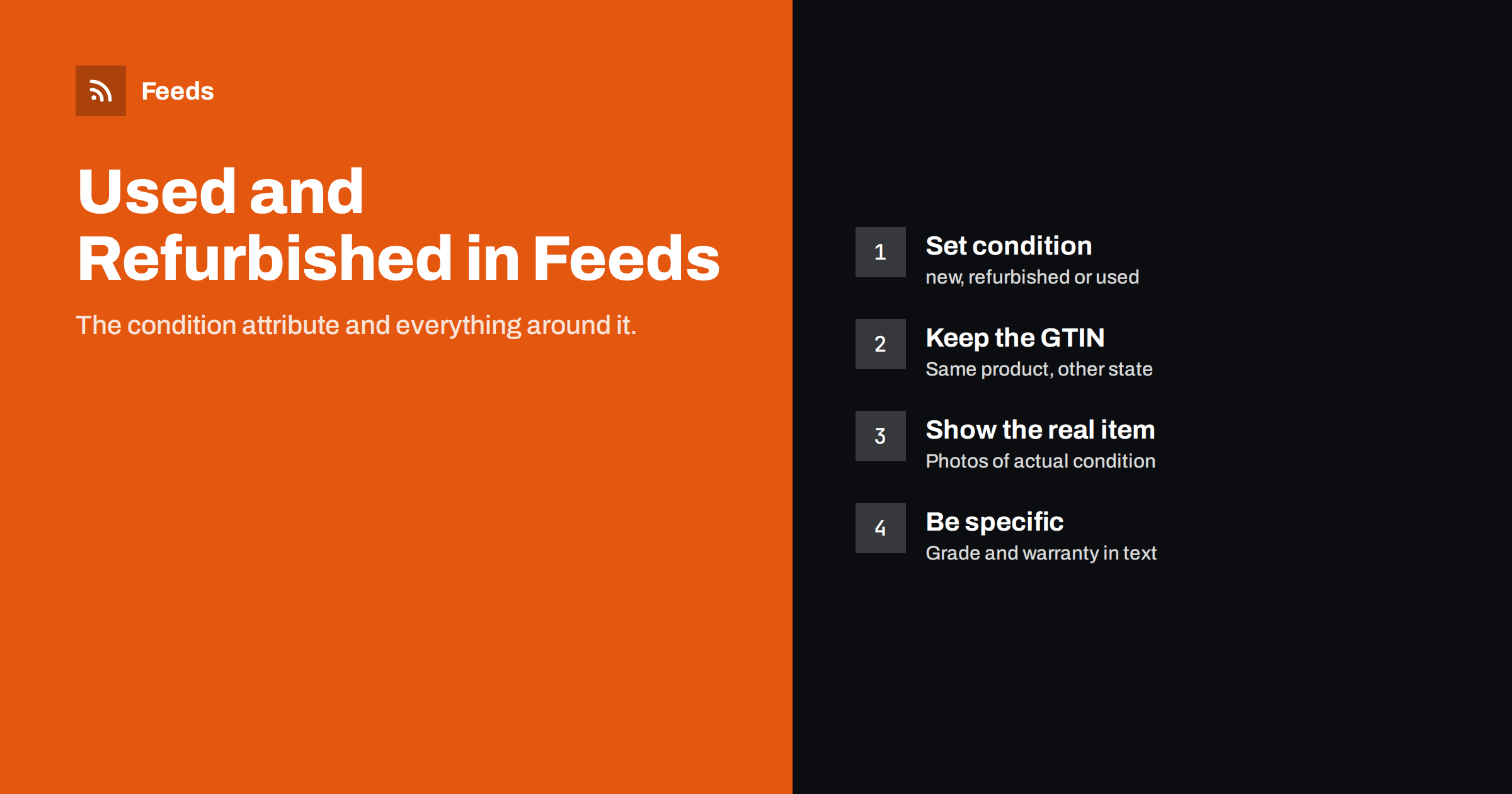
Short answer: In a product feed, every used or refurbished item must carry the condition attribute set to used or refurbished; new is the default and should only describe new items. Keep the product’s original GTIN and brand so platforms can match it, state the condition clearly in the title or description with any grade and warranty, and use photos that show the item’s actual state. The landing page must describe the same condition, and refurbished should mean professionally restored, not simply second-hand.
Why condition matters
Used and refurbished goods are a growing part of online retail, from phones and laptops to cameras, furniture and fashion. Shoppers searching for these products want to see condition clearly, and many search specifically for “refurbished” or “used” versions to save money. Others want only new products and would be disappointed to land on a second-hand item.
The condition attribute is how platforms tell the two apart. Google shows condition in listings where relevant and uses it when matching searches and comparing offers. Meta requires condition for every catalog item. Sending new for a used item is not a small data error; it is a misrepresentation of the offer, and platforms treat it that way.
At the same time, correct condition data opens opportunities. Refurbished offers can appear next to new offers of the same product, with a lower price that attracts price-conscious shoppers. That only works when identifiers and condition are both correct.
There is also a sustainability angle that many shoppers care about. Refurbished electronics and second-hand fashion appeal to people who want to buy less new. Clear condition data helps these shoppers find you, and honest descriptions help them trust that the item is what it claims to be.
The three condition values
- new: brand new, unused, in original packaging where applicable. Most products in most stores.
- refurbished: professionally restored to working order, cleaned, tested and often repackaged, typically with a warranty. The item may show minor signs of previous use.
- used: previously owned and sold as is, or with limited checks. Includes items with original packaging opened or missing.
Google requires condition for used and refurbished products; for new products it is recommended. Meta requires it for all items. The simplest rule is to send condition for every item in the feed, even when all your products are new.
Open-box items, returned goods and display models sit in a gray area. If an item has been used or its packaging opened, it is usually safer to classify it as used and explain the details in the description, rather than calling it new.
Identifiers stay with the product
A refurbished iPhone is still the same model as a new one. Keep the manufacturer’s GTIN, brand and MPN in the feed for used and refurbished items. That lets platforms match your offer to the right product, show it for searches about that model, and group it with other offers where appropriate.
What changes is the condition attribute, the price, and usually the id. If you sell the same model both new and refurbished, each needs its own item with its own id, for example by adding a suffix to the SKU. Never reuse the id of the new item for the refurbished one, or one will overwrite the other.
For one-off used items without identifiers, such as vintage goods or custom pieces, send brand if there is one and set identifier_exists to no.
If you buy stock from different sources, such as trade-ins, liquidation lots and certified refurbishers, record the source and process for each item in the store. That information decides the condition value and the description, and it is much harder to reconstruct later than to capture when the item arrives.
Titles and descriptions
Condition should also be visible in the text, because shoppers do not always notice the condition label in listings:
- Add the condition to the title, for example “Refurbished” or “Used”, along with the grade if you use one: “Apple iPhone 13, 128 GB, Midnight, Refurbished Grade A”.
- Explain what the grade means in the description: cosmetic condition, battery health where relevant, what was tested or replaced.
- State the warranty period and who provides it.
- List what is included and what is not, such as original box, charger or accessories.
Avoid vague phrases like “like new” without explanation. If you use grades, define them once on your website and use the same definitions everywhere.
Consistency across channels matters here as well. If your grade names differ between your website, the feed and a marketplace listing, shoppers comparing them may lose trust. Use the same names and definitions everywhere.
Images of the real item
For new products, a manufacturer’s studio image is fine. For used items, and to some extent refurbished ones, shoppers want to see what they will receive. Photos of the actual item, or at least of an item in the same grade, build trust and reduce returns.
For unique used items, use your own photos showing any wear or defects. For refurbished stock sold in larger quantities, representative photos per grade are a reasonable compromise, as long as the description explains that the image is representative. Keep the main image clean and without text overlays like “refurbished” badges; use the title and condition attribute for that.
Where an item has a visible flaw, show it in one of the additional images and mention it in the description. Shoppers who buy used goods generally accept wear; what they do not accept is surprises.
Refurbished versus used: getting it right
| Situation | Condition | Notes |
|---|---|---|
| Tested, restored, warranty provided | refurbished | State who refurbished it and the warranty |
| Manufacturer-certified refurbished | refurbished | Mention certification if the manufacturer allows it |
| Second-hand, checked but not restored | used | Describe condition and any defects |
| Open box, unused | used (or new if truly unused and resealed per policy) | Explain packaging state |
| Display or demo model | used | Mention display use and any wear |
Calling a merely second-hand item refurbished is a common source of complaints and can conflict with platform policies. Refurbished implies a process; if that process did not happen, the item is used.
Pricing and stock for second-hand goods
Used and refurbished inventory behaves differently from new stock. Often each unit is unique, or a batch contains only a few units of each grade. That has consequences for the feed:
- Stock turns over fast. A single-unit item is either available or gone. Refresh the feed often enough that sold items disappear quickly, and exclude sold items by rule.
- Prices vary by grade. If different grades of the same model are separate products in the store, each needs its own item with its own price and condition details.
- Price comparisons are visible. Because the GTIN matches the new product, shoppers may see your refurbished offer alongside new offers. Make sure the price difference is meaningful and the value is explained.
- Reference prices need care. Showing the new product’s price as a “was” price for a refurbished item can be misleading. Use sale_price only for genuine reductions of your own price.
For marketplaces and resellers with large refurbished catalogs, a custom label for grade makes it easy to set different bids or product sets per grade, since conversion rates and margins often differ between them.
Landing pages and policies
The product page must show the same condition as the feed, near the title or price, not only in the fine print. Return policies for used and refurbished items should be clear, especially if they differ from those for new products. Platforms review landing pages, and a page that looks like a new-product listing while the feed says refurbished, or the reverse, creates a mismatch.
Some product categories have additional rules for used goods, such as certain electronics, safety equipment or products for children. Check the platform policies for your categories before listing used items there.
How Feeds helps
Feeds builds a Google product XML feed from WooCommerce, Shopify or a CSV link, with id, title, link, image, price, availability and brand, which Merchant Center and Meta can both fetch. Title rules let you add consistent wording, such as a condition or grade, across a group of products without editing each one, and other rules skip out-of-stock items and adjust prices. See the pricing page for plans.
Related reading
- GTIN, MPN and Brand: Product Identifiers in Feeds Explained
- Product Feed Title Optimization: Formulas That Work
- How to Write Product Descriptions for Shopping Feeds
The bottom line
Set condition correctly for every item, keep the original identifiers so platforms recognize the product, give used and refurbished versions their own IDs, and make condition, grade and warranty visible in titles, descriptions and landing pages. Reserve refurbished for items that went through a real restoration process, and show shoppers what they will actually receive.
FAQ
Is the condition attribute required?
Google requires it for used and refurbished products and recommends it for new ones. Meta requires it for every catalog item.
Should a refurbished product keep its original GTIN?
Yes. It is the same product model, so the original GTIN helps platforms match it. Only condition, price and item ID change.
Can I use the same ID for new and refurbished versions?
No. Each version needs its own unique ID, otherwise one item overwrites the other in the feed.
What is the difference between used and refurbished?
Refurbished items have been professionally restored and tested, usually with a warranty. Used items are sold in their existing condition.
Should I put “refurbished” on the product image?
No. Text overlays on the main image are not allowed. Use the condition attribute and mention the condition in the title instead.