ENEnglish
 LTLietuviškai
 DEDeutsch
 FRFrançais
 RUРусский
 ESEspañol
 PLPolski
 ITItaliano
 UKУкраїнська
 CSČeština
 PTPortuguês
 JA日本語
JA日本語 LVLatviešu valoda
 ETEesti
 HUMagyar
 IDBahasa Indonesia
 TRTürkçe
 HIहिन्दी
 ELΕλληνικά
 ARالعربية
 THไทย
THไทย VITiếng Việt
 RORomână
 MSBahasa Melayu
 BNবাংলা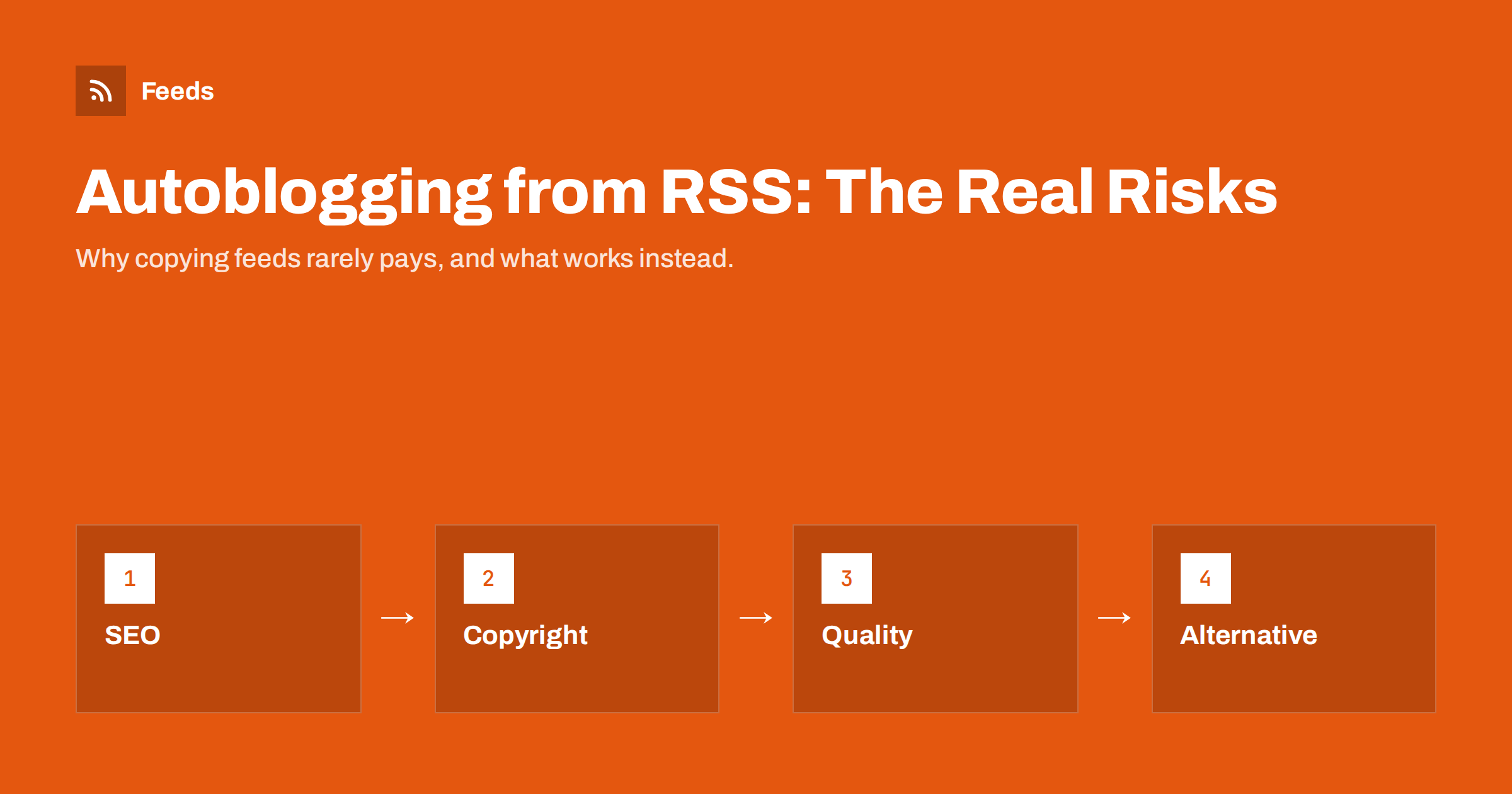
Short answer: Autoblogging means automatically republishing items from other sites’ RSS feeds as posts on your own website. It is technically easy, but it carries serious risks: search engines treat mass-copied or thinly rewritten content as low value or spam, republishing full articles usually infringes copyright unless you have permission, and nobody checks what appears on your site. Safer alternatives are link-based curation with your own commentary, licensed syndication with canonical links, and using feeds to power newsletters, social posts or research rather than your pages.
What autoblogging is
An autoblog is a website whose posts are created automatically from external sources, usually RSS feeds. A plugin or script checks the feeds, and every new item becomes a post on the autoblog, sometimes with the full text, sometimes with an excerpt, sometimes with the text “spun” or rewritten by software. The goal is usually to fill a site with content quickly and earn from ads or affiliate links.
The idea is as old as RSS itself, and there are legitimate relatives of it: news aggregators that show headlines with links, internal dashboards, licensed syndication between partner sites. The problem is the specific pattern of republishing other people’s work as your own pages, at scale, without permission or added value.
It is worth separating this from automating the distribution of your own content. Sharing your own new articles on social networks or in a newsletter is ordinary content automation. Autoblogging is about filling your website with content you did not create.
Risk 1: search engines
Search engines have spent decades learning to recognise copied and automatically generated content. Google’s spam policies, for example, describe practices such as scraped content, meaning content copied from other sites without adding value, and scaled content abuse, meaning many pages generated primarily to manipulate rankings rather than help users. Autoblogs fit these descriptions almost by definition.
The practical consequences range from pages that simply never rank, because the original source ranks instead, to manual actions against the whole site. Even when an autoblog briefly gets traffic, it is fragile: a single algorithm update can remove it.
There is also collateral damage. If a legitimate business website adds an autoblog section, the low-value pages can weigh on how search engines assess the site overall. Google’s guidance on helpful content makes clear that site-wide signals can be affected by large amounts of unhelpful content.
Rewriting feed content with software does not solve this. Automatically rewritten text is usually still low value, and policies on scaled content apply regardless of how the text was produced.
Risk 2: copyright and terms of use
A public RSS feed makes content easy to read; it does not grant permission to republish it. In most jurisdictions, articles, photos and even substantial excerpts are protected by copyright. Republishing full text or images without a licence can lead to takedown requests, hosting complaints, removal from ad networks and, in some cases, legal claims. Many publishers also state in their terms that feed content is for personal use.
Short quotations with attribution may be allowed under exceptions such as fair use in the US or quotation rights in the EU, but these are limited and depend on context, purpose and amount. They do not cover copying entire articles as your own posts. For the legal side of creating feeds from other sites, see the related article on whether it is legal to create RSS feeds from other websites; for anything beyond headlines and short excerpts, ask for permission or a licence, and get legal advice for your jurisdiction if unsure.
Risk 3: quality and reputation
An autoblog publishes whatever arrives. That includes articles that are wrong, outdated, offensive, sponsored by competitors or completely off-topic because a source changed its focus. Images may be copyrighted by third parties who never agreed to their use. Links may point to sites you would never recommend.
Visitors notice. A site full of other people’s articles, often with broken formatting, gives a poor impression, and for a business website it undermines the trust that the rest of the site tries to build. If a source feed is hijacked or starts publishing spam, the autoblog republishes that too.
Why autoblogging is tempting anyway
It is worth understanding the appeal, because it points to real needs with better solutions.
- “We need more content.” Real need; the answer is a sustainable publishing rhythm of original content, even if slower.
- “Our site looks inactive.” Real need; a small news or resources section with curated links and commentary solves it without copying.
- “Our audience wants industry news in one place.” Real need; a curated digest, newsletter or links page delivers it.
- “We want to save time.” Real need; automate collection and distribution, not authorship.
Safer alternatives that still use feeds
Link-based curation with commentary
Collect items from feeds automatically, pick the best ones by hand, and publish a regular roundup: headline, source, one or two sentences of your own view, link to the original. This adds value, respects the source and builds your authority.
Headline widgets and news sections
Displaying headlines and short snippets from a few sources, each linking to the original, is a common and generally accepted use of feeds. Keep excerpts short and do not present the items as your own articles. For search purposes, such sections are rarely valuable on their own, so many sites keep them out of the index.
Licensed syndication
If you want full articles from a partner, agree it in writing. Use a canonical link to the original, attribute clearly and follow the partner’s conditions.
Feeds for everything except your pages
The biggest time savings from feeds rarely come from filling your website. They come from newsletters, social posting of your own content, team news channels, research and monitoring. None of these carry the SEO and copyright risks of autoblogging.
A quick decision guide
| Use of other sites’ feed content | Typical risk |
|---|---|
| Reading in a feed reader or team channel | Low |
| Headlines with links in a curated newsletter | Low, with attribution |
| Roundup posts with your own commentary and links | Low to moderate, keep quotes short |
| Headline widget on your site | Moderate, keep snippets short |
| Full articles republished with permission and canonical link | Low if the licence is clear |
| Full articles or rewritten copies without permission | High: SEO, copyright and reputation |
If you already have autoblog pages
Some businesses inherited an autoblog section from an old agency or plugin, or added one years ago when it seemed harmless. Cleaning it up is usually worth the effort.
- Stop the import. Disable the plugin or script so no new copied posts are created.
- Inventory the pages. Export a list of the autoblog posts with their traffic from your analytics and search console data. Most will have little or none.
- Decide per group. Pages with no traffic and no links can usually be removed. If a handful attract genuine visitors, consider replacing them with original articles on the same topic.
- Handle removed URLs properly. Return a 410 or 404 status for deleted pages, or redirect to a genuinely relevant page where one exists. Avoid redirecting everything to the homepage.
- Replace the need. If the section existed to make the site look active, start a small curated roundup or a news section with your own updates instead.
Cleanup is not instant in search results; search engines need time to recrawl. But removing a large block of copied content removes a lasting risk and makes the rest of the site’s quality easier to judge.
How Feeds fits responsible use
Feeds turns pages without RSS into feeds, merges sources, filters by keyword and removes duplicates. It is designed to help you follow sources and distribute or curate content, for example to read in a reader, send to a team channel, build a digest or post your own content to social networks. The same responsibilities apply as with any feed: link to originals, keep excerpts short, respect publishers’ terms and add your own value when you share. Plans and limits are on the pricing page.
Related reading
- Is It Legal to Create RSS Feeds from Other Websites?
- How to Automate Content Curation Without Losing Quality
- Full Auto vs Approval Queue: Choosing a Content Workflow
- Does an RSS Feed Help SEO? What Feeds Really Do for Search
The bottom line
Autoblogging looks like free content but usually delivers the opposite: poor rankings, copyright exposure and a weaker reputation. Use feeds to collect, filter and distribute, and publish on your own site only what you wrote, what you curated with genuine commentary, or what you are licensed to republish. That keeps the time savings of automation without the risks.
FAQ
Is autoblogging illegal?
Republishing full articles or images without permission usually infringes copyright, although exceptions for short quotations exist in many jurisdictions. Headlines with short excerpts and links are generally treated more leniently, but get legal advice for your situation.
Will Google penalise an autoblog?
Google’s spam policies target scraped content and content produced at scale mainly to manipulate rankings. Autoblogs commonly fall into these categories, which can result in poor rankings or manual actions.
Does rewriting feed content with software make it safe?
No. Automatically rewritten text usually adds little value, and it may still infringe copyright because it is derived from the original work.
Can I show headlines from other sites on my website?
Showing headlines and short snippets that link to the original source is a common use of feeds. Keep snippets short, attribute clearly and do not present them as your own articles.
What is a safer alternative to autoblogging?
Curate: collect items automatically, choose the best by hand, add your own commentary and link to the originals, for example in a newsletter or a regular roundup post.