ENEnglish
 LTLietuviškai
 DEDeutsch
 FRFrançais
 RUРусский
 ESEspañol
 PLPolski
 ITItaliano
 UKУкраїнська
 CSČeština
 PTPortuguês
 JA日本語
JA日本語 LVLatviešu valoda
 ETEesti
 HUMagyar
 IDBahasa Indonesia
 TRTürkçe
 HIहिन्दी
 ELΕλληνικά
 ARالعربية
 THไทย
THไทย VITiếng Việt
 RORomână
 MSBahasa Melayu
 BNবাংলা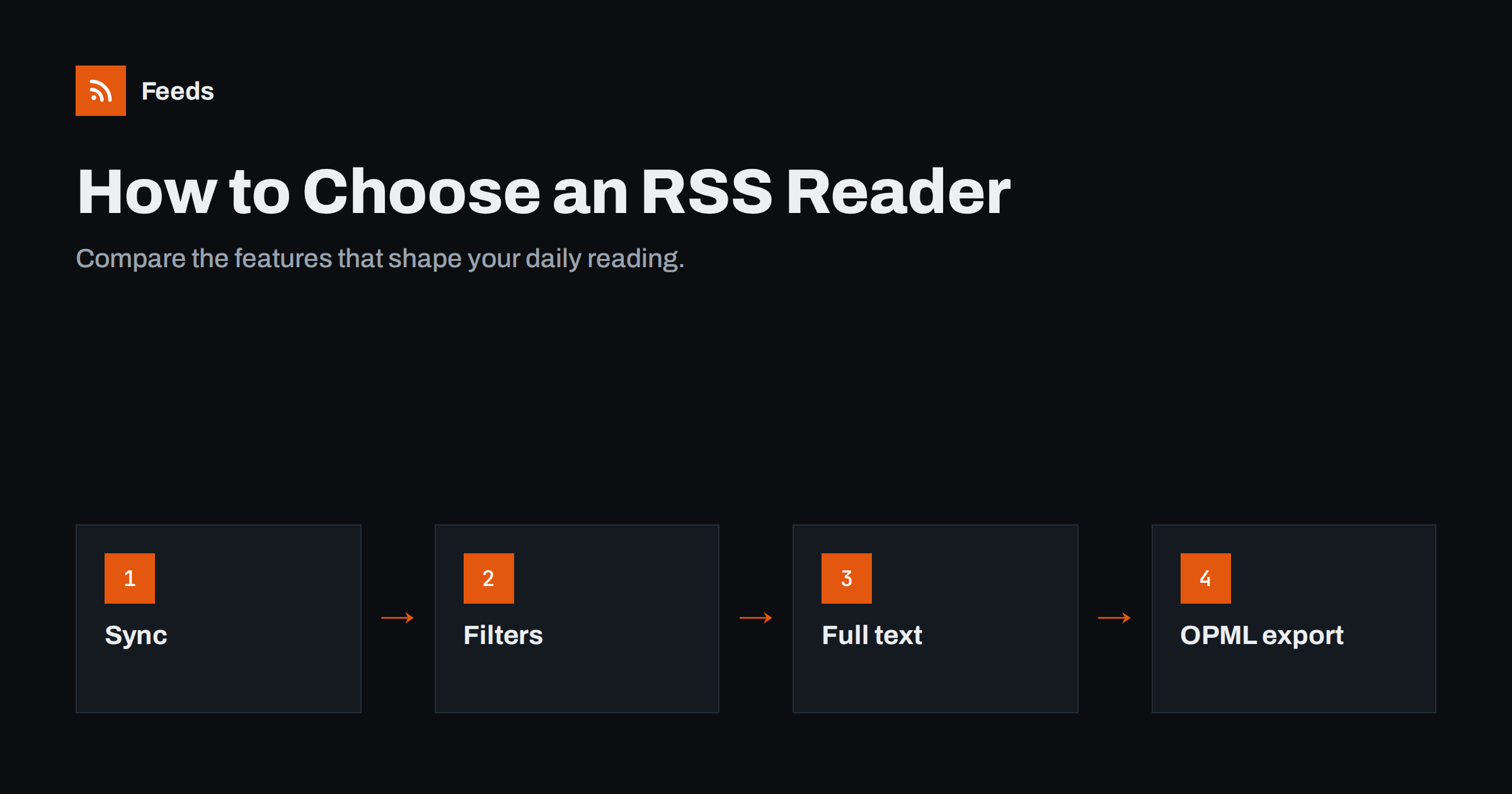
Short answer: Choose an RSS reader by how you read, not by feature count. Most people need reliable sync across devices, a clean reading view, folders, keyword filters and OPML import and export so they can leave at any time. Heavy users and teams should add full-text fetching, rules, search across old items and shared folders to the list, and everyone should check the privacy policy and the pricing of the features they actually use.
RSS readers look similar at first glance: a list of sources on the left, a list of items in the middle, an article on the right. The differences show up after a few weeks, when you follow a hundred sources, read on three devices and find that one site’s feed only has summaries. This guide walks through the features that genuinely change daily use, the trade-offs between types of readers, and a simple way to test a reader before committing to it.
Start with how you read
Before comparing apps, answer four questions honestly. They narrow the field faster than any feature table:
- How many sources? Twenty blogs is a different job from five hundred news sources. The bigger the list, the more you need filters, rules and fast keyboard navigation.
- Which devices? If you read on a phone during the commute and on a laptop at work, sync is non-negotiable.
- Skim or study? Skimmers want dense headline lists and quick “mark all as read”. Readers of long articles want a comfortable reading view, full text and a way to save for later.
- Alone or as a team? Agencies, newsrooms and research teams often need shared folders, notes and a way to pass items to colleagues.
It also helps to notice what currently annoys you. If you keep missing items because a busy source buries a quiet one, you need per-folder views and unread counts. If you keep seeing the same story from five outlets, you need duplicate handling. If you open your reader and close it again because there are 2,000 unread items, you need better ways to mark things as read and to hide noise, not more sources.
Write the answers down. Every feature below either serves one of them or does not matter to you.
The core features every reader should have
These are the basics. If a reader misses one of them, move on:
- Reliable fetching. New items should appear within a reasonable time. Hosted services typically poll popular feeds every few minutes and less popular ones less often; desktop apps fetch when they are open.
- Folders or tags for sources. Grouping sources is how you stay sane beyond a few dozen feeds.
- Unread counts and “mark as read” controls. Including “mark older than a day as read”, which saves you after a holiday.
- Good handling of broken feeds. The reader should show which sources have stopped updating or return errors, rather than failing silently.
- OPML import and export. OPML is the standard file for a list of subscriptions. Export means you are never locked in.
- Support for RSS, Atom and ideally JSON Feed. Almost universal, but worth confirming.
Sync and devices
There are three common models, each with real trade-offs:
| Model | Cách hoạt động | Good for | Watch out for |
|---|---|---|---|
| Hosted service | A company’s servers fetch feeds; you use web and mobile apps | Many devices, many feeds, no setup | Privacy policy, free-tier limits, service longevity |
| Local app | The app on your device fetches feeds directly | Privacy, one main device, no account | Sync between devices may be limited or absent |
| Self-hosted server | Open-source software on your own server, used with compatible apps | Control, teams with technical skills | Maintenance, security updates, backups |
Many local apps can also connect to hosted or self-hosted sync services, giving you a native app with cross-device sync. If you like one app’s interface but need sync, check which sync backends it supports.
Filtering, rules and search
Once you follow more than a handful of busy sources, filtering is what keeps a reader useful instead of overwhelming. Look for:
- Mute filters. Hide items containing words you never want to see, such as “sponsored” or a topic you do not follow.
- Keyword highlights or alerts. Surface items that mention your brand, competitors or clients.
- Rules. Automatically tag, star, move or mark as read items that match conditions.
- Search across history. Useful when you remember reading something last month. Some services limit how far back search reaches on free plans.
- Duplicate handling. When several sources publish the same press release, the best readers collapse or hide the copies.
Filtering inside the reader only helps that reader. If you want the same filtered stream in several places, for example a reader, a Slack channel and a newsletter, it can be simpler to filter the feed itself before it reaches any app. We come back to this below.
Full text, images and the reading view
Many sites publish only summaries in their feeds. A reader can then either send you to the website or try to fetch the full article for you. Full-text extraction, often called “reader mode” or “readability” mode, is one of the features people miss most when switching readers. Check:
- Can you turn full-text fetching on per source?
- Does the reader show the feed’s images, including thumbnails in the list view?
- Can you adjust font, size, width and dark mode?
- Does it play podcasts and show videos embedded in items, if you follow such sources?
Remember that full-text fetching is a convenience, not a right: it depends on the site’s layout and may break when the site changes. Respect paywalls and publishers’ terms.
Features for teams and professionals
Newsrooms, agencies, PR teams and researchers have needs that a personal reader rarely covers:
- Shared folders and boards so everyone follows the same sources without each person maintaining a list.
- Notes, highlights and comments on items.
- Sending items onwards to email, chat tools, project boards or a read-later service.
- Integrations and an API for automation.
- User management and clear per-seat pricing.
If a team mostly needs “the same filtered stream in several tools”, a single merged and filtered feed can be simpler and cheaper than seats in a team reader.
Privacy, pricing and longevity
Your reading list says a lot about you or your company. Read the privacy policy of any hosted service: does it track what you read, sell data, or show adverts based on your feeds? Local and self-hosted readers avoid most of these questions.
On pricing, look beyond the headline price. Free tiers often limit the number of sources, the refresh speed, search history or full-text fetching. Check the limits against your answers from the first section. Finally, think about longevity. RSS readers do shut down; Google Reader’s closure in 2013 is the famous example. Regular OPML exports mean a shutdown costs you an afternoon, not your whole reading setup.
How to test a reader in one week
- Export your current subscriptions as OPML, or collect 20 to 30 feeds you care about.
- Import them into the candidate reader and check that all sources were found and fetched.
- Read on every device you normally use for a full week. Notice friction: slow sync, missing images, awkward navigation.
- Test one filter and one “save for later” workflow.
- Break it on purpose. Add a feed that only has summaries and one that is slow, and see how the reader copes.
- Export again. Confirm that the OPML export works before you invest more time.
When the sources are the problem, not the reader
Sometimes no reader can help because the source itself is the issue: a site with no feed, a feed with no images, or ten sources that you want as one clean stream. Our tool, Feeds, works on that side. It turns a page without RSS into a feed, uses an existing feed when the site has one, and merges several sources into one feed that keeps only items with your words, with duplicates removed. You get one link that works in any reader. You see a preview before anything is created; see the plans for limits.
Related reading
- What Is an RSS Feed? A Plain-English Guide for Site Owners
- How to Create an RSS Feed for a Website Without RSS
- How to Monitor Websites for New Content Automatically
The bottom line
The best RSS reader is the one that matches how many sources you follow, which devices you use and whether you read alone or with a team. Insist on reliable fetching, folders, sync where you need it and OPML export. Add filters, full text and team features if your volume demands them. Test for a week with your real feeds, and keep an OPML backup so you are never locked in.
FAQ
What is the most important feature in an RSS reader?
For most people it is reliable sync across the devices they actually use, followed by folders and OPML export. Without sync you re-read items on every device, and without export you are locked in to one service.
Are free RSS readers good enough?
Often, yes. Free tiers usually cover a modest number of sources and basic reading. Paid tiers typically add faster refresh, more sources, full-text fetching, search history, filters and team features.
What is an OPML file?
OPML is an XML file that stores a list of feed subscriptions, often with folders. Almost every reader can import and export it, which makes moving between readers quick and painless.
Why do some feeds show only a summary in my reader?
The publisher chose to include only an excerpt in the feed. Some readers can fetch the full article from the website for you; otherwise you need to open the item in a browser.
Is a self-hosted RSS reader worth it?
It is worth it if you value privacy and control and are comfortable maintaining a small server. For most people a hosted service or a local app with sync is less work and just as good.