ENEnglish
 LTLietuviškai
 DEDeutsch
 FRFrançais
 RUРусский
 ESEspañol
 PLPolski
 ITItaliano
 UKУкраїнська
 CSČeština
 PTPortuguês
 JA日本語
JA日本語 LVLatviešu valoda
 ETEesti
 HUMagyar
 IDBahasa Indonesia
 TRTürkçe
 HIहिन्दी
 ELΕλληνικά
 ARالعربية
 THไทย
THไทย VITiếng Việt
 RORomână
 MSBahasa Melayu
 BNবাংলা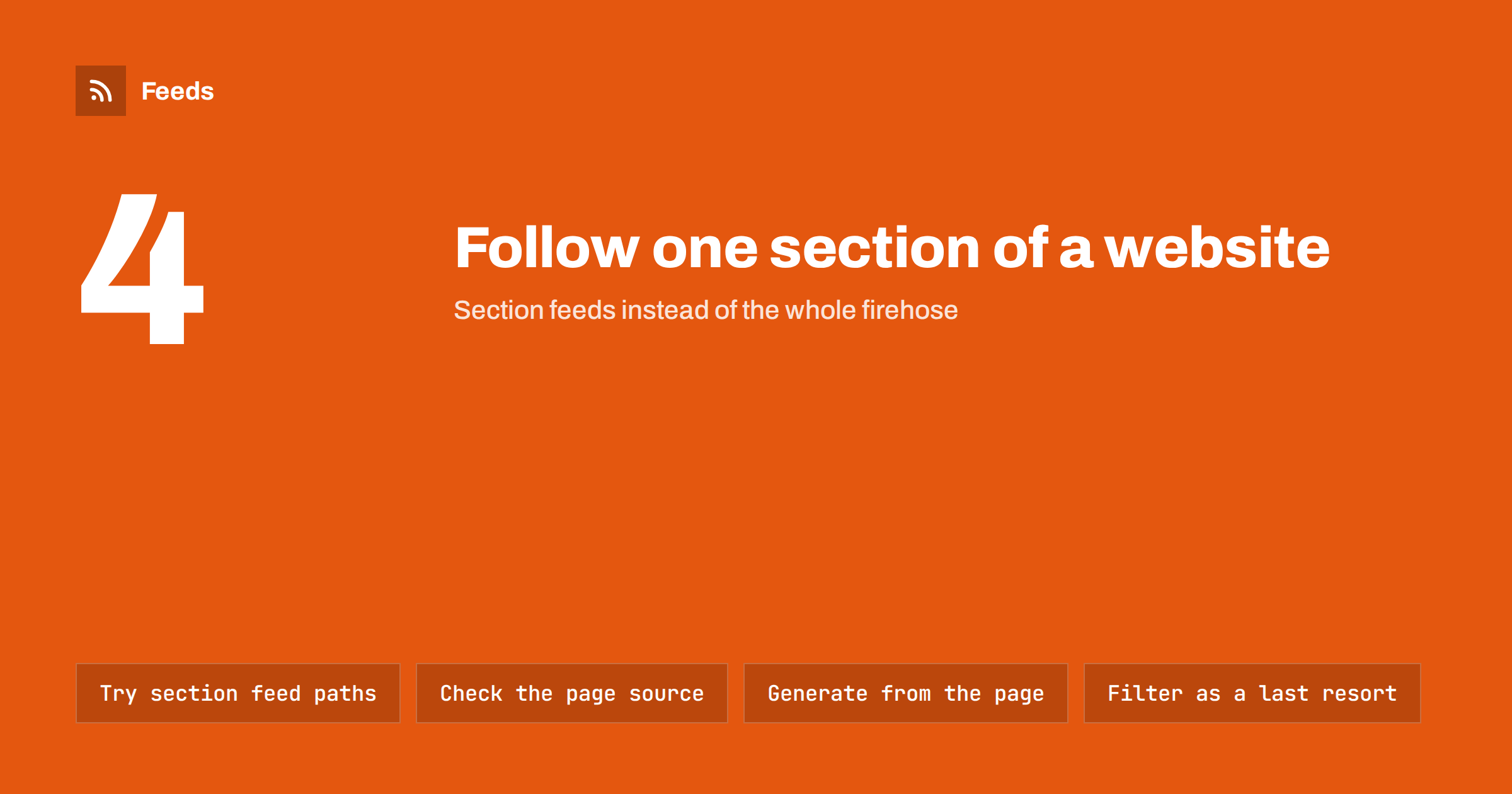
Short answer: First look for a feed specific to the section: many sites publish separate feeds per category, tag, topic or author, often at the section’s address plus a feed path. If none exists, create a feed directly from the section page with a page-to-feed tool, which gives you only that section’s items. Filtering the site-wide feed by keywords is the fallback, because it depends on the right words appearing in each headline or summary.
Large websites publish across many subjects. A business newspaper covers markets, technology, politics and lifestyle; a software company’s blog mixes product news, hiring stories and event recaps; a council website publishes everything from waste collection to planning notices. Following the whole site brings far more than you want, and it buries the one section that matters. The good news is that following just one section is usually possible, and often easy, once you know where to look.
The methods below are ordered from most to least reliable. Work through them in order for each site, and stop at the first one that works. Most sites fall at the first or second step; the rest almost always yield to the third.
Why section feeds beat site-wide feeds
- Less noise without filters. The publisher has already categorized the content. You get every item in the section and nothing else.
- No missed items. Keyword filters can miss items whose headlines do not contain your words. A section feed does not depend on wording.
- Stable over time. Section structures change less often than the language of headlines.
- Easy to combine. Several section feeds from different sites merge cleanly into a topic stream.
In short, a section feed does the filtering at the source, which is always more reliable than filtering after the fact.
Step 1: Try the common section feed patterns
Most content management systems generate feeds for categories and tags automatically. The exact address depends on the platform, but a few patterns cover many sites.
| Pattern | Example | Typical platforms |
|---|---|---|
Section address plus /feed/ |
/category/energy/feed/ |
WordPress and similar |
Section address plus .rss or .xml |
/news/energy.rss |
Various CMS and forums |
Section address plus /rss |
/technology/rss |
Many news sites |
| Feed with a query parameter | /feed/?cat=12 or ?tag=energy |
Various |
| Dedicated feeds page | A page listing all section feeds | Large publishers and public bodies |
Try the pattern that fits the site’s addresses. If the section page is /topics/energy/, try /topics/energy/feed/ and /topics/energy/rss. Open the result in a browser: a feed shows as XML or as a formatted list of items, while a wrong guess usually shows an error page or the normal website.
Step 2: Check the section page’s source and the site’s feed page
Open the section page, view its source and search for application/rss+xml. Many sites advertise the feed for the current section in the page head, even when they show no icon. Some also list all available feeds on a single “RSS” or “subscribe” page, often linked in the footer, which saves guessing.
Be careful to confirm that the advertised feed is really section-specific. Some sites advertise the site-wide feed on every page. Compare the feed’s newest items with the section page: they should match.
Step 3: Create a feed from the section page
If there is no section feed, create one from the section page itself. A page-to-feed tool reads the section’s list of articles and turns it into a feed containing only those items. This works for category pages, tag pages, topic hubs, filtered listings and search results with stable addresses.
- Use the section’s own page rather than the home page with a filter.
- If the section page shows featured items at the top and a list below, check that the preview includes the list, not just the featured block.
- If the section is paginated, the first page is enough for monitoring, since new items appear there.
- For sites with filters in the address, such as
?topic=energy&type=news, the filtered address makes an excellent feed source.
Step 4: Filter the site-wide feed only as a fallback
If the site has a site-wide feed but no section feed, and the section page cannot be turned into a feed, filter the site-wide feed with keywords. It works, but with limitations.
- Filters see only what the feed item contains, usually the title and summary.
- Items relevant to the section may not contain your words.
- Items outside the section may contain them.
Some feeds include category labels in each item. If your filter tool can match those, filtering by the category name can be almost as good as a section feed. Check a few items in the raw feed to see whether categories are included. If you must rely on keywords, test the filter against a couple of weeks of the section page: open the section, note which recent items the filter would have caught, and adjust until nearly all of them pass.
Combining section feeds from several sites
The real power of section feeds shows when you combine them. Take the energy sections of three publications, the energy tag of an association’s news page and the energy category of a think tank’s blog, merge them into one feed, and you have a focused energy news stream with very little noise. Because each source is already on topic, you need few or no filters, and duplicates across sources can be removed automatically.
This approach scales well. When you discover a new source, you add its section feed to the merge; when a source stops being useful, you remove it. The stream stays focused without a growing list of filter words, and anyone on your team can understand how it is built just by looking at the list of sources.
A worked example
A sustainability consultant wants news about building energy performance, not general business or climate coverage. She follows the buildings section of one trade publication, which has a section feed at the section address plus /feed/, and the “energy efficiency” tag of an industry association’s news page, which has no feed, so she generates one from the tag page. A national newspaper has no section feeds at all, but its “property and construction” section page converts cleanly into a feed. A government agency lists its publications with a topic filter in the address, and the filtered address becomes the fourth source.
She merges the four into one feed without any keyword filters, because every source is already on topic. The result is about three to five relevant items a day, compared with more than a hundred if she had followed the four sites’ main feeds. When a fifth source appears, she simply adds its section page to the merge.
Common mistakes
- Subscribing to the whole site out of habit. Always look for the narrower feed first.
- Trusting the advertised feed without checking. It may be the site-wide feed.
- Building elaborate filters when a section page exists. A section page feed is simpler and more complete.
- Using a home page with a filter parameter that is not in the address. If the filter is applied by scripts, the address does not reflect it, and a feed tool will see the unfiltered page.
- Forgetting that sections get renamed. Sites reorganize categories. If a section feed goes quiet, check whether the section moved.
How Feeds helps
Feeds makes the “create a feed from the section page” step simple. Paste the section, category, tag or filtered listing address, and Feeds uses the page’s existing feed if it has one, or finds the list of articles on the page and shows a preview before creating anything. You can merge section feeds from several sites into one topic feed and keep items with or without your words, with duplicates removed automatically. Feeds refresh on their own, and paid plans alert you if a feed stops finding items. See the plans for limits.
Related reading
- WordPress RSS Feed URLs: Every Feed Your Site Already Has
- How to Create an RSS Feed for a Website Without RSS
- How to Merge Multiple RSS Feeds into One Clean Feed
The bottom line
Following one section of a website is usually better than following the whole site and filtering. Try the common section feed paths, check the section page’s source and the site’s feeds page, and if nothing exists, create a feed directly from the section page. Keep keyword filtering of the site-wide feed as a fallback, and merge section feeds from several sites into focused topic streams.
FAQ
How do I get an RSS feed for one category of a website?
Try adding a feed path such as /feed/ or /rss to the category address, and check the category page’s source for a feed link. If there is none, create a feed from the category page with a page-to-feed tool.
Why does my category feed show articles from other sections?
You may have subscribed to the site-wide feed that the site advertises on every page. Compare the feed’s items with the category page and look for a category-specific address.
Is filtering a site-wide feed as good as a section feed?
Usually not. Filters depend on words in titles and summaries, so they can miss relevant items and include irrelevant ones. A section feed follows the publisher’s own categorization.
Can I follow a tag or topic page?
Yes. Many sites publish feeds for tags and topics, and where they do not, the tag or topic page can be turned into a feed like any other list page.
Can I follow a site’s search results?
If the search results page has a stable address containing your query, it can often be turned into a feed. Results sorted by date work best for monitoring.