ENEnglish
 LTLietuviškai
 DEDeutsch
 FRFrançais
 RUРусский
 ESEspañol
 PLPolski
 ITItaliano
 UKУкраїнська
 CSČeština
 PTPortuguês
 JA日本語
JA日本語 LVLatviešu valoda
 ETEesti
 HUMagyar
 IDBahasa Indonesia
 TRTürkçe
 HIहिन्दी
 ELΕλληνικά
 ARالعربية
 THไทย
THไทย VITiếng Việt
 RORomână
 MSBahasa Melayu
 BNবাংলা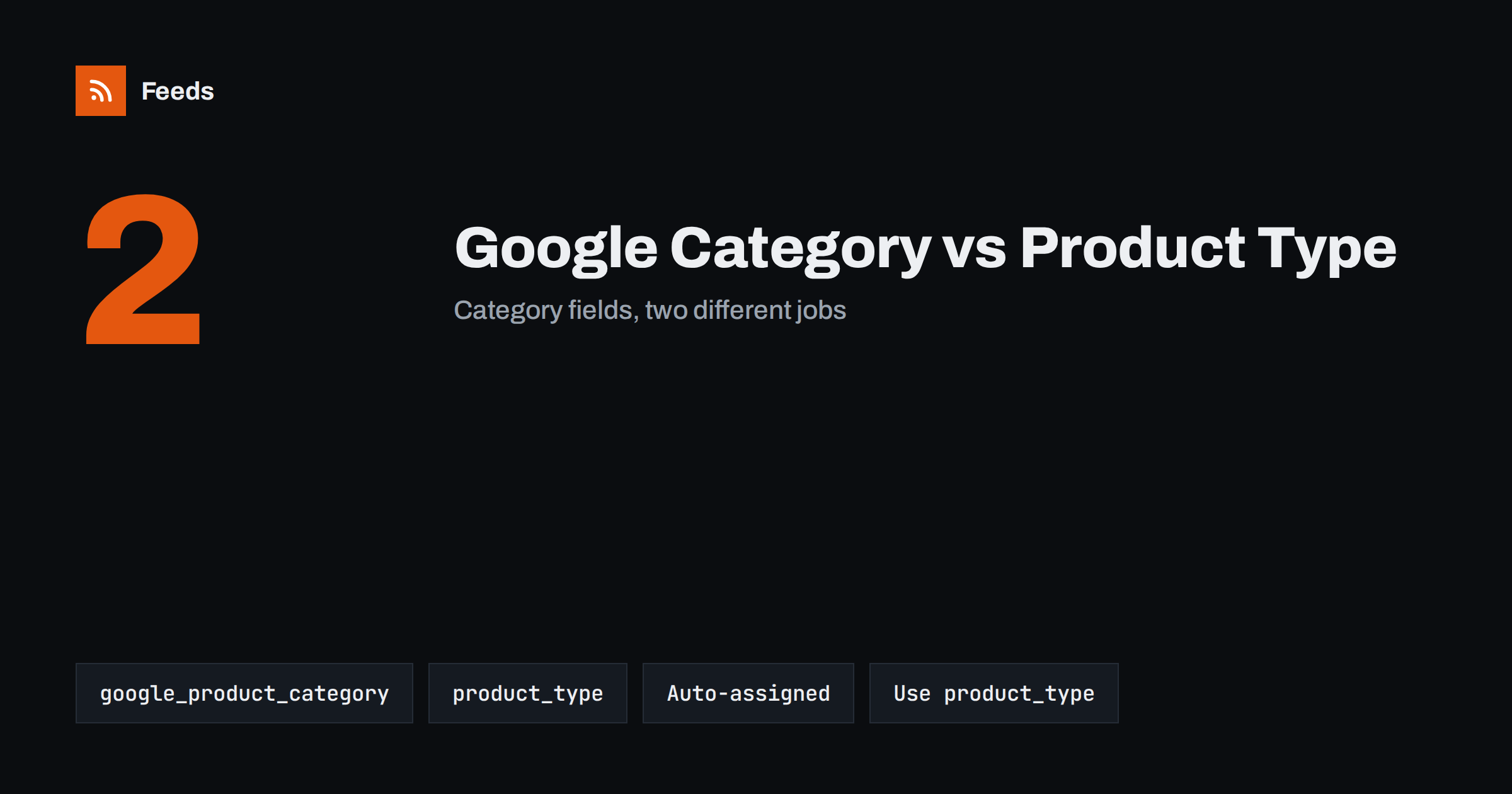
Short answer: google_product_category is a category from Google’s fixed product taxonomy, and Google assigns it automatically for most items, so you only need to set it when the automatic choice is wrong or when a category triggers specific requirements. product_type is your own free-text category path, such as “Home > Kitchen > Knives > Chef Knives”. It is never required, but it is one of the most useful attributes for organizing campaigns, reporting and bidding.
Two attributes, two different jobs
The two attributes sound similar and are often confused, but they serve different purposes. google_product_category tells Google where your product sits in Google’s own classification. Google uses it to understand the product, apply category-specific rules (such as apparel requirements or tax treatment in some cases), and match it with searches. product_type describes where the product sits in your store’s structure. Google may use it as an extra signal, but its main value is for you: it lets you group, filter and report on products the way your business thinks about them.
Put simply, google_product_category speaks Google’s language and product_type speaks yours. A feed benefits from both, but for different reasons. The mistake is to treat them as interchangeable, for example by copying Google’s category path into product_type, which throws away the flexibility of your own structure.
Meta catalogs follow a similar pattern: Meta accepts google_product_category and has its own category field, while product_type remains your internal classification.
How google_product_category works
Google maintains a product taxonomy with thousands of categories organized in a tree, from broad top-level categories like “Apparel & Accessories” or “Home & Garden” down to specific leaves like “Kitchen Knives”. Each category has a numeric ID and a full text path. In a feed, you can send either the ID or the full path in the language of the target country.
Today, Google assigns a category to every product automatically, based on the title, description, image and other data. For most products the automatic category is correct, which is why the attribute is optional. You can see the assigned category in Merchant Center’s product details. When you do send a value, Google may still use its own assessment if it disagrees strongly, but your value is taken into account.
The official taxonomy files are available for download from Google in several languages. It is worth downloading the file for your market rather than guessing paths, because the exact wording matters when you send text paths.
When you should set google_product_category yourself
- When the automatic category is wrong. A phone case classified as a phone, or a toy knife classified as a kitchen knife, can lead to wrong requirements or policy flags.
- When category-specific rules apply. Apparel and accessories trigger requirements for color, size, gender and age_group; being in the right category ensures the right rules are applied.
- When items are ambiguous by nature. Replacement parts, accessories and bundles are often misclassified because their titles mention the main product.
- When you want consistency across a large catalog. Mapping each of your store categories to a Google category once gives predictable results.
Choose the most specific category that fits. “Home & Garden > Kitchen & Dining > Kitchen Tools & Utensils > Kitchen Knives” is more useful than “Home & Garden”. If no leaf fits exactly, use the closest parent rather than a wrong leaf.
How product_type works
product_type is free text, typically a path separated by “>”. It can have several levels and you can include more than one value in some formats, although the first one is the one most tools use. There is no approved list; you decide the structure.
In practice, most stores map product_type from their store categories, breadcrumbs or collection structure. “Women > Shoes > Running Shoes” or “Coffee > Beans > Single Origin” describe the product in the way your merchandising team already thinks. Because it is your structure, it can include distinctions Google’s taxonomy does not have, such as “Private label” versus “Brands”, “Core range” versus “Seasonal”, or collections that only exist in your store.
A good product_type is consistent. If one product says “Shoes > Running” and another says “Running shoes”, they will not group together in reports. Generate the value from a structured source, not from manually typed text.
Using product_type for campaigns and reporting
In Google Ads, Shopping campaigns can subdivide products by product type, and Performance Max listing groups can be split by it too. This is where product_type pays for itself. With a clean hierarchy, you can:
- set different bids or targets for categories with different margins;
- see performance by your own categories in reports instead of Google’s taxonomy;
- exclude categories that do not perform or should not be advertised;
- launch campaigns for one department without touching the rest of the catalog.
Agencies in particular benefit from a clean product_type. When a client asks why a category underperforms, a report split by product type answers it in minutes. Without it, the analysis starts with manually grouping product IDs, which is slow and error-prone every single time.
Since product_type has up to five levels available for subdivision, a hierarchy of three or four levels usually gives enough granularity without becoming unwieldy.
Custom labels complement product_type. Where product_type describes what a product is in your structure, custom labels describe how you want to treat it: margin band, season, best seller or clearance. Keeping those two ideas separate makes both cleaner. If you find yourself adding “Sale” or “High margin” as a level in product_type, that information probably belongs in a custom label instead, where it can change without disturbing the category hierarchy and the history attached to it.
Side-by-side comparison
| Aspect | google_product_category | product_type |
|---|---|---|
| Values | Fixed list from Google’s taxonomy | Free text you define |
| Required? | No; assigned automatically | No |
| Main purpose | Tell Google what the product is | Organize products your way |
| Triggers rules? | Yes, for some categories | No |
| Used in campaign structure | Possible, but coarse | Yes, very flexible |
| Typical source | A mapping table from your categories | Store categories or breadcrumbs |
The comparison also shows why the two rarely conflict. You can send a very detailed product_type with dozens of internal distinctions while google_product_category stays at a sensible, specific leaf of Google’s tree. Neither value needs to mirror the other, and it is normal for several of your product types to map to the same Google category.
Common mistakes
- Sending invented google_product_category values, such as your own category names. Values must come from Google’s taxonomy.
- Using the homepage breadcrumb “Home > …” at the start of every product_type. It adds a useless first level to every report.
- Assigning products to many store categories and letting the feed pick one at random. Decide which category is primary.
- Mapping everything to a top-level Google category, which gives Google almost no information.
- Changing product_type structure frequently, which breaks campaign subdivisions and historical comparisons.
A simple way to set both
- List your store categories, ideally at the most specific level.
- For each, choose the best matching Google category from the taxonomy file. Keep this mapping in a small table.
- Generate product_type from the product’s primary store category path, without the “Home” prefix.
- Apply the mapping in the feed so every product receives both values automatically.
- Review the automatic category in Merchant Center for a sample of products, and adjust the mapping only where Google disagrees for good reason.
For stores with products in several store categories, pick the primary category by a clear rule, such as the deepest category or the one used in the product’s breadcrumb. Random selection produces product types that jump between values on each export, which confuses both reports and campaign subdivisions.
If you sell in several countries, remember that google_product_category text paths are language-specific. Sending numeric category IDs avoids translation issues entirely, because the same ID works in every language, and it is less sensitive to small wording changes when Google updates the taxonomy.
This takes an afternoon for a typical small catalog and rarely needs attention afterwards, except when you add new store categories.
How Feeds helps
Feeds creates Google product XML feeds from WooCommerce, Shopify or a CSV link, with id, title, link, image, price, availability and brand for every item, and it refreshes them automatically. Rules let you rewrite titles, adjust prices and skip out-of-stock products, and you check a preview of the products before the feed is created. See the pricing page for plans and what each includes.
Related reading
- Google Product Feed Attributes: Required and Recommended
- Product Feed Title Optimization: Formulas That Work
- Merchant Center Disapproved Products: Causes and Fixes
The bottom line
google_product_category is Google’s classification, assigned automatically and worth setting only when the automatic choice is wrong or rules depend on it. product_type is your own category path and one of the most useful fields for campaign structure and reporting. Map both once from your store categories and keep the structure stable.
FAQ
Is google_product_category required?
No. Google assigns a category automatically. Setting it is useful when the automatic category is wrong or when category-specific requirements apply.
Can I use my own category names in google_product_category?
No. The value must be a category ID or path from Google’s product taxonomy. Your own names belong in product_type.
How many levels should product_type have?
Three or four levels usually give enough detail for campaigns and reports without becoming hard to maintain.
Does product_type affect where my products appear?
Google may use it as an additional signal, but its main value is in organizing campaigns and reports. Titles and other data matter more for matching.
Where can I find Google’s product taxonomy?
Google publishes the taxonomy as downloadable text and spreadsheet files in several languages, linked from the google_product_category help page.