ENEnglish
 LTLietuviškai
 DEDeutsch
 FRFrançais
 RUРусский
 ESEspañol
 PLPolski
 ITItaliano
 UKУкраїнська
 CSČeština
 PTPortuguês
 JA日本語
JA日本語 LVLatviešu valoda
 ETEesti
 HUMagyar
 IDBahasa Indonesia
 TRTürkçe
 HIहिन्दी
 ELΕλληνικά
 ARالعربية
 THไทย
THไทย VITiếng Việt
 RORomână
 MSBahasa Melayu
 BNবাংলা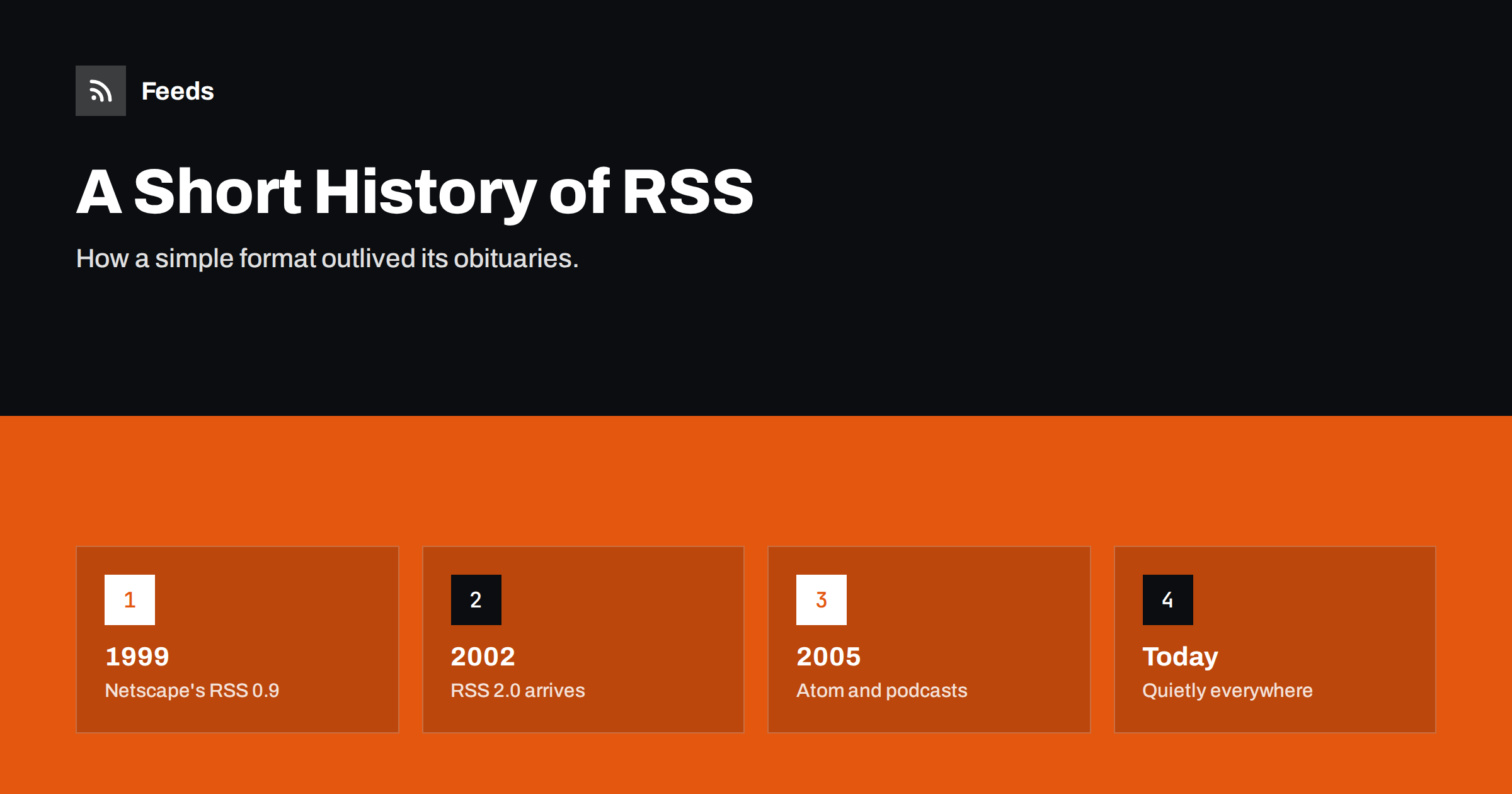
Short answer: RSS began in 1999 at Netscape as a way to show headlines from other sites on its My Netscape portal. Competing versions followed, leading to RSS 1.0 in 2000 and RSS 2.0 in 2002, while the stricter Atom format became an IETF standard in 2005. Podcasting made RSS essential from 2004 onward, Google Reader popularised feed reading until its closure in 2013, and although browsers dropped built-in support, RSS still quietly powers podcasts, newsletters, automation and much of the open web.
RSS has been declared dead many times, most loudly in 2013. Yet in 2026 every podcast still depends on it, most content management systems publish it by default, and a new generation of social platforms offers feeds for their profiles. Knowing how RSS evolved explains some of its oddities, such as its several versions and its looser rules compared with Atom, and why it keeps coming back. Here is the story in brief.
1999: Netscape and the portal era
In the late 1990s, web portals wanted to show content from many sites on one personalised page. In 1999 Netscape introduced RSS 0.9 for its My Netscape portal. At the time the initials stood for “RDF Site Summary”, because the format was based on RDF, a framework for describing metadata. Sites published a small file listing their headlines, and the portal displayed them in boxes on users’ home pages.
Netscape soon simplified the format into RSS 0.91, dropping RDF. Around the same time, Dave Winer of UserLand Software, who had worked on similar syndication formats, became closely involved in developing and promoting it. The idea of a machine-readable list of headlines caught on quickly among bloggers and news sites.
2000 to 2002: forks and the 2.0 compromise
The early 2000s brought a split. A working group of developers, including a teenage Aaron Swartz, created RSS 1.0 in 2000, returning to RDF and adding modules for extensions. Meanwhile, the simpler line continued with RSS 0.92 and related versions promoted by UserLand, which among other things added the enclosure element for attaching files.
In 2002, RSS 2.0 appeared, continuing the simple line while allowing extensions through XML namespaces. The acronym was now usually read as “Really Simple Syndication”. In 2003 the RSS 2.0 specification was placed with Harvard’s Berkman Center under a Creative Commons licence and declared frozen, so that it would remain stable. That stability is one reason RSS 2.0 is still the most common format today.
2003 to 2005: Atom brings stricter rules
Many developers were frustrated by RSS’s ambiguities and the politics around its versions. A community effort started in 2003 to design a new format with precise rules and an open standards process. The result was Atom, published by the IETF as RFC 4287 in 2005, with a companion publishing protocol later. Atom defines required identifiers, strict date formats and explicit content types. It never replaced RSS, but it became widely supported, and platforms such as Blogger and Shopify blogs publish Atom feeds to this day.
2004 to 2005: podcasting changes everything
The enclosure element, little used at first, turned out to be the seed of podcasting. Around 2004, developers and broadcasters, notably Adam Curry together with Dave Winer, built workflows that downloaded audio files referenced by RSS enclosures onto portable music players. The word “podcast” appeared that year. In 2005 Apple added podcasts to iTunes, along with its own RSS extension tags, and podcasting became mainstream.
Apple’s tags, the itunes: namespace, became the de facto standard for podcast metadata across the whole industry, used by apps and directories that have nothing to do with Apple. That decision cemented RSS’s future. Every podcast app since has relied on RSS feeds, and podcast directories are, at heart, catalogues of feed addresses. Whatever happened to feed reading on the web, podcasting kept RSS in daily use by millions of people.
2005 to 2013: the feed reader golden age
The mid-2000s were RSS’s most visible years. Browsers added feed support: Firefox introduced Live Bookmarks, and the orange feed icon, first used by Mozilla, was adopted by Microsoft and others as a common symbol. Google Reader launched in 2005 and became the dominant web-based reader, used heavily by journalists, researchers and bloggers. Services such as FeedBurner offered feed statistics and email subscriptions.
Social networks gradually drew attention away. Many people found news through Facebook and Twitter feeds instead of RSS feeds. In 2013 Google closed Google Reader, citing declining usage. Many commentators declared RSS dead. Instead, users moved to a new wave of readers, several of which, including Feedly and Inoreader, grew rapidly as refugees arrived, while others such as NewsBlur and The Old Reader also gained users.
2013 to today: quiet ubiquity
After Google Reader, RSS became less visible but no less useful:
- Browsers removed built-in feed features. Firefox dropped Live Bookmarks and its feed preview in 2018. Feeds now open as raw XML unless styled.
- Automation adopted RSS. Newsletter platforms, social scheduling tools and workflow services used feeds as triggers.
- JSON Feed appeared in 2017 as a JSON-based alternative, supported by many modern readers.
- Podcasting 2.0, started in 2020, extended podcast RSS with open tags for transcripts, chapters, funding and more.
- The open social web, including Mastodon and Bluesky, offered RSS feeds for profiles, reconnecting social posts with feed readers.
Why RSS survived when so much else did not
Many web technologies of the early 2000s disappeared. RSS did not, for reasons that are instructive:
- It is simple. A feed can be written by hand, generated by a few lines of code or produced by any content management system. Low cost of entry means almost every site has one.
- Nobody owns it. No single company can shut it down or change the rules. Google Reader’s closure hurt users, but the format carried on because readers, publishers and tools did not depend on Google for the feeds themselves.
- It is stable. The frozen RSS 2.0 specification means feeds written twenty years ago still work in today’s apps, and today’s feeds will likely work for years to come.
- It is extensible. Namespaces let podcasting, media, comments and many other uses build on RSS without breaking older readers.
- It solves a lasting problem. People and software will always need a simple way to learn “what is new on this site”.
These properties also explain RSS’s weaknesses. Because nobody owns it, nobody markets it, and many people never learn it exists. Because it is simple, it lacks features such as built-in subscriber counts. Most publishers find the trade-off worthwhile.
Timeline at a glance
| Year | Milestone |
|---|---|
| 1999 | Netscape releases RSS 0.9 for My Netscape, then 0.91 |
| 2000 | RSS 1.0, based on RDF, published by an independent working group |
| 2002 | RSS 2.0 released |
| 2003 | RSS 2.0 specification moved to Harvard’s Berkman Center and frozen |
| 2004 | Podcasting emerges using RSS enclosures |
| 2005 | Atom becomes RFC 4287; Apple adds podcasts to iTunes; Google Reader launches |
| 2013 | Google Reader closes; new readers grow |
| 2017 | JSON Feed introduced |
| 2018 | Firefox removes Live Bookmarks and feed previews |
| 2020 | Podcasting 2.0 namespace work begins |
What the history means for publishers today
Three lessons stand out. First, simple open formats last: RSS 2.0 has been frozen for over two decades and still works everywhere. Second, RSS thrives where it is infrastructure rather than a consumer brand, in podcasts, newsletters and automation. Third, publishers who keep a clean feed benefit from every new tool that adopts it, without doing anything extra. The practical advice is unchanged since 2005: publish a valid feed, keep identifiers stable, and make it easy to find. For sites that never published one, our tool, Feeds, can create a feed from a page’s list of articles and merge several sources into one filtered feed; see the plans.
Related reading
- What Is an RSS Feed? A Plain-English Guide for Site Owners
- RSS vs Atom: Which Feed Format Should Your Site Publish?
- Why So Many Websites No Longer Offer RSS Feeds
The bottom line
RSS started as a portal feature in 1999, split into competing versions, settled into the frozen RSS 2.0 and the stricter Atom, became the backbone of podcasting, peaked in visibility with Google Reader and then became quiet infrastructure for podcasts, newsletters, automation and the open social web. Its history is a good argument for publishing a clean feed today: it is one of the most durable formats on the web.
FAQ
Who invented RSS?
RSS 0.9 was created at Netscape in 1999 for the My Netscape portal. Dave Winer of UserLand Software played a major role in developing and promoting later versions, and a separate working group, including Aaron Swartz, created RSS 1.0.
What does RSS stand for?
It has had several meanings: “RDF Site Summary” in the earliest version and RSS 1.0, “Rich Site Summary” for some versions, and “Really Simple Syndication” for RSS 2.0, which is the meaning most people use today.
Why did Google Reader close?
Google closed Google Reader in July 2013, citing declining usage and a wish to focus on fewer products. Its users moved to other readers, several of which grew quickly as a result, and many of those readers are still operating today.
Is RSS still developed?
The RSS 2.0 specification is frozen by design, but extensions continue to evolve, most actively the Podcasting 2.0 namespace. JSON Feed and the Atom standard also remain in use alongside RSS.
How is RSS connected to podcasting?
Podcasting was built on RSS enclosures, which attach audio files to feed items. Every podcast app still finds new episodes by reading RSS feeds, which is why podcasts are the largest everyday use of RSS.