ENEnglish
 LTLietuviškai
 DEDeutsch
 FRFrançais
 RUРусский
 ESEspañol
 PLPolski
 ITItaliano
 UKУкраїнська
 CSČeština
 PTPortuguês
 JA日本語
JA日本語 LVLatviešu valoda
 ETEesti
 HUMagyar
 IDBahasa Indonesia
 TRTürkçe
 HIहिन्दी
 ELΕλληνικά
 ARالعربية
 THไทย
THไทย VITiếng Việt
 RORomână
 MSBahasa Melayu
 BNবাংলা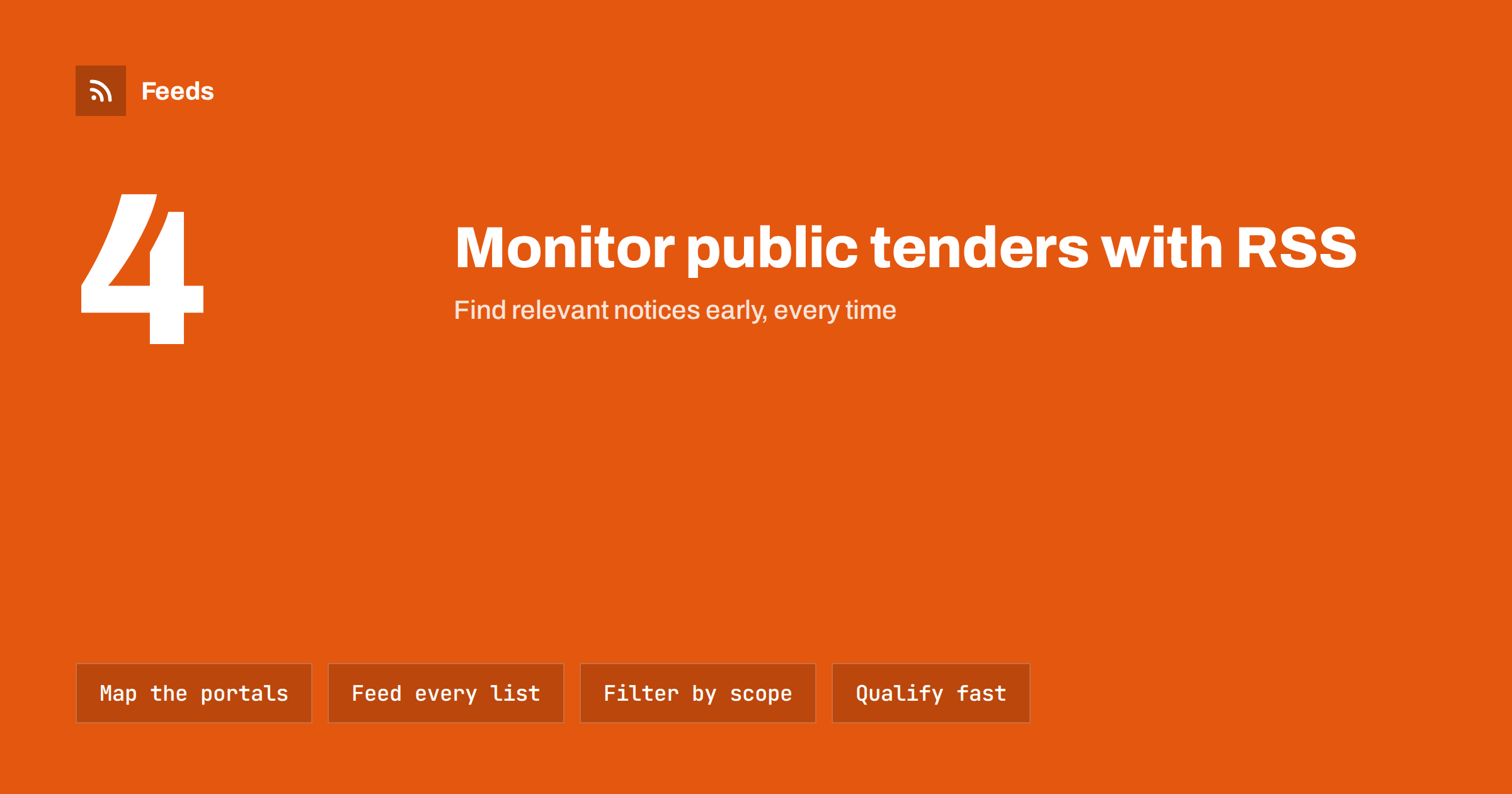
Short answer: List the procurement portals and buyer websites where tenders in your field are published, get an RSS feed for each notice list or saved search, and filter the feeds with words that describe your services, sectors and regions. Deliver matches to the person who decides whether to bid, and track each notice’s deadline. Portals that offer saved-search feeds are easiest; for buyer pages without feeds, a page-to-feed tool fills the gap.
For companies that sell to the public sector, the tender notice is where every opportunity starts. Notices appear on national portals, regional platforms and individual buyers’ websites, often with tight response windows. Firms that see a notice on the day it is published have time to ask clarification questions, find partners and write a strong bid. Firms that find it late submit rushed bids or none at all. Monitoring is therefore not a nice-to-have; it directly affects win rates.
Where tender notices are published
The landscape differs by country, but most businesses need to cover several layers of sources.
- National procurement portals where public bodies are required to publish notices above certain values.
- Cross-border publications, such as the European Union’s Tenders Electronic Daily for contracts above EU thresholds, if you operate in Europe.
- Regional and sector platforms used by groups of municipalities, health systems or utilities.
- Individual buyer websites, where smaller contracts, below formal thresholds, are often announced only on the buyer’s own “tenders” or “procurement” page.
- Prior information and market engagement notices, which signal upcoming tenders months before they open.
The last two layers are where monitoring pays off most. Large portals are watched by everyone; small buyer pages and early engagement notices are where attentive firms find less contested opportunities.
Commercial tender aggregation services exist and can be worth their subscription for firms bidding across many countries. Even then, adding your own feeds for the buyers you care most about gives you a second, independent check that nothing important was missed.
Step 1: Build your source list
Start with the portals that cover your country and sector, then add the buyers you most want to work with. For each source, record the address of the page that lists new notices, whether it offers RSS or saved-search alerts, and the kind of contracts it tends to publish.
Look especially for buyer organizations that match your ideal customer profile: the municipalities, agencies, universities or hospitals you have served before or could serve well. Their procurement pages are frequently simple lists without feeds, and they rarely appear in commercial tender aggregators with full reliability.
Step 2: Use saved-search feeds where portals offer them
Many procurement portals let you save a search and receive results by email or feed. If a portal offers RSS for a saved search, use it: the portal does the filtering by category or classification code, and the feed delivers new matching notices.
- Search by classification codes, such as the Common Procurement Vocabulary codes used in the EU, where the portal supports them. Codes are more precise than free-text keywords.
- Add region filters if you only deliver in certain areas.
- Create several saved searches rather than one broad one, so each feed has a clear purpose.
- Verify the feed: open it and check that the newest notices match what the portal shows.
Step 3: Create feeds for pages without RSS
For portals without feed options and for individual buyer pages, generate a feed from the notice list page. Tender lists are usually tables or lists of titles with dates and links, which suits page-to-feed tools well.
- Open the list of current or new notices and copy its address. If the list can be filtered and the filter appears in the address, use the filtered version.
- Create the feed and review the preview: each item should be one notice with its title and a link to the notice details.
- Check how dates appear. Notices often show both publication and deadline dates; the item date in a feed usually reflects publication or first-seen time, so read the notice for the deadline.
- Repeat for each buyer page on your list, then merge them into one “buyer pages” feed.
Step 4: Filter for your scope
Tender titles are formal and often long. Good filters reflect how buyers describe the work, not how you describe your services.
| Doanh nghiệp | Include words | Exclude words |
|---|---|---|
| IT services firm | software, system, maintenance, licences, hosting, website | vehicle, catering, construction |
| Facilities company | cleaning, maintenance, security, facility, grounds | software, consultancy |
| Consultancy | study, evaluation, advisory, assessment, strategy | supply of, works |
| Printing and signage | printing, signage, publications, promotional | none at first |
Keep filters loose at first and review a few weeks of results. Buyers use varied wording, and overly strict filters silently drop relevant notices. Read the titles of notices you won or bid on in the past; they are the best source of the words buyers actually use.
Step 5: Route notices into a bid workflow
A filtered feed is only the start. The real value comes from quick, consistent qualification.
- Daily review. One person scans new notices every working day. With good filters this takes minutes.
- Quick qualification. For each promising notice, answer a few questions: do we meet the requirements, can we deliver, is the value worth the effort, and is the deadline realistic?
- Record the decision. Log the notice, its deadline and the bid or no-bid decision in a shared tracker.
- Calendar the deadlines. Add clarification and submission deadlines immediately.
- Review monthly. Look at which sources produced the notices you bid on and won. Invest more in those and drop sources that never produce anything.
Mistakes that cost opportunities
- Relying on one portal. Below-threshold contracts and framework call-offs often appear only on buyer pages or regional platforms.
- Filters in your own marketing language. Buyers write “provision of digital services”, not “growth-focused web experiences”. Use their words.
- Ignoring early notices. Prior information and market engagement notices give you months to prepare, build relationships within the rules and find partners.
- No owner during holidays. Tender windows keep running in summer and at year end. Name a backup reviewer.
- Not checking feed health. Buyers change procurement platforms, and an old buyer page can silently stop listing new notices. Check the newest item date on each source feed every month.
- Treating every match as a bid. Bidding is expensive. A disciplined no-bid decision frees time for the tenders you can win.
Keep in mind that feeds only tell you a notice exists. The official notice and tender documents on the portal remain the authoritative source for requirements, deadlines and any clarifications published later.
A worked example
A small web development agency wants more public-sector work. It saves three searches on the national portal by classification code for software, web design and IT maintenance, each with an RSS feed. It then lists twenty-five municipalities and cultural institutions in its region and generates feeds from their procurement pages, most of which have no feeds. These are merged into one feed filtered for “website”, “web”, “digital”, “platform” and “system”.
The office manager reviews both feeds each morning and flags candidates in a shared channel; a director makes bid decisions twice a week. In the first quarter, most notices the agency bids on come from the small buyer pages, where competition is lower, and one early market engagement notice gives the team two months to prepare for a larger tender.
How Feeds helps
Feeds turns procurement list pages into RSS feeds without any access to the buyer’s website, which is exactly what small buyer pages need. It uses an existing feed when a portal provides one and otherwise finds the list of items on the page, showing a preview before anything is created. You can merge several buyer pages into one feed and keep only notices with your words, with duplicates removed automatically. Feeds refresh on their own, and paid plans alert you if a feed stops finding items, for example after a buyer moves to a new procurement platform. See pricing for how many feeds and sources each plan includes.
Related reading
- How to Track Government and Regulator Updates with RSS
- How to Set Up Keyword Alerts Using RSS Feed Filters
- How to Merge Multiple RSS Feeds into One Clean Feed
The bottom line
Winning public contracts starts with seeing the right notices early. Cover national portals with saved-search feeds, cover individual buyers with generated feeds, filter using the language buyers actually use, and run a short daily qualification routine with a tracked decision for each notice. Small buyer pages and early engagement notices are where consistent monitoring gives you an edge.
FAQ
Do procurement portals offer RSS feeds?
Some do, often for saved searches or categories, while others only offer email alerts or nothing at all. Check the portal’s alert or subscription options and the page source for feed links.
How can I follow a buyer’s tender page that has no alerts?
Create a feed from the buyer’s list of tenders with a page-to-feed tool. Each new notice then appears as a feed item you can filter and merge with other sources.
Should I filter tenders by keywords or classification codes?
Use classification codes where a portal supports them, since they are more precise. Use keywords for sources without codes, and keep them loose enough to catch the varied wording buyers use.
Does the feed date show the tender deadline?
Usually not. The item date typically reflects when the notice was published or first seen, so open each notice to confirm the deadline and record it in your tracker.
How often should tender feeds be checked?
Once each working day is enough for most businesses, because response windows are usually measured in weeks. What matters most is consistency, so no notice sits unread for days.