ENEnglish
 LTLietuviškai
 DEDeutsch
 FRFrançais
 RUРусский
 ESEspañol
 PLPolski
 ITItaliano
 UKУкраїнська
 CSČeština
 PTPortuguês
 JA日本語
JA日本語 LVLatviešu valoda
 ETEesti
 HUMagyar
 IDBahasa Indonesia
 TRTürkçe
 HIहिन्दी
 ELΕλληνικά
 ARالعربية
 THไทย
THไทย VITiếng Việt
 RORomână
 MSBahasa Melayu
 BNবাংলা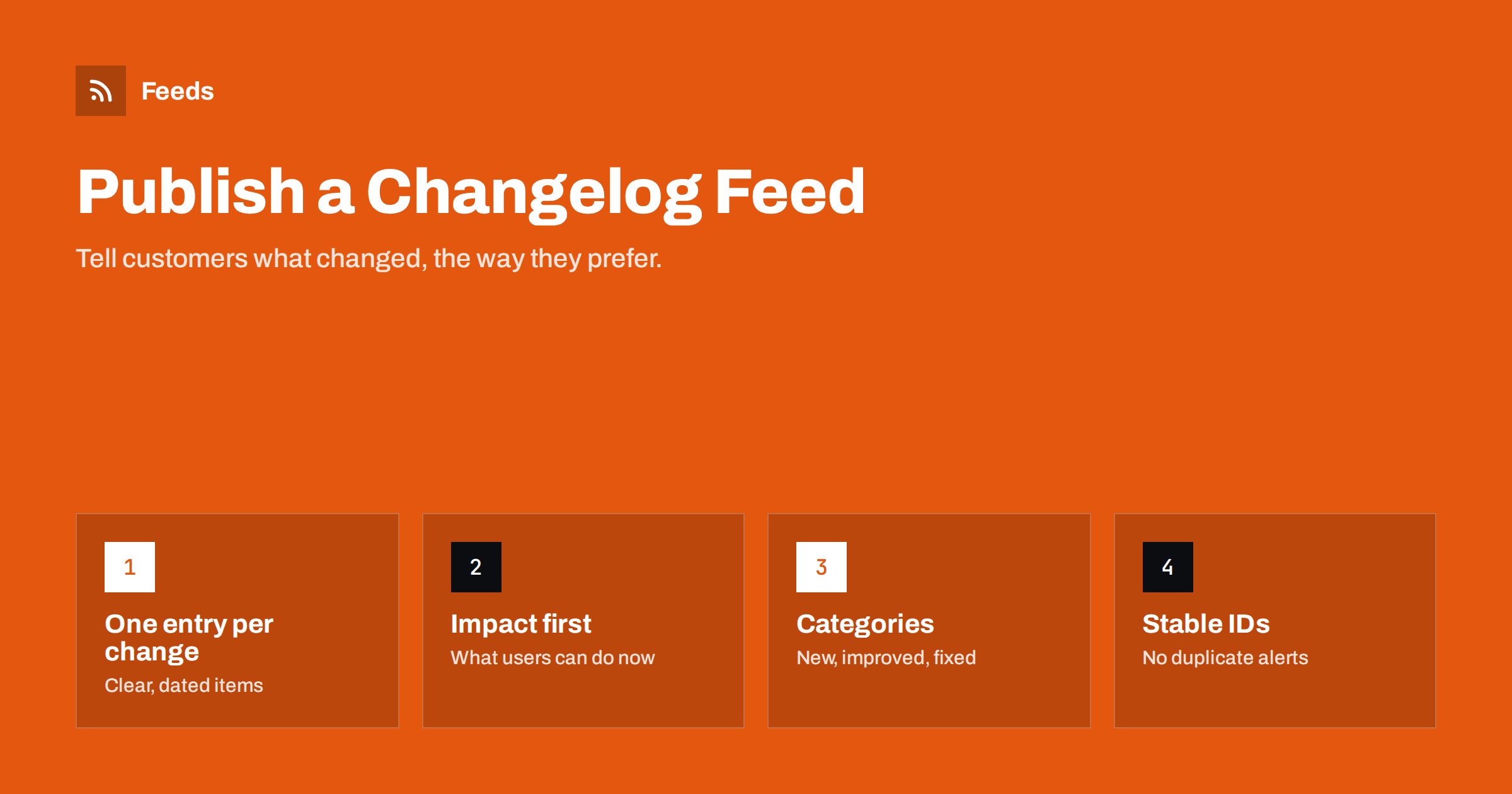
Short answer: A changelog feed is an RSS or Atom feed with one item per release or notable change, each with a descriptive title, a date, a permanent identifier, a short summary that states the impact first and a link to details. Categories such as New, Improved, Fixed and Deprecated let customers filter. Publish it from your changelog page or documentation site, advertise it with autodiscovery and on the changelog page itself, and keep it separate from your marketing blog.
Shipping is only half of the work; customers must also learn that something changed. Customers of software products, APIs, plugins and online services want to know what changed, especially when a change affects their work. Many will not read a marketing newsletter, but they will happily follow a changelog feed in a reader or pipe it into a team chat channel. A good changelog feed reduces support questions, makes new features visible and builds trust that the product is actively maintained. This guide explains how to design one and publish it on common platforms.
Who follows changelog feeds
- Technical customers, such as developers integrating with your API, who need to know about new endpoints, deprecations and breaking changes.
- Admins and power users who manage your product for their teams.
- Agencies and partners who support clients using your product.
- Your own teams: support, sales and success staff who need to know what shipped.
- Automation: chat integrations, internal dashboards and monitoring tools that react to new entries.
Internal readers are easy to forget, yet they often benefit most: a support agent who sees a fix in the changelog channel can answer a customer’s question before it is escalated. Many of these readers will never visit your changelog page unprompted. The feed brings the changes to them.
Designing good entries
The feed is only as good as the entries in it. Good entries are short, specific and written for users rather than for the engineers who built the change. Each feed item should answer three questions quickly: what changed, who is affected, and what they should do. Practical rules:
- Descriptive titles. “Export reports to CSV” beats “Version 4.12.0”. Put the version number in the body or a category if it matters.
- Impact first. Open with what users can now do, or what they must change, before any technical detail.
- One item per meaningful change, or one per release with a clear list, depending on your release rhythm. Avoid dozens of tiny items per day.
- Links to documentation for details, migration guides and examples.
- Dates that reflect availability, not the date the entry was drafted.
- Clear labels for breaking changes and deprecations, including deadlines.
An example entry, before and after
Consider a typical changelog entry written in a hurry:
“v4.12.0 – various improvements and bug fixes.”
In a reader or a chat channel, this tells customers nothing. They cannot tell whether it affects them, so they either ignore it or have to click through and search. Compare it with an entry written for the feed:
- Title: “Reports can now be exported to CSV”
- Summary: “Admins can export any report to CSV from the report menu. Exports respect current filters and include up to one year of data.”
- Body: a short explanation, a screenshot, a link to the documentation and, at the end, “Released in version 4.12.0”.
- Categories: New, Reports.
The second version works in every channel: the title alone is useful in a chat notification, the summary is enough for a digest, and the body answers follow-up questions. It takes a few more minutes to write, but those minutes are repaid many times over in avoided support tickets and in customers actually discovering what you built.
If a release contains many small fixes, group them into one entry with a clear title such as “Fixes for reports and exports” and a bullet list, rather than publishing a separate item for each.
Categories and filtering
| Category | Use for |
|---|---|
| New | New features and capabilities |
| Improved | Enhancements to existing features |
| Fixed | Bug fixes users may have noticed |
| Deprecated | Features or APIs scheduled for removal, with dates |
| Security | Security-related changes, where you publish them |
Keep the list of categories short and stable. A category that is used once and never again helps nobody, and renaming categories breaks filters that customers have already set up. Put categories in the feed with category elements. Readers and automation tools can then filter, for example sending only “Deprecated” and “Security” items to an engineering channel. For larger products, publish separate feeds per product area or per API version, so customers follow only what they use.
Technical essentials
- Permanent identifiers. Give each entry a guid that never changes, so edits or migrations do not trigger duplicate alerts in customers’ chat channels.
- Correct dates with time zones.
- Clean HTML in the content: headings, lists, code snippets in
preblocks, and absolute links. - A reasonable item count, such as the last 30 to 50 entries.
- Autodiscovery on the changelog page and documentation pages.
- Validation after every change to the template.
Code examples deserve special care. Feed readers and chat tools display code with varying fidelity, so keep snippets short in the feed and link to the full example in your documentation. Escape angle brackets and ampersands correctly, or the feed may break the moment someone publishes an entry containing HTML or XML examples.
Publishing on common platforms
- WordPress: use a dedicated “Changelog” category or custom post type; its feed is available at the category or post type archive plus
/feed/. - Documentation generators and static sites: most can generate a feed from a changelog collection; one Markdown file per entry works well.
- Git hosting: repository release pages on major code hosts often provide Atom feeds of releases, which suit developer tools; add a human-written summary to each release.
- Dedicated changelog services usually offer RSS out of the box; check that identifiers and categories are included, and that you can export entries if you ever switch services.
- Headless or custom sites: generate the feed from the same data as the changelog page, at build time or in a cached route.
Promoting the feed
Changelog pages are often buried in a footer or inside documentation. A changelog feed only helps if customers know about it. Put a visible “Subscribe via RSS” link at the top of the changelog page, mention it in onboarding emails and admin documentation, and explain how to connect it to common chat tools. Many team chat tools can post feed items to a channel, which is often the most effective way for a customer’s whole team to stay informed. Make it clear that the feed is a service, not marketing.
Common mistakes
Most of these mistakes come from treating the changelog as an afterthought written by whoever merged the last change. Assign an owner, keep a short style guide, and review entries before they are published, just as you would review documentation. The most frequent problems:
- Mixing marketing posts into the changelog feed, which makes technical readers unsubscribe.
- Version-number-only titles that tell readers nothing.
- Silent breaking changes that appear only in the documentation.
- Regenerating identifiers when the changelog tool changes, flooding customers’ channels with old entries.
- Very long entries with no summary; chat integrations show only the first lines.
Following changelogs of your own vendors
The same logic applies in reverse: your team depends on vendors whose changes affect you. Many vendors publish changelog pages without feeds. Our tool, Feeds, turns a public page that lists entries into an RSS feed, uses an existing feed when there is one, and can merge several vendors’ changelogs into one feed that keeps only items with words like “deprecated” or “breaking”. You see a preview before anything is created. See the plans.
Related reading
- How to Follow Software Changelogs and Release Notes with RSS
- Why Every Company Blog Should Publish a Clean RSS Feed
- RSS GUIDs Explained: Why Readers Show Old Posts as New
The bottom line
A changelog feed is one of the most useful feeds a product company can publish, and one of the cheapest, because the content already exists. Give each change a descriptive, dated entry that states the impact first, categorise entries so customers can filter, keep identifiers permanent, publish it from the same source as your changelog page, and promote it where customers work. It turns product changes into information customers actually receive.
FAQ
What is a changelog RSS feed?
It is a feed with one item per release or notable product change. Customers subscribe in a reader or connect it to team chat, so they learn about changes without checking the changelog page or waiting for a newsletter.
Should changelog entries be per release or per change?
Either works. Per change suits continuous delivery with occasional notable updates; per release suits scheduled versions. Avoid publishing many tiny items a day, which overwhelms subscribers.
How do I highlight breaking changes?
Use a dedicated category such as Deprecated or Breaking, state it in the title, and include dates and migration links. Subscribers can then filter for these critical items and route them to the people who must act on them.
Can I use my blog feed as a changelog?
It is better to keep them separate. Technical readers want product changes only; mixing in marketing posts makes the feed noisy and leads to unsubscribes. On WordPress, a separate category with its own feed is enough to keep them apart.
Why did customers get duplicate changelog alerts?
The entries’ identifiers probably changed, often after moving to a new changelog tool. Keep guids permanent and carry them over during migrations, and test the new feed before switching.