ENEnglish
 LTLietuviškai
 DEDeutsch
 FRFrançais
 RUРусский
 ESEspañol
 PLPolski
 ITItaliano
 UKУкраїнська
 CSČeština
 PTPortuguês
 JA日本語
JA日本語 LVLatviešu valoda
 ETEesti
 HUMagyar
 IDBahasa Indonesia
 TRTürkçe
 HIहिन्दी
 ELΕλληνικά
 ARالعربية
 THไทย
THไทย VITiếng Việt
 RORomână
 MSBahasa Melayu
 BNবাংলা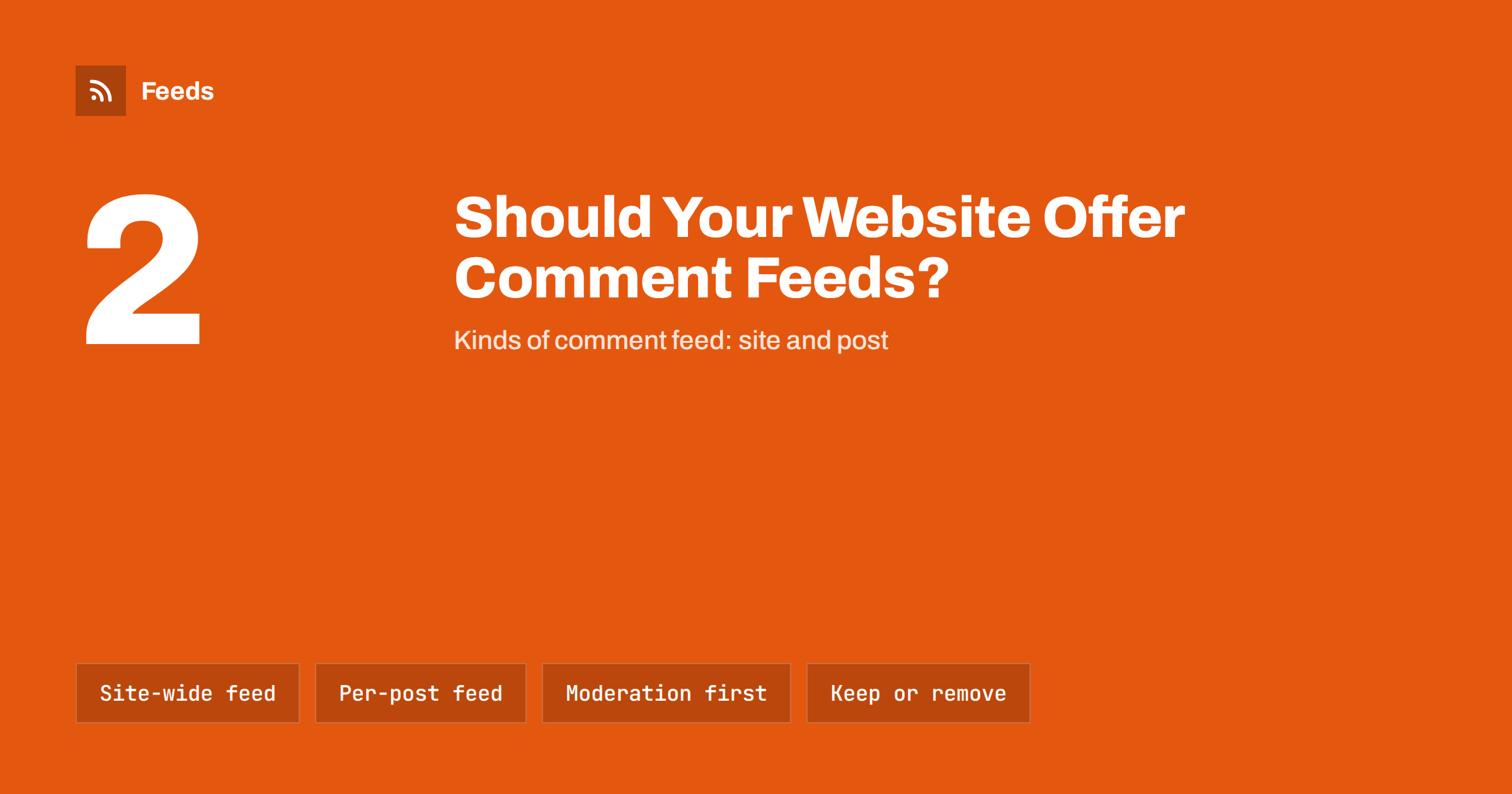
Short answer: A comment feed is an RSS feed of new comments, either for the whole site or for a single post. It lets readers follow a discussion without revisiting the page, and lets moderators and authors see new comments in one place. Offer comment feeds if your site has active discussions, and make sure only approved comments appear in them. If comments are closed, rare or mostly spam, it is reasonable to remove the links to comment feeds or switch them off.
What comment feeds are
Most people think of RSS as a feed of articles. Many content management systems also publish feeds of comments. There are usually two kinds:
- Site-wide comment feed: every new approved comment on the site, newest first. Each item shows the commenter’s name, the comment text and a link to the comment on its article.
- Per-post comment feed: new comments on one specific article. Readers subscribe to follow a particular discussion.
In addition, article feeds can point to comment feeds. In RSS 2.0, an item may include a <comments> element with the URL of the comments page, and many platforms add a separate element from a common extension namespace that gives the address of the per-post comment feed, along with the number of comments. Readers that understand these elements can show a comment count or offer to subscribe to the discussion. Our guide to every element of an RSS 2.0 feed explains the core elements.
Where to find comment feeds on common platforms
WordPress publishes both kinds by default. The site-wide comment feed is at /comments/feed/, and each post has its own comment feed at the post address followed by /feed/. WordPress also adds autodiscovery links for comment feeds to page headers, so readers can find them. Our overview of every WordPress feed URL lists these and the other built-in feeds.
Other platforms vary. Some content management systems provide comment feeds through modules or extensions, some hosted blog platforms offer them, and many sites use third-party comment systems that have their own notification options instead of RSS. If your comments are handled by an external service, check its settings for email notifications, feeds or webhooks.
Who actually uses comment feeds
Comment feeds are a niche feature, but for certain people they are very useful:
- Engaged readers who comment on a post and want to see replies without an account or email notifications.
- Authors who want to respond to comments on their articles quickly.
- Moderators and community managers who want one stream of new comments across the whole site, including older articles where discussions restart unexpectedly.
- Researchers and journalists following discussions on specialist blogs or community sites.
- Automation that sends new comments to a team chat or a support queue.
For moderators, the site-wide comment feed is often the most useful. It shows discussion on old posts that nobody is watching, which is where spam and unanswered questions tend to collect. Our guide to monitoring forums and community sites with RSS covers similar needs on other kinds of sites.
Arguments for and against
| Keep comment feeds if… | Consider removing them if… |
|---|---|
| Posts regularly get meaningful discussion | Comments are closed site-wide |
| Authors or moderators use them to respond | Almost all comments are spam |
| Your community includes feed-reader users | Posts rarely get any comments at all |
| You send new comments to a team channel | Empty comment feeds clutter autodiscovery and confuse readers |
There is no strong search engine reason either way. Feeds are generally not shown as search results, and comment feeds contain content that is already on your pages. The practical questions are whether anyone uses them and whether they contain anything worth reading. Our article on what RSS feeds really do for search covers the broader SEO picture.
Moderation and privacy considerations
A comment feed publishes the same content as the comments on your pages, so the rules that apply to comments apply to the feed:
- Only approved comments should appear. Check that pending and spam comments never reach the feed. Standard platforms handle this correctly, but custom themes and plugins sometimes do not.
- Deleted comments linger. A comment removed from your site may already be stored in subscribers’ readers. Moderate before publishing where possible, rather than after.
- Personal data: commenter names, and sometimes links to their websites, appear in the feed. Email addresses must never appear. If a commenter asks for removal, delete the comment; the feed will follow.
- Links in comments: comment spam often exists to place links. Keep link attributes consistent between pages and feeds, and do not let comment feeds become a way to spread spam links.
How to limit or switch off comment feeds
If you decide comment feeds are not useful, you have a few options, from mild to strict:
- Remove the autodiscovery links from page headers, so readers no longer offer the comment feed when someone subscribes to your site. The feeds still exist for anyone who uses them.
- Close comments on old posts after a set number of days. The per-post feeds then stop changing, and spam on old posts disappears from the site-wide feed.
- Disable the comment feeds entirely, for example with a small code snippet or a plugin in WordPress, returning a “not found” or redirecting to the main feed.
Whatever you choose, keep your main article feed untouched. If you are tidying up what your main feed contains, see how to exclude categories or posts from your WordPress feed. After any change, test the feed addresses and check that readers subscribing to your homepage are offered the right feed.
Making comment feeds more useful
If you keep comment feeds, a few improvements make them better for readers and moderators alike:
- Clear titles. Items titled “Comment on Article title by Name” are easy to scan. Many platforms do this by default.
- Enough items. A site-wide comment feed with only the last ten comments can miss activity on busy days. Consider a larger number for moderators.
- A link to subscribe. Under the comment form, a small “follow replies via RSS” link helps readers who prefer feeds to email notifications.
- Filtering for moderators. Moderators can filter a site-wide comment feed for words that often indicate spam or complaints and send those to a chat channel for quick attention.
Sending new comments to your team
One of the most practical uses of a comment feed has nothing to do with readers. Businesses that publish articles often miss questions left in comments, especially on older posts that still rank in search and attract visitors years after publication. A customer asks how a product works under an article from two years ago, and nobody answers, because nobody is looking.
A comment feed fixes this with very little effort:
- Take the site-wide comment feed and connect it to an automation tool or a chat integration.
- Send each new comment to a team channel, such as the support or marketing channel, with the article title and a link to the comment.
- Filter if needed. On busy sites, send only comments that contain a question mark or words like “how”, “price”, “problem” or your product names.
- Assign responsibility. Decide who answers comments on which topics, and aim for a reply within a working day.
This small workflow turns old articles into a support and sales channel instead of a place where questions go unanswered. It also shows which articles generate questions, which is useful input for updating the content or writing new articles.
Keep the same moderation rules in mind: send only approved comments to shared channels, or send pending comments only to moderators, so spam and personal data do not spread across the organisation.
Where a feed tool fits
Comment feeds are one more source to monitor. Feeds can merge the comment feeds of several of your sites into one, keep only comments that contain or exclude certain words, and remove duplicates, which is handy for community managers looking after multiple blogs. For sites whose comments or discussions appear on a page without any feed, Feeds can create a feed from that page as long as each entry has its own link. See the pricing page for plan details.
Related reading
- RSS Feed Best Practices for Publishers: A 24-Point Checklist
- RSS Autodiscovery: Help Readers and Apps Find Your Feed
- Why Every Company Blog Should Publish a Clean RSS Feed
The bottom line
Comment feeds let readers follow discussions and help moderators see every new comment in one stream. Keep them if your site has real conversations and someone uses them, and make sure only approved comments appear. If comments are closed, rare or mostly spam, remove the autodiscovery links or switch the feeds off, and keep your main article feed clean either way.
FAQ
What is a comment feed?
It is an RSS feed that lists new comments instead of new articles. Sites usually offer one feed for all comments and a separate feed for each post’s discussion.
Where is the WordPress comment feed?
The site-wide comment feed is at /comments/feed/ on your domain, and each post’s comment feed is the post address followed by /feed/.
Do comment feeds hurt SEO?
There is little evidence that they do. They contain content already on your pages. The main reasons to remove them are practical: no one uses them, or they fill up with spam.
Can spam comments appear in comment feeds?
Only approved comments should appear. Standard platforms handle this correctly, but check custom setups, and remember that comments removed later may remain in subscribers’ readers.
Should I switch off comment feeds if comments are closed?
Yes, it is reasonable. Empty or unchanging comment feeds add nothing, and removing their autodiscovery links makes it clearer to readers which feed to subscribe to.