ENEnglish
 LTLietuviškai
 DEDeutsch
 FRFrançais
 RUРусский
 ESEspañol
 PLPolski
 ITItaliano
 UKУкраїнська
 CSČeština
 PTPortuguês
 JA日本語
JA日本語 LVLatviešu valoda
 ETEesti
 HUMagyar
 IDBahasa Indonesia
 TRTürkçe
 HIहिन्दी
 ELΕλληνικά
 ARالعربية
 THไทย
THไทย VITiếng Việt
 RORomână
 MSBahasa Melayu
 BNবাংলা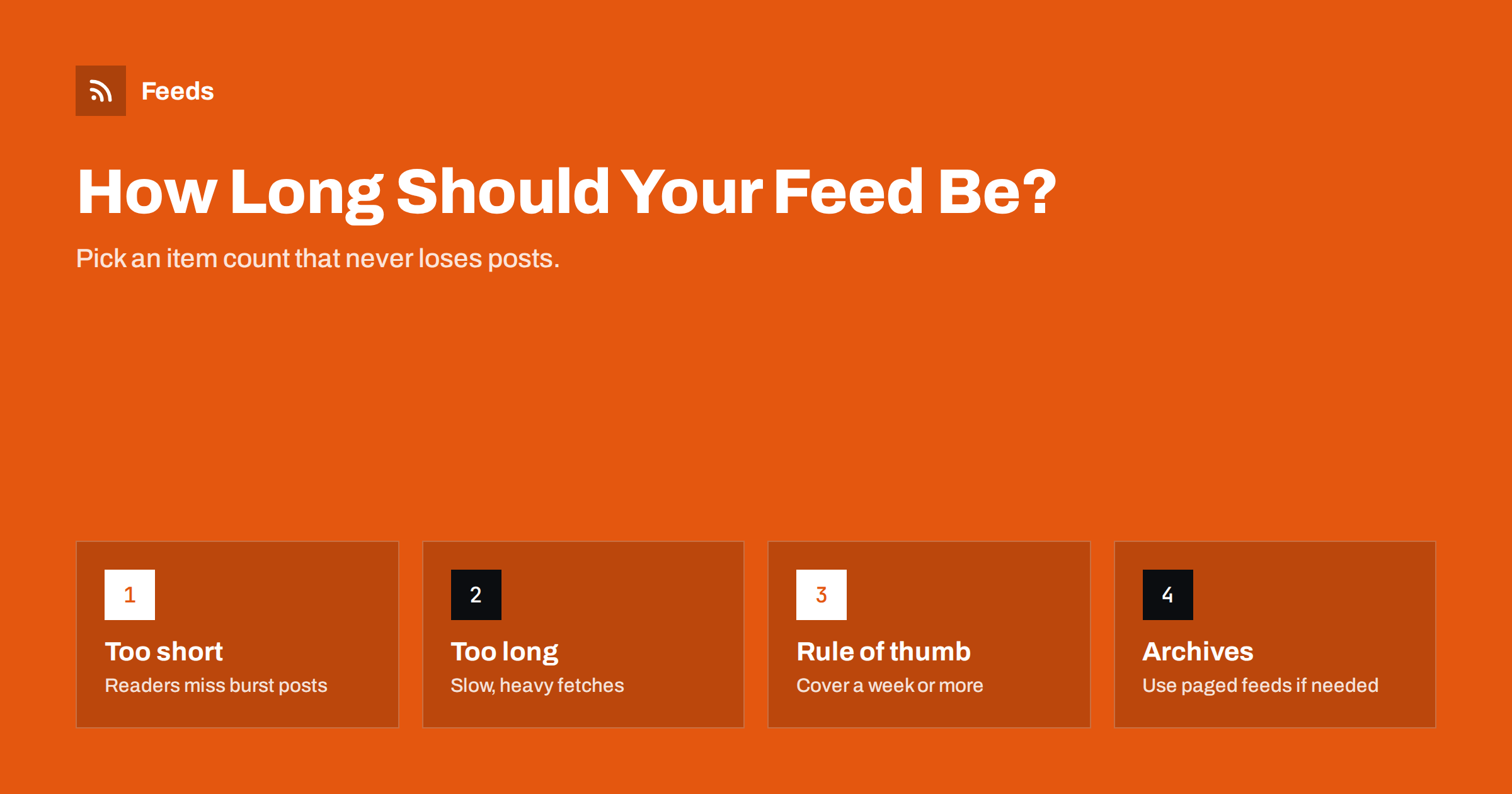
Short answer: Include enough items to cover at least several days of publishing, and ideally a week or two, so that a reader or tool that checks infrequently never misses a post. For most blogs that means 10 to 30 items; busy news sites often need 50 or more. Keep the feed file reasonably small, especially with full text, and if some consumers need a longer history, offer a separate archive or paged feed rather than making the main feed huge.
The number of items in a feed is one of those settings nobody thinks about until something goes wrong. A newsletter tool skips half of Monday’s posts; a partner’s portal shows a gap; a reader returning from holiday finds only the last ten stories of a busy week. Or the opposite: a feed with five hundred full-text items weighs several megabytes and slows down every reader that fetches it. Getting the length right is simple once you understand how feeds are consumed.
Why feed length matters
A feed is a sliding window over your newest content. Each time a reader or tool fetches it, it compares the items with what it saw before and keeps the new ones. If more items are published between two fetches than the window holds, the oldest of those items slide out of the window before the reader ever sees them. They are simply missed.
Several things make that more likely than you might think:
- Infrequent polling. Some tools check feeds every few hours, some once a day, and personal readers may not fetch at all while the device is off.
- Bursty publishing. Many sites publish in batches: several posts on Monday morning, a flurry of news on a busy day, or a content migration that republishes many items at once.
- Multiple content types. If the main feed mixes articles, short news and podcasts, volume adds up quickly.
- Outages. If a reader or your site is down for a day, the window must still cover the gap when it comes back.
The cost of feeds that are too long
Longer is safer, but not free. Every fetch downloads the whole file unless the server can reply “not modified”. Very long feeds:
- Waste bandwidth for you and for every subscriber, multiplied by every poll.
- Slow down readers and tools, especially on mobile connections.
- Put load on your server if the feed is generated dynamically without caching.
- Hit size limits in some services, which may reject or truncate feeds over a certain size.
- Cause floods when a new subscriber adds the feed and receives hundreds of old items at once.
Full-text feeds are the heaviest. Fifty long articles with embedded HTML can easily reach a few megabytes. Summary feeds of the same length are a fraction of that.
A simple way to choose the number
Use your publishing pattern to calculate a sensible minimum:
- Find your busiest realistic day or week. Look at your archive: how many items did you publish on your busiest day in the last few months?
- Decide how long a gap you want to cover. One day covers daily tools; a week covers most readers and people returning from short trips; two weeks is generous.
- Multiply and add a margin. Items per day at peak times the gap, plus 20 to 50 percent.
Also consider who reads the feed. If an important consumer, such as a newsletter tool, checks only once a day, the window must cover at least a full day of your busiest publishing plus a margin for that tool being late. A blog that publishes three posts a week needs only about 10 items to cover more than three weeks. A news site with 40 items on a busy day needs at least 40 to cover one day, and more for comfort.
Typical settings by type of site
| Type of site | Publishing volume | Suggested item count |
|---|---|---|
| Company blog | 1 to 5 posts per week | 10 to 20 |
| Active blog or magazine | 1 to 5 posts per day | 20 to 50 |
| News site | Dozens per day | 50 to 100, or section feeds |
| Podcast | Weekly or less | Often the full back catalogue |
| Changelog or release notes | Irregular bursts | 20 to 50 |
Podcasts are the exception to “keep it short”: listeners and apps expect to see the whole back catalogue in the feed, because the feed is the show’s episode list. For very large catalogues, podcast hosts may limit the public feed and offer the full archive in apps or private feeds.
Setting the count in WordPress and other platforms
- WordPress: Settings → Reading → “Syndication feeds show the most recent”. The default is 10; raise it to 20 or 30 for most blogs. It applies to all feeds, including category feeds.
- Static site generators usually have a limit option in the feed plugin or configuration. Without one, some generators include every post.
- Drupal Views set the item count per feed display.
- Hosted platforms such as Medium or Squarespace often use a fixed number you cannot change.
After changing the setting, purge caches and look at the raw feed to confirm the new count.
What changes when you edit or republish old posts
Feed length interacts with another common event: updating old content. On most platforms, the feed is ordered by publication date, so editing an old article does not bring it back into the feed. But some actions do:
- Changing the publication date to “refresh” an article moves it to the top of the feed, and readers may show it as new if the identifier also changed.
- Bulk imports or migrations can insert dozens of items with recent dates, pushing genuinely new posts out of a short feed.
- Scheduled batches, such as ten posts set to publish at the same minute, arrive in the feed together.
Before a migration or a batch of updates, temporarily consider what subscribers will see. It is often better to keep original dates and identifiers, and to let a longer feed absorb any batch, than to surprise readers with a flood of “new” old articles. If you must change many dates, do it in smaller groups over several days.
Section feeds instead of one giant feed
High-volume sites should not solve everything with one long feed. Topic or section feeds give each audience a manageable stream: a reader who wants only “Technology” does not need to download a hundred items about sport. They also keep each feed short while making sure every section’s items stay in their window long enough. Advertise the main feed and list section feeds on a “Subscribe” page.
Archives and paged feeds
Some consumers need more history than a normal feed provides, for example a partner importing your back catalogue or a researcher analysing your publishing. Options:
- Paged feeds. WordPress supports a
pagedparameter on feeds, such as/feed/?paged=2, returning older items page by page. - Archived feeds. RFC 5005 describes “Feed Paging and Archiving”, with links between pages of a feed so clients can walk back through history. Support in readers is limited, but it is a clean standard for custom integrations.
- An export or API. For one-off imports, an export file or your platform’s API is often better than any feed.
Help readers fetch efficiently
Whatever the length, make each fetch as cheap as possible. Serve ETag and Last-Modified headers so readers can ask “has anything changed?” and receive a tiny “304 Not Modified” reply when nothing has. Enable compression, which shrinks XML dramatically. Cache the generated feed for a few minutes. These measures matter more for performance than trimming ten items. When you consume feeds from other sites that are too short or missing, our tool, Feeds, refreshes feeds on its own schedule and can merge several sources into one feed with duplicates removed; refresh intervals and item limits per plan are on the pricing page.
Related reading
- How Often Do RSS Feeds Update? Refresh Intervals Explained
- WordPress RSS Feed URLs: Every Feed Your Site Already Has
- Full Text or Summary? Choosing What Your RSS Feed Shows
The bottom line
A feed is a window over your newest content, and it must be wide enough that no reader or tool misses items between fetches. Size it from your busiest publishing periods: 10 to 30 items suits most blogs, news sites need more or several section feeds, and podcasts usually list their whole catalogue. Keep full-text feeds reasonably small, serve caching headers and compression, and offer paged or archive feeds for anyone who needs history.
FAQ
What is the default number of items in a WordPress feed?
Ten. You can change it under Settings → Reading, in “Syndication feeds show the most recent”. The setting applies to the main feed and to category, tag and author feeds.
Can readers miss posts if my feed is too short?
Yes. If you publish more items between two fetches than the feed contains, the oldest ones drop out before the reader sees them. Size the feed to cover your busiest periods.
Is a very long feed bad?
It is wasteful. Every fetch downloads the whole file, which slows readers and costs bandwidth, and some services limit feed size. Use section feeds or archive feeds instead of one huge feed.
Should a podcast feed include every episode?
Usually yes. Listeners expect to see the whole back catalogue, and apps use the feed as the show’s episode list. Very large shows may be limited by their host.
How can I give someone my full archive?
Use paged feeds, such as /feed/?paged=2 on WordPress, an archived feed following RFC 5005, or a one-off export or API for large imports.