ENEnglish
 LTLietuviškai
 DEDeutsch
 FRFrançais
 RUРусский
 ESEspañol
 PLPolski
 ITItaliano
 UKУкраїнська
 CSČeština
 PTPortuguês
 JA日本語
JA日本語 LVLatviešu valoda
 ETEesti
 HUMagyar
 IDBahasa Indonesia
 TRTürkçe
 HIहिन्दी
 ELΕλληνικά
 ARالعربية
 THไทย
THไทย VITiếng Việt
 RORomână
 MSBahasa Melayu
 BNবাংলা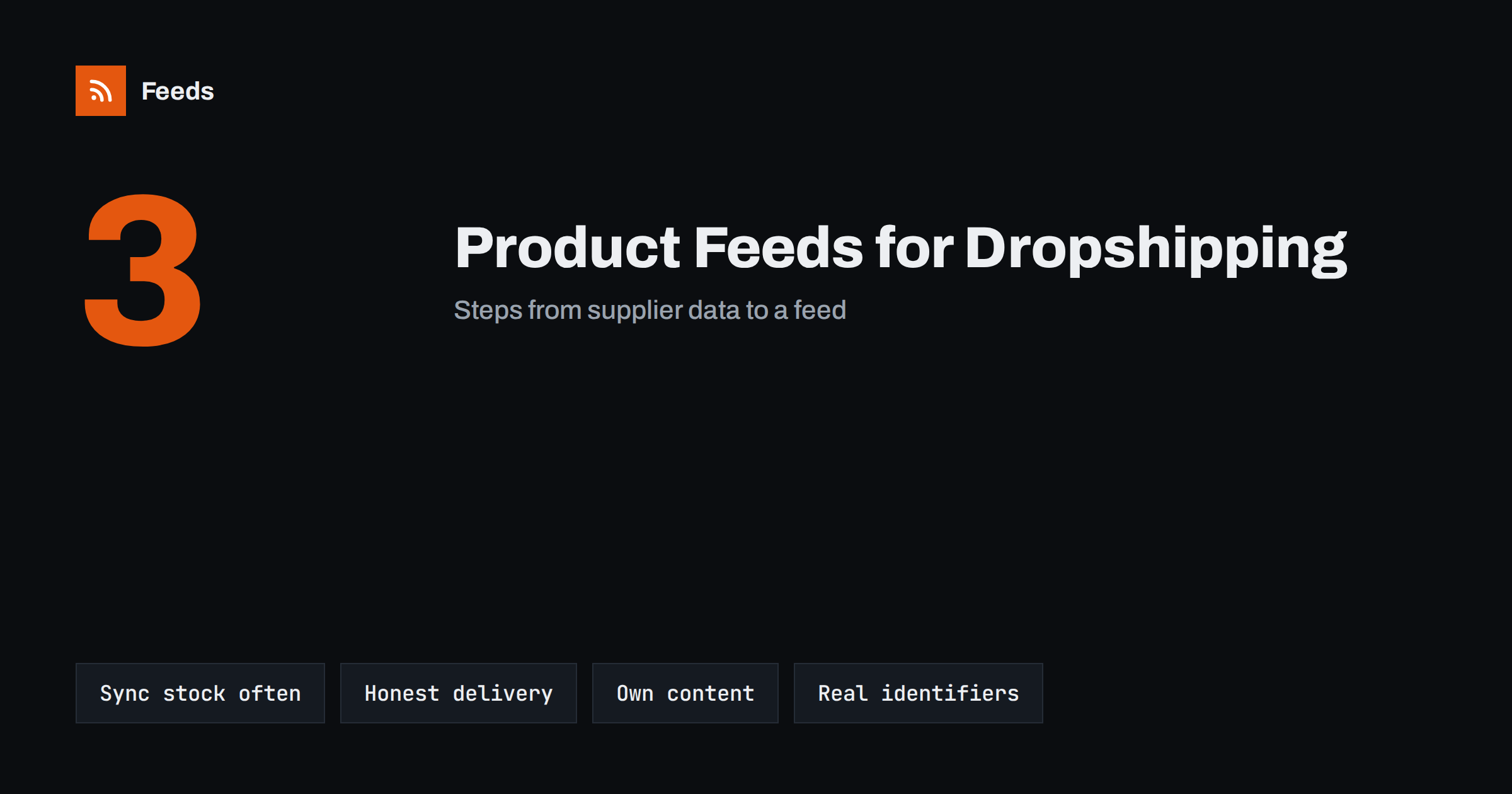
Short answer: A dropshipping store’s product feed is only as good as its supplier data. Sync supplier stock and prices into the store frequently, exclude items the supplier cannot ship, set delivery times that include the supplier’s handling and international transit, rewrite supplier titles and descriptions so they describe products clearly, and use real GTINs from the supplier where they exist. Then generate the feed from the store, not directly from the supplier file, so the feed always matches your own product pages.
Why dropshipping feeds are harder
In a classic store, stock is on your shelf and you know when it runs out. In dropshipping, stock lives in someone else’s warehouse, prices can change without notice, and delivery depends on a supplier you do not control. Your product feed promises shoppers a price, availability and delivery time on behalf of that supplier.
Shopping platforms apply the same rules to dropshipping stores as to any other. They check that prices and availability match your pages, that delivery information is realistic, and that the website represents the business honestly. Merchant Center’s policies on misrepresentation and on unrealistic delivery times are especially relevant for dropshipping, because problems there often lead to account-level issues rather than individual disapprovals.
None of this makes dropshipping incompatible with Shopping ads or catalog ads. It means the data pipeline from supplier to store to feed must be taken seriously.
Build the pipeline: supplier to store to feed
The safest structure has three steps, each with a clear job:
- Supplier data into the store. Import products, stock and prices from the supplier’s CSV, XML or API into your store, on a schedule.
- Store as the source of truth. Your product pages show what the store holds: your titles, your prices, your stock status.
- Feed from the store. The product feed is generated from the store, so it always matches the pages platforms compare it with.
It is tempting to build the feed directly from the supplier file and skip a step. That breaks the most important rule: the feed must match your landing pages. Your pages show your prices, which include your margin, and your titles, which you may have rewritten. A feed built from supplier data shows neither.
If your store platform has no built-in supplier import, many stores use an import plugin or app, or a scheduled script. The requirement is frequency and reliability, not a particular tool.
Test the pipeline end to end before relying on it. Change a price and a stock level in a test product at the supplier level, or simulate it in the import file, then follow the change through the store and into the feed. Note how long each step takes. The total delay is the window in which your ads can show outdated information, and it should be shorter than the time in which your stock typically changes.
Keeping stock and prices in sync
Stock is the most dangerous field in dropshipping feeds. Supplier stock can sell out because of other retailers’ orders, without anything happening in your store. If your store still shows the product as available, your ads keep sending shoppers to something you cannot deliver.
- Sync stock several times a day if the supplier allows it, and at least daily.
- Use a safety threshold. Treat very low supplier stock, such as one or two units, as out of stock, because those units may be gone before your order arrives.
- Refresh the feed after each stock sync, and schedule platform fetches to match.
- Watch supplier price changes. If the supplier raises prices, your margin shrinks or your store must update prices, which must then flow into the feed.
When a supplier stops providing a product altogether, remove it from the store or set it to unavailable immediately. Discontinued items lingering in a feed are one of the most common sources of shopper complaints.
Working with several suppliers adds another layer. Each supplier may deliver data in a different format, at different times and with different field names. Normalize everything in the store import, so that the store has one consistent structure regardless of where a product came from. The feed then only needs one mapping, and problems can be traced to a specific supplier import rather than hidden in the feed.
Honest delivery times
Delivery time in dropshipping is the supplier’s handling time plus shipping from the supplier’s location, which may be in another country. Your Merchant Center shipping settings must reflect the whole chain. If shipping from the supplier takes two weeks, stating three to five days is misleading, and platforms treat misleading delivery promises seriously.
Set handling time to the supplier’s actual processing time and transit time to the real carrier time for each destination. Show the same estimate on your product pages and at checkout. Where different suppliers have very different delivery times, use shipping labels to group products and give each group its own shipping service.
Longer delivery times may reduce conversion rates, but they avoid returns, chargebacks, poor reviews and account problems, which cost far more.
Rewrite supplier titles and descriptions
Supplier titles are often written for other purposes: keyword-stuffed marketplace titles, machine-translated text or internal codes. Descriptions may be identical to those of hundreds of other stores selling the same item. Using them unchanged has two costs: poor readability in Shopping results and no differentiation from competitors.
- Write titles with a clear formula: brand if relevant, product type, key attributes such as size, color and material.
- Remove promotional phrases and repeated keywords that supplier titles often contain.
- Correct translations and units for your market.
- Write the first sentences of descriptions yourself, describing what the product is and who it is for.
Feed title rules can do part of this work at scale, but changing titles in the store is better where possible, because product pages and feed then tell the same story.
Rewriting everything at once is rarely realistic for large supplier catalogs. Start with the products that receive impressions or sales, and use rules for the long tail. Over time, the products that matter most get hand-written content, while the rest at least have clean, formula-based titles.
Identifiers, brands and images
Supplier data often includes GTINs. Use them when they are real barcodes for the product, but verify a sample, because supplier files sometimes contain internal codes in barcode fields or reuse one barcode across variants. For unbranded generic products without identifiers, set brand only if there is a real brand, and set identifier_exists to no.
Supplier images may be shared with many other stores, and some include watermarks or promotional text. Choose clean images without overlays for the main image, and check the supplier’s terms regarding image use. Where possible, your own photos help you stand out in a grid of identical supplier pictures.
Also check variant data from suppliers. Colors and sizes may use supplier-specific codes or inconsistent names. Map them to clear values in the store, so that feed attributes like color and size read naturally to shoppers.
Website trust and policies
Account-level reviews look at the whole website. Dropshipping stores are more often flagged for misrepresentation when basic trust information is missing. Before submitting a feed, make sure the site has:
| Area | What reviewers look for |
|---|---|
| Contact information | Real business name, address, email or phone |
| Shipping policy | Realistic delivery times per destination |
| Return policy | Clear terms, including where items are returned to |
| Product claims | No exaggerated or unsupported claims |
| Checkout | Transparent prices, taxes and fees before payment |
These are not dropshipping-specific rules, but dropshipping stores are more likely to miss them, especially when launched quickly from a template.
Customer service matters for account health too. Complaints about late or missing deliveries tend to show up in reviews and seller ratings, which some platforms display next to listings. Answering customers quickly and keeping order tracking visible protects those signals.
How Feeds helps
Feeds builds the product feed from your store: WooCommerce and Shopify are read automatically, and other platforms work through a CSV link. It publishes a Google product XML file that Merchant Center and Meta can fetch, refreshes it automatically, and lets you skip out-of-stock products, rewrite titles and adjust prices with rules. You see a preview of the products before the feed is created. See the pricing page for plans.
Related reading
- Out-of-Stock Products in Your Feed: Keep, Mark or Remove?
- Shipping in Product Feeds: Account Settings vs Attributes
- Product Feed Title Optimization: Formulas That Work
The bottom line
Dropshipping feeds need a reliable chain: supplier data into the store on a frequent schedule, the store as the source of truth, and the feed generated from the store. Keep stock conservative, delivery times honest, titles and descriptions your own, identifiers verified and the website transparent. That combination keeps both platforms and shoppers on your side.
FAQ
Can dropshipping stores use Google Shopping?
Yes. The same rules apply as for any store: accurate prices and stock, realistic delivery times and a trustworthy website.
Should I build my feed directly from the supplier file?
No. Build it from your store, because the feed must match your own product pages, including your prices and titles.
How often should supplier stock be synced?
Several times a day if possible, at least daily. Refresh the feed after each sync and treat very low supplier stock as out of stock.
Can I use supplier product images?
Often yes, if the supplier’s terms allow it and the images are clean. Your own photos help you stand out from other stores.
Why was my dropshipping store flagged for misrepresentation?
Common causes are missing contact details, unrealistic delivery promises, unclear return policies or exaggerated claims. Fix the website, then request a review.