ENEnglish
 LTLietuviškai
 DEDeutsch
 FRFrançais
 RUРусский
 ESEspañol
 PLPolski
 ITItaliano
 UKУкраїнська
 CSČeština
 PTPortuguês
 JA日本語
 LVLatviešu valoda
 ETEesti
 HUMagyar
 IDBahasa Indonesia
 TRTürkçe
 HIहिन्दी
 ELΕλληνικά
 ARالعربية
 THไทย
 VITiếng Việt
 RORomână
 MSBahasa Melayu
 BNবাংলা
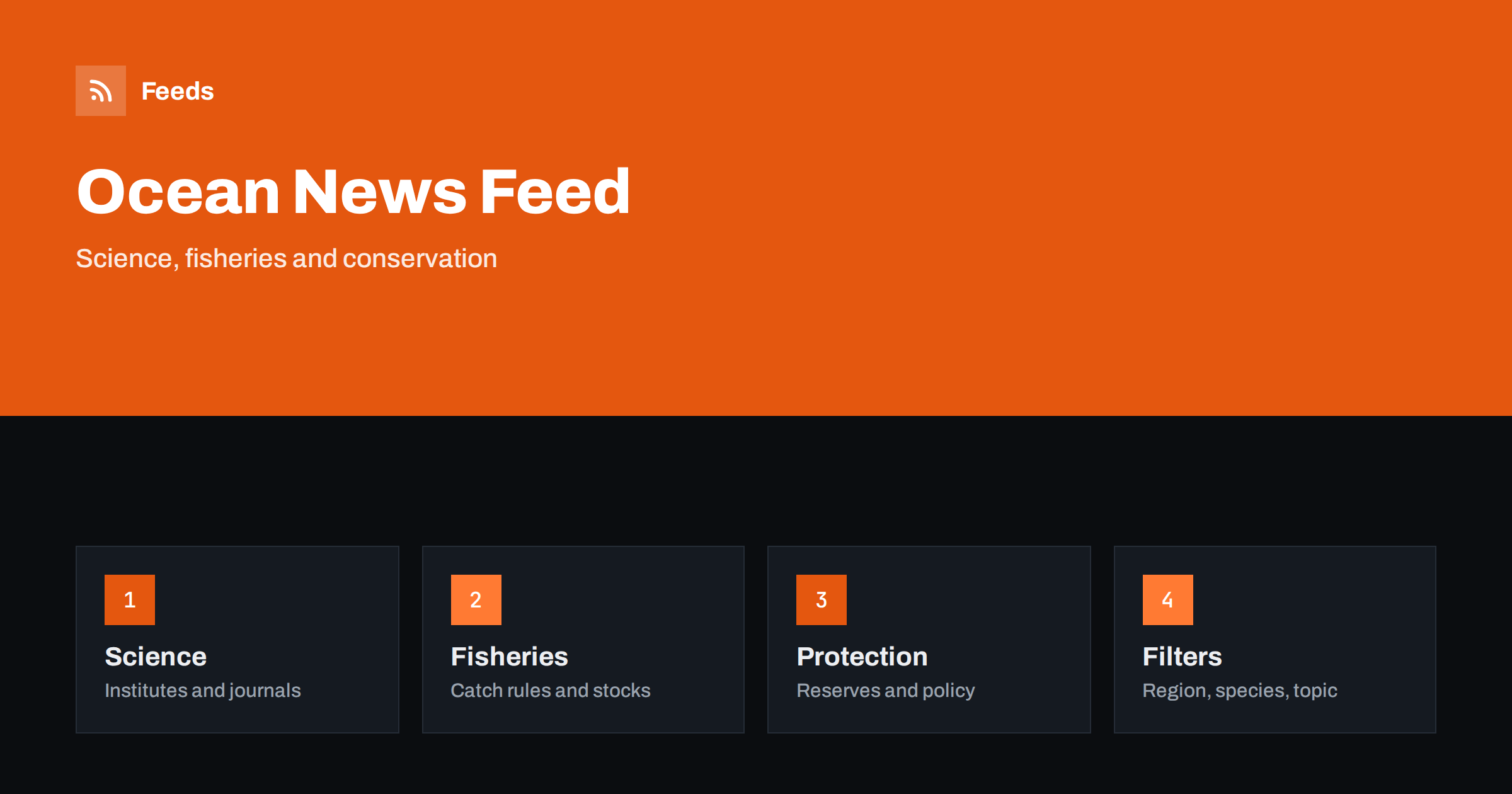
Short answer: News about oceans, fisheries and marine science comes from research institutes, universities, government agencies, international bodies, conservation groups and journals. RSS lets you follow these sources in one reader, filter them by region, species or topic, and read new items in order. Start with agencies and institutes for facts, add journals for evidence and treat campaign material as advocacy that needs the same checks as any claim.
Why ocean news is hard to follow
The sea covers most of the planet, yet news about it appears in small pieces: a survey of fish stocks, a new protected area, a heatwave in the water, a change in quotas, a paper about deep-sea mapping. Stories are scattered across science, business, environment and politics sections, and many never reach mainstream media. A person interested in marine topics, whether as a student, a fisher, a diver or a policy adviser, has to look in many places.
A feed brings them together. You choose the sources and receive their updates in order, with no algorithm deciding what you see. If the idea is new to you, what is an RSS feed explains it simply. For related areas, how to follow shipping and maritime industry news and climate and environment news and reports cover neighbouring subjects.
Look at data portals as well as news. Many institutes publish open datasets on temperature, salinity, fish catches and satellite observations. A feed that tells you when a dataset is updated is valuable for students, analysts and hobbyists. Read the documentation, since measurements have limits and units that are easy to misread.
Students can use these feeds to find thesis topics and supervisors, since active groups announce projects and openings on their news pages.
Research institutes and universities
Marine research institutes, oceanographic centres and university departments publish news about cruises, surveys, models and papers. Many share data portals, interactive maps and educational material. Their pages are the best place to learn what scientists are studying now, and often they explain results in plain language alongside the technical paper.
Research cruises have blogs, and field seasons bring bursts of posts. Some institutes announce public lectures and open days. When a page has no feed, a page-to-feed tool can turn its news list into one, as explained in how to create an RSS feed for a website without RSS. For journals, how to follow academic journals and research with RSS alerts shows how to set up article alerts.
Keep a calendar of seasons and deadlines. Closing dates, quota allocations and licence renewals are repeated every year, and entering them once saves worry later. A reminder two weeks before each date, linked to the official page, is the simplest protection against missed rules.
Fisheries agencies and management bodies
Fisheries are managed by national agencies and regional or international bodies that set quotas, seasons, gear rules and protected areas. They publish stock assessments, advice, regulations and enforcement news. For anyone who fishes, sells seafood or advises on policy, these pages contain rules that affect daily work.
Follow the agency for your region, and the body that covers your target species. Keep rules and advice separate from news: a notice about a closed season is an action item, while a stock assessment is background. How to track government and regulator updates with RSS explains how to build a feed that does not miss official notices, and customs, tariff and trade rule changes helps seafood traders.
Beyond reports, many groups run citizen science projects, from counting seabirds to reporting jellyfish. Following their pages tells you when a project opens or a survey season begins, and gives you a way to take part and not only read.
Conservation groups and protected areas
Conservation organizations publish reports on marine protected areas, endangered species, pollution, plastics and bycatch. Park authorities and reserve managers announce access rules, monitoring results and events. These sources help you see how policy changes work on the water.
Read them with the same care as any source. Campaign reports can contain strong data and clear advocacy at the same time. Check the method, compare with institute or agency data and look for the original figures. How to follow wildlife and conservation news with RSS offers more on this approach.
Revisit the filter after a season. Names of places and species can change with new policies or taxonomy, and new technical terms appear. A short review twice a year keeps the feed relevant and prevents the quiet loss of important items.
Filtering by region, species and topic
A general ocean feed is too wide for most people. Choose a region, such as a sea or a coast, a species group such as cod, tuna or coral, or a topic like aquaculture, plastics or deep-sea mining. Keyword filters keep the items that mention your terms and remove the rest. Include common names and scientific names, because sources use both.
Add exclusion words for unrelated meanings, such as a sports team named after a sea creature. Check the preview for a week and adjust. Set up keyword alerts using RSS feed filters describes the steps. For several regions, create one folder each, so that you can read them separately.
Think about the schedule of your readers as well. If you run a diving centre or a coastal business, set up a feed for warnings that is checked every morning by the person who decides on the day’s activities. Write down the rule for what happens when a warning appears so that decisions are consistent.
Weather, hazards and conditions
Sailors, divers, fishers and coastal communities care about forecasts, warnings and sea conditions. National weather and maritime services publish warnings for storms, swell, tides and ice, and some offer feeds. Those who work on the water should rely on official channels for safety and treat any aggregator as a convenience, not a replacement.
For a wider view, weather and natural hazard alerts with RSS for businesses shows how to follow warnings systematically. Harbour authorities and coast guards also publish notices to mariners that may matter for planning.
Disease, algal blooms and ocean heatwaves can affect farms and fisheries suddenly. Follow veterinary and environmental agencies as well as trade news, because their notices often come first. For businesses, this early warning gives time to adjust orders and inform customers.
Consumers increasingly ask where their fish comes from, so restaurants and shops benefit from knowing the story behind each product.
Seafood, aquaculture and markets
Seafood is traded globally, and prices, quotas and disease outbreaks affect supply. Industry news sites, market reports and producer associations publish updates on catches, farmed fish, certification schemes and trade rules. Retailers and restaurants can use these feeds to anticipate price changes and supply issues.
Sustainability labels and certifications change, and new reports rank species and fisheries. Follow the bodies that publish them and read the criteria before you quote a rating. Commodity prices and supply chain news with RSS shows how to follow markets in general.
Local context makes ocean stories real. A post that links a global finding to your own coast, harbour or market is more useful than a general headline, and it shows your audience why the subject matters to them.
Sharing ocean knowledge responsibly
Teachers, divers’ clubs, aquariums and coastal businesses often share ocean news with their audiences. Credit the source, link to the original and say what the finding does and does not show. A study of one reef may not describe all reefs. Avoid fear-based headlines and offer something readers can do, such as a local beach clean-up or a citizen science project.
If you share automatically, add a human check and keep images properly credited, since marine photographers often license their work. Full auto vs approval queue explains a safe approach.
How RSS Feed Creator helps
RSS Feed Creator turns institute, agency, reserve and conservation group pages into clean RSS feeds, even when the site has no feed of its own. It reads titles, images, summaries and dates, uses an existing feed when there is one, and shows a preview of the items before the feed is created. You can merge several sources into one feed (up to 10 sources), keep only the items that contain your keywords and have duplicates removed automatically, which suits a feed of ocean news for one region or species. Feeds refresh every 3 hours on the free plan and every 30 minutes on paid plans. The free plan allows up to 20 items per feed, and the details are on the pricing page.
Related reading
- How to Follow Shipping and Maritime Industry News with RSS
- How to Follow Climate and Environment News and Reports with RSS
- How to Follow Wildlife and Conservation News with RSS
The bottom line
RSS gives you a steady view of oceans, fisheries and marine science. Follow institutes, agencies and journals for facts, conservation groups for context, weather services for safety, and filter by region, species and topic. Check methods, credit sources and keep the feed small enough to read.
FAQ
Which sources are best for marine science?
Research institutes, university departments, government agencies and peer-reviewed journals.
How do I follow fishing rules?
Follow the fisheries agency for your region and the body that manages your species, and keep notices separate from news.
Can I filter by species?
Yes. Use keyword filters with both common and scientific names, and exclude unrelated meanings.
Should I rely on a feed for sea safety?
No. Use official weather and maritime services for safety, and treat feeds as a convenience.
How should I treat campaign reports?
As advocacy with data. Check the method and compare with institute or agency figures.