ENEnglish
 LTLietuviškai
 DEDeutsch
 FRFrançais
 RUРусский
 ESEspañol
 PLPolski
 ITItaliano
 UKУкраїнська
 CSČeština
 PTPortuguês
 JA日本語
JA日本語 LVLatviešu valoda
 ETEesti
 HUMagyar
 IDBahasa Indonesia
 TRTürkçe
 HIहिन्दी
 ELΕλληνικά
 ARالعربية
 THไทย
THไทย VITiếng Việt
 RORomână
 MSBahasa Melayu
 BNবাংলা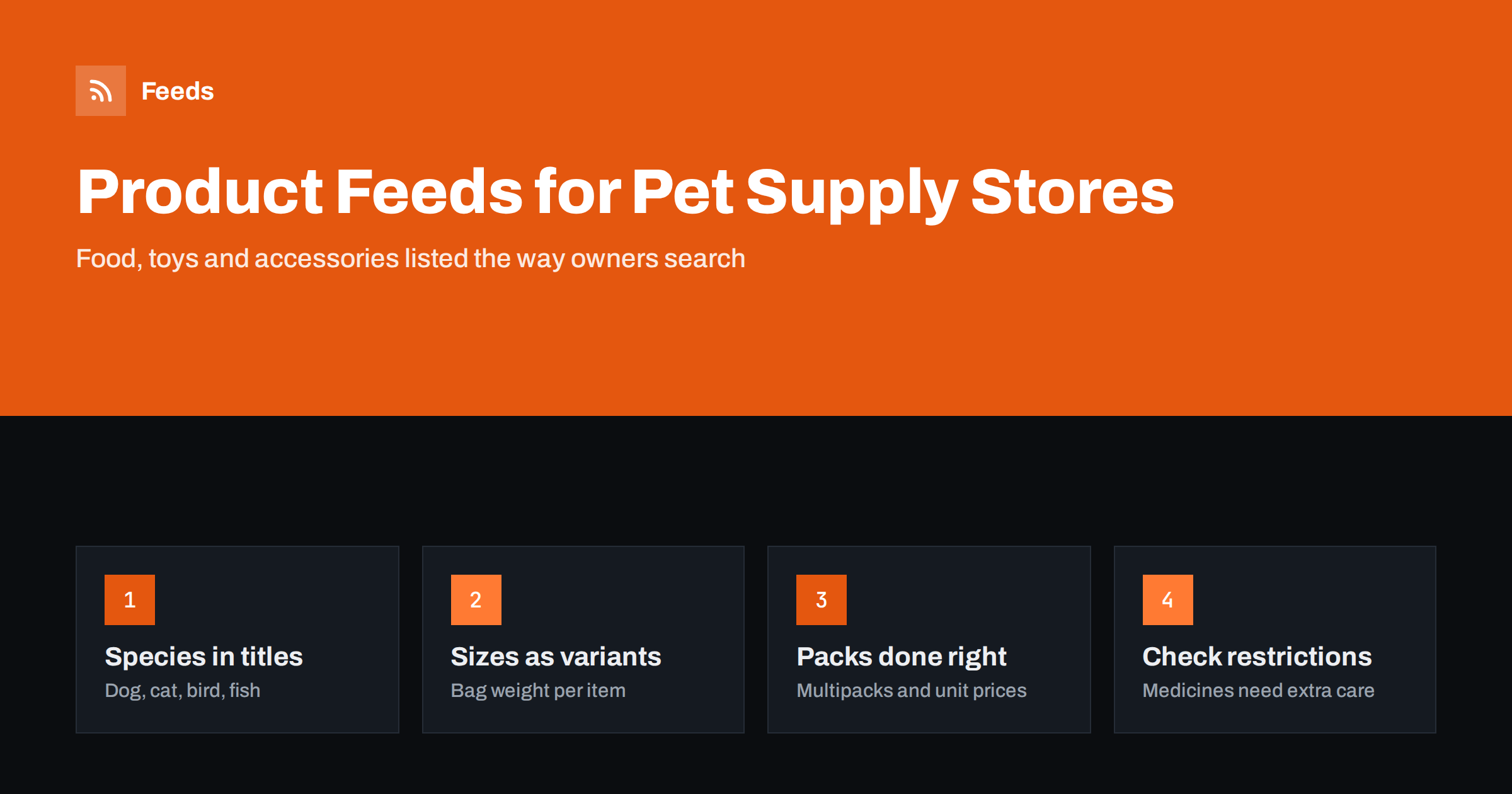
Short answer: A good pet supply feed tells shoppers exactly which animal a product is for and in which size, flavour or life stage it comes. List each bag weight and flavour as its own item grouped as variants, mark multipacks correctly, use unit pricing where it is expected, and put brand, species and key attributes in titles. Real GTINs matter for branded food, and veterinary medicines and some treatments need extra policy checks before they go into any shopping feed.
What makes pet supply feeds different
Pet supplies combine repeat purchases, many variants and strong brand loyalty. An owner who has found a food their dog tolerates will search for exactly that brand, recipe and bag size again and again. A store that lists the product clearly, with the right identifiers and the right price per size, earns that repeat click; a store with vague titles loses it to a competitor.
The category is also wide. A single shop may sell dry and wet food, treats, litter, toys, beds, leashes, aquariums, bird cages and care products. Each subcategory has its own important attributes: for food it is species, life stage, flavour and weight; for accessories it is size, colour and material; for aquarium equipment it is capacity and power. A feed that treats them all the same leaves out what shoppers compare.
Finally, pet products are bought for an animal, not for the shopper. That means the most important word in many titles is the species, and the most important number is often the size or weight that fits the animal.
Titles that name the animal and the size
A practical title formula for pet food and supplies is brand, product line, species, life stage or type, key attribute such as flavour, and size or weight. For accessories, replace flavour with the size or dimension that determines fit.
| Produkt | Useful title pattern |
|---|---|
| Dry dog food | Brand, line, adult or puppy, main protein, bag weight |
| Wet cat food | Brand, line, adult or kitten, flavour, pack size |
| Cat litter | Brand, type such as clumping, scent, weight or volume |
| Dog collar or harness | Brand, type, size range, colour |
| Aquarium filter | Brand, model, tank capacity, flow rate |
Keep titles factual and avoid health claims such as “cures allergies”. Claims like that can cause disapprovals and are hard to support. More title advice is in our guide to product feed title optimization.
Sizes, flavours and life stages as variants
Most pet foods come in several bag sizes and flavours. Each combination is a separate product with its own barcode, price and stock, so in a feed it should be its own item. All variants of the same product line share one group identifier, so platforms can show them together and send shoppers to the right option.
- Give each bag size and flavour its own id, GTIN, price and availability.
- Put the size and flavour in the title so the items are distinguishable at a glance.
- Use the size attribute for wearable items such as harnesses, coats and collars.
- Keep puppy, adult and senior versions as separate items, because they are different recipes.
The technical side of grouping is covered in product variants in feeds and how item_group_id works. The key point for pet stores is to make sure every attribute that differs between variants is actually filled in, rather than repeating the same title for every bag size.
Multipacks, bundles and unit prices
Wet food and treats are often sold in multipacks, such as 12 tins or 24 pouches. When a store creates its own pack from single units, the feed should mark it as a multipack with the number of units, so the price is compared fairly. When the manufacturer sells the pack with its own barcode, use that GTIN and treat the pack as a product in its own right.
Bundles are different: a starter kit with a bed, bowl and toy is a bundle of different products, and should be marked as one. Our article on bundles and multipacks in product feeds explains both cases.
In many countries, especially in the European Union, food sold by weight or volume must show a price per unit, such as per kilogram. Pet food is a typical example. Adding unit pricing measures to the feed lets platforms show that price next to the main one, which helps shoppers compare bag sizes. See unit pricing in product feeds for the attributes.
Identifiers and brands
Branded pet food, litter and accessories almost always carry a GTIN. Platforms use it to recognise the product and to compare offers from different stores, so it is worth filling in for every variant. Use the brand exactly as the manufacturer writes it and add the manufacturer part number where you have it.
Own-label products, handmade treats and small-batch accessories often have no GTIN. In that case, use your own brand name and state that no identifier exists rather than inventing a number. Inventing or reusing barcodes causes more problems than leaving them out honestly.
Watch out for barcodes copied between variants. When a store adds a new flavour by duplicating an existing product, the old GTIN often comes along. Two items with the same GTIN but different flavours confuse platforms and can lead to the wrong product being shown. A quick check for duplicate GTINs in your catalog before each feed review catches this early, and fixing the value in the store corrects it in every channel at once.
Medicines, treatments and restricted items
Pet stores often sell products that fall under special rules. Prescription veterinary medicines are restricted or prohibited in shopping ads in many regions, and even non-prescription treatments, such as flea and worm products, may be subject to local regulation. Live animals are generally not allowed in shopping listings.
- Check the current policies of each channel for veterinary medicines and pest-control products before including them.
- Exclude items that cannot be advertised rather than letting them collect disapprovals.
- Avoid medical claims in titles and descriptions of supplements and care products.
- Keep age or species warnings accurate, for example products that are toxic to cats.
Excluding categories is easier when product types are well organised in your store. Our guide on which products to exclude from your feed shows the common approaches.
Images and descriptions that help owners decide
For food, a clear packshot of the bag or tin on a plain background is usually best, with the flavour and size visible on the packaging. For accessories, show the product itself and, where possible, a second image that shows scale. Do not use the same image for every flavour or colour; each variant should show its own packaging or colour.
Descriptions should answer the questions owners ask before buying: which animal and life stage the product is for, main ingredients, size guidance for wearables, and any feeding or care notes. Plain, specific sentences work better than marketing copy, both for shoppers and for platforms that read the description to understand the product.
Seasonality matters too. Cooling mats and travel accessories sell in summer, coats and heated beds in winter, and gifts before the holidays. Custom labels in the feed let you group these products so campaigns can be adjusted by season without editing every item.
How RSS Feed Creator helps
RSS Feed Creator (Feeds) creates Google Merchant Center and Meta catalog XML directly from a WooCommerce or Shopify store, or from a CSV link for other platforms, without plugins or code on your site. The feed uses the Google product XML format with id, title, link, image, price, availability and brand, and Meta reads the same file. You can skip out-of-stock products, rewrite titles to put species and size first and adjust prices with rules, while the currency is detected automatically. Extra attributes, such as GTIN or unit pricing, can be added in Merchant Center with a supplemental feed. Compare plan limits on the pricing page.
Related reading
- Sale prices in product feeds: sale_price and effective dates
- Custom labels in product feeds: a practical guide
- GTIN, MPN and brand: product identifiers explained
The bottom line
Pet supply feeds work when every item says which animal it is for, in which size and flavour, at which price. List variants separately and group them, mark multipacks and bundles correctly, add unit prices where they are expected, use real GTINs for branded products and keep restricted medicines and treatments out unless the channel’s policy allows them. Clear data wins the repeat purchases this category depends on.
FAQ
Should each bag size of pet food be a separate item?
Yes. Each size has its own barcode, price and stock, so it should be its own item in the feed. Group all sizes and flavours of one product line with a shared item_group_id.
How do I list a 12-pack of cat food?
If you created the pack from single tins, mark it as a multipack with the number of units. If the manufacturer sells the 12-pack with its own barcode, use that GTIN and treat it as a separate product.
Can I advertise flea and worm treatments in shopping ads?
It depends on the product, the channel and the country. Check each platform’s current healthcare and pest-control policies first, and exclude items that are not allowed rather than leaving them disapproved.
Do pet food feeds need unit pricing?
In regions where unit prices are required for products sold by weight, such as many European countries, adding unit pricing is strongly recommended. It lets shoppers compare prices across bag sizes.
What brand should own-label pet products use?
Use your store’s own brand name. If the products have no barcode, state that no identifier exists instead of inventing or copying a GTIN.