ENEnglish
 LTLietuviškai
 DEDeutsch
 FRFrançais
 RUРусский
 ESEspañol
 PLPolski
 ITItaliano
 UKУкраїнська
 CSČeština
 PTPortuguês
 JA日本語
JA日本語 LVLatviešu valoda
 ETEesti
 HUMagyar
 IDBahasa Indonesia
 TRTürkçe
 HIहिन्दी
 ELΕλληνικά
 ARالعربية
 THไทย
THไทย VITiếng Việt
 RORomână
 MSBahasa Melayu
 BNবাংলা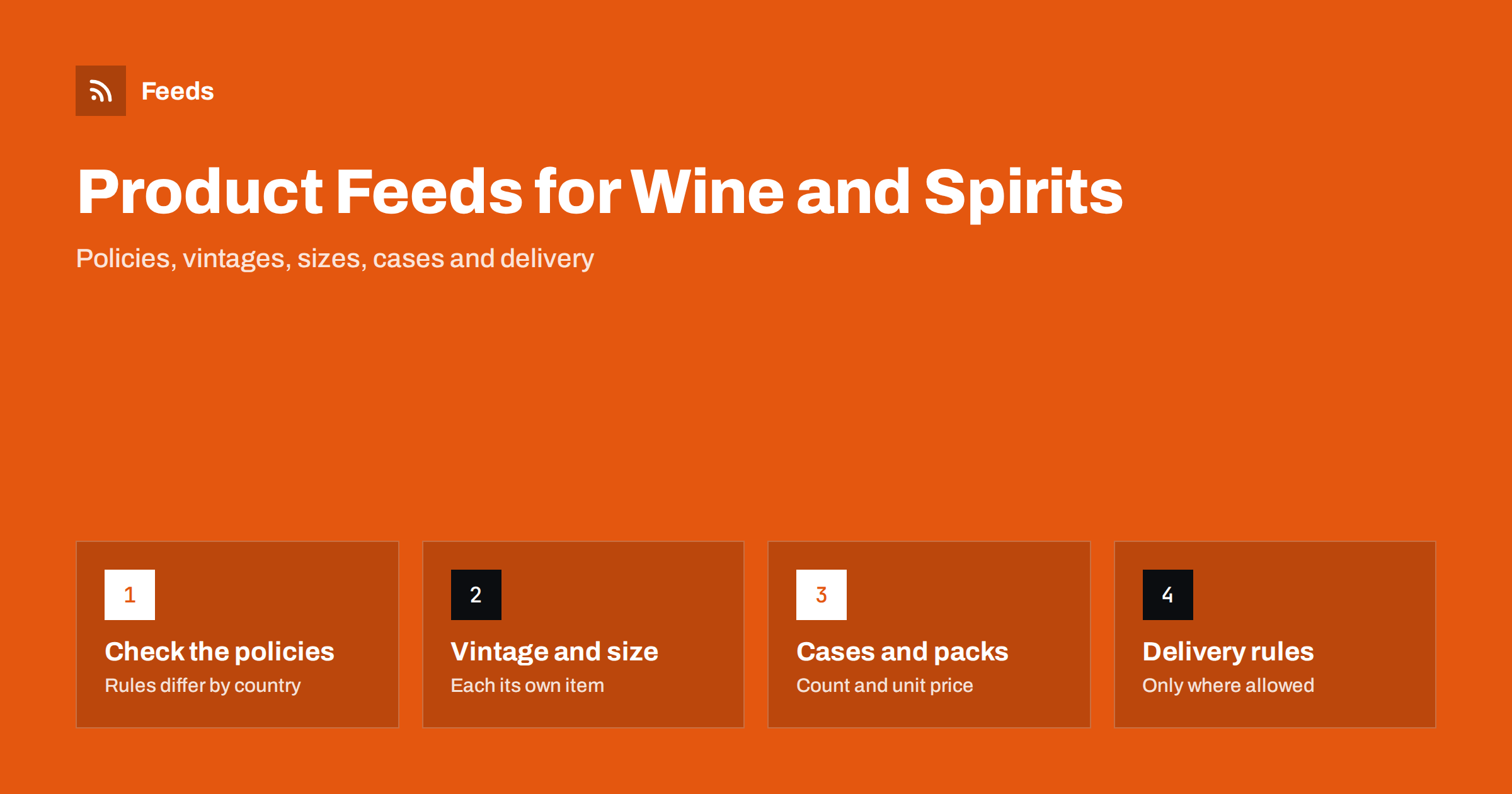
Short answer: Alcohol feeds work when they follow the advertising rules of each target country and describe every bottle precisely. Check Google’s and Meta’s current alcohol policies for the countries you sell to, then name the producer, product, vintage or age statement and bottle size in each title, list each vintage, size and pack as its own item, include GTINs where bottles have them, add unit pricing where required, and set shipping only to places where you can legally deliver.
Why alcohol is a special category
Wine, beer and spirits are sold online in many countries, but they are regulated products. Advertising rules, age requirements and delivery laws differ from country to country, and sometimes between regions of the same country. Shopping and social platforms reflect that: alcohol is usually allowed only in certain countries, with restrictions on targeting and on what the ads may say.
That makes the policy check the first step, not an afterthought. A technically perfect feed can still be disapproved if it targets a country where alcohol ads are not allowed, or if the landing pages are missing what the rules require, such as age confirmation where that is mandatory.
The rest is a question of data quality. Drinks shoppers are often knowledgeable and search for exact products: a specific producer and vintage, a whisky with a certain age statement, a beer from a particular brewery. The feed needs to carry that detail.
Start with the policies for your countries
Before building the feed, read the current alcohol policies of each platform you plan to use, for each country you target. Policies change, so check them directly rather than relying on older articles, including this one. In general, expect to deal with:
- Country restrictions. Alcohol may be allowed in some countries, restricted in others and not allowed in some.
- Age and audience rules. Ads usually must not target minors, and some platforms restrict alcohol ads to adults automatically.
- Content rules. Ads and product data should not suggest that drinking improves health, performance or social success, or encourage excessive drinking.
- Licences. Some countries require sellers to hold a licence to sell or deliver alcohol, and platforms may ask about it.
If you sell both alcoholic and non-alcoholic products, such as glassware, snacks or alcohol-free wines, consider separating them in campaigns. That way, restrictions on alcohol do not affect the rest of the catalog. Ways to exclude or split products are in which products to exclude from your feed and how and one product feed or several.
Titles that name the exact bottle
Drinks buyers compare exact products, so titles should identify them clearly. A useful pattern differs a little by category.
| Category | Title pattern | Example |
|---|---|---|
| Wine | Producer, wine name or grape, region, vintage, size | “Domaine Example Pinot Noir Bourgogne 2021, 75 cl” |
| Spirits | Brand, product, age statement or style, size | “Example Distillery 12 Year Old Single Malt, 70 cl” |
| Beer and cider | Brewery, beer name, style, size and pack | “Example Brewing Hazy IPA, 4 x 440 ml Cans” |
| Gift sets | Brand, product, what the set contains | “Example Gin 70 cl Gift Set with Two Glasses” |
Keep superlatives and health-related wording out of titles and descriptions. “Smooth”, “fruity” or “peated” are useful descriptions; “the best gin for a perfect night” is not. More on title structure is in product feed title optimization.
Vintages, sizes and packs as separate items
Each version that changes the price or what the buyer receives should be a separate feed item:
- Vintages. The 2019 and the 2021 of the same wine are different products with different prices and often different reviews. List each vintage separately and put the year in the title.
- Bottle sizes. Half bottles, standard bottles and magnums are separate items. Fill in the size or volume clearly.
- Packs and cases. A single can, a four-pack and a case of 24 are separate items. Use the multipack attribute for packs of identical items you assembled, and the bundle attribute for mixed sets with a main product.
- Grouping. Sizes and packs of the same product can share an item_group_id so they appear as options.
Mixed cases, such as a “discovery case” of six different wines, are treated as bundles. The attributes are explained in bundles and multipacks in product feeds, and grouping in product variants and item_group_id.
Be careful with vintage changes. When a new vintage replaces an old one on your shelves, update the product or create a new item rather than quietly keeping the old year in the title. Shoppers notice, and reviews and prices often refer to a specific year.
Identifiers, unit prices and descriptions
Most commercially produced wines, beers and spirits carry barcodes, and including their GTINs helps platforms match your offer to the right product. Set brand to the producer, brewery or distillery. Small producers, private labels and some imported bottles may not have GTINs; in that case leave the field empty and set identifier_exists to “no”. See GTIN, MPN and brand explained.
In many countries, especially in the European Union, the price per litre must be shown for drinks. The unit_pricing_measure and unit_pricing_base_measure attributes let shopping platforms show it, as described in unit pricing in product feeds.
Descriptions should include the facts buyers use to decide: alcohol by volume, region and appellation, grape varieties or main ingredients, cask or style, tasting notes in plain language and food pairings. Keep them factual and free from health or lifestyle claims. If your landing pages require age confirmation, make sure the product page still loads correctly for platform reviewers, as blocked pages are a common cause of disapprovals. The usual causes are listed in Merchant Center disapproved products.
Shipping and delivery restrictions
Delivery is where alcohol differs most from other categories. Some regions do not allow alcohol to be delivered to homes, some require an adult signature, and couriers may have their own rules.
- Set shipping only for regions where you can legally deliver, and exclude the rest.
- Include signature or age-check fees in the shipping cost if they are charged.
- Reflect the weight of bottles and cases in shipping rates; a case of wine costs more to send than a single bottle.
- If you also offer collection from a shop, show it clearly.
Shipping structure is explained in shipping in product feeds. If you sell to several countries, also check prices, currency and tax for each, as covered in multi-country product feeds and VAT and tax in product feed prices. Excise duties make cross-border alcohol pricing more complex than most products.
Seasonal ranges and stock
Drinks sales have strong seasons: summer rosé and beer, autumn releases, gift sets before the holidays. Allocations of popular wines and limited spirits releases sell out quickly.
- Label seasonal and limited products with custom labels so campaigns can push or pause them.
- Keep availability accurate. Advertising a sold-out limited release frustrates collectors who search for it.
- Add gift sets in good time before peak season, since new products may need time for review.
Keeping the feed in sync with the store
Most wine and drinks shops run on WooCommerce, Shopify or another platform that already holds products, vintages, stock and prices. The feed should be generated from that data and refreshed automatically, so that new vintages and sold-out bottles are reflected without manual work.
RSS Feed Creator creates Google Merchant Center and Meta catalog XML feeds straight from a WooCommerce or Shopify store, or from a CSV file link for other platforms. It can skip out-of-stock products, apply title and price rules and detects the currency automatically, and you see a preview before anything is created. Compliance with alcohol policies stays your responsibility, as with any feed tool. Plan limits are on the pricing page.
Related reading
- Google product feed attributes: required and recommended
- Meta catalog ads: what your product feed must get right
- Custom labels in product feeds: a practical guide
The bottom line
Alcohol feeds need two things: compliance and precision. Check each platform’s current alcohol policy for each target country, and keep alcoholic and non-alcoholic products separable. Then name the producer, product, vintage or age and size in every title, list each vintage, size and pack as its own item, include GTINs and unit prices, and set shipping only where delivery is legal. Keep stock and vintages up to date automatically.
FAQ
Can I advertise wine and spirits on Google Shopping?
In many countries, yes, but with restrictions, and in some countries alcohol ads are not allowed. Check Google’s current alcohol policy for each country you target before you submit the feed.
Should each vintage of a wine be a separate product?
Yes. Different vintages have different prices, reviews and availability, so each should be its own item with the year in the title. When a new vintage arrives, update or add the item instead of keeping the old year.
How do I list a case of 12 bottles in a feed?
List the case as its own item with the price for the whole case and the multipack attribute set to 12 if all bottles are the same. A mixed case of different wines is a bundle instead.
Do I need to show the price per litre?
In many countries, including those in the European Union, shops must show unit prices for drinks. Use the unit pricing attributes in the feed so shopping platforms can display the price per litre.
Can an age gate on my site cause feed problems?
It can, if it stops platform reviewers from seeing the product page. Make sure the page loads correctly after confirmation and that required product information is visible.