ENEnglish
 LTLietuviškai
 DEDeutsch
 FRFrançais
 RUРусский
 ESEspañol
 PLPolski
 ITItaliano
 UKУкраїнська
 CSČeština
 PTPortuguês
 JA日本語
 LVLatviešu valoda
 ETEesti
 HUMagyar
 IDBahasa Indonesia
 TRTürkçe
 HIहिन्दी
 ELΕλληνικά
 ARالعربية
 THไทย
 VITiếng Việt
 RORomână
 MSBahasa Melayu
 BNবাংলা
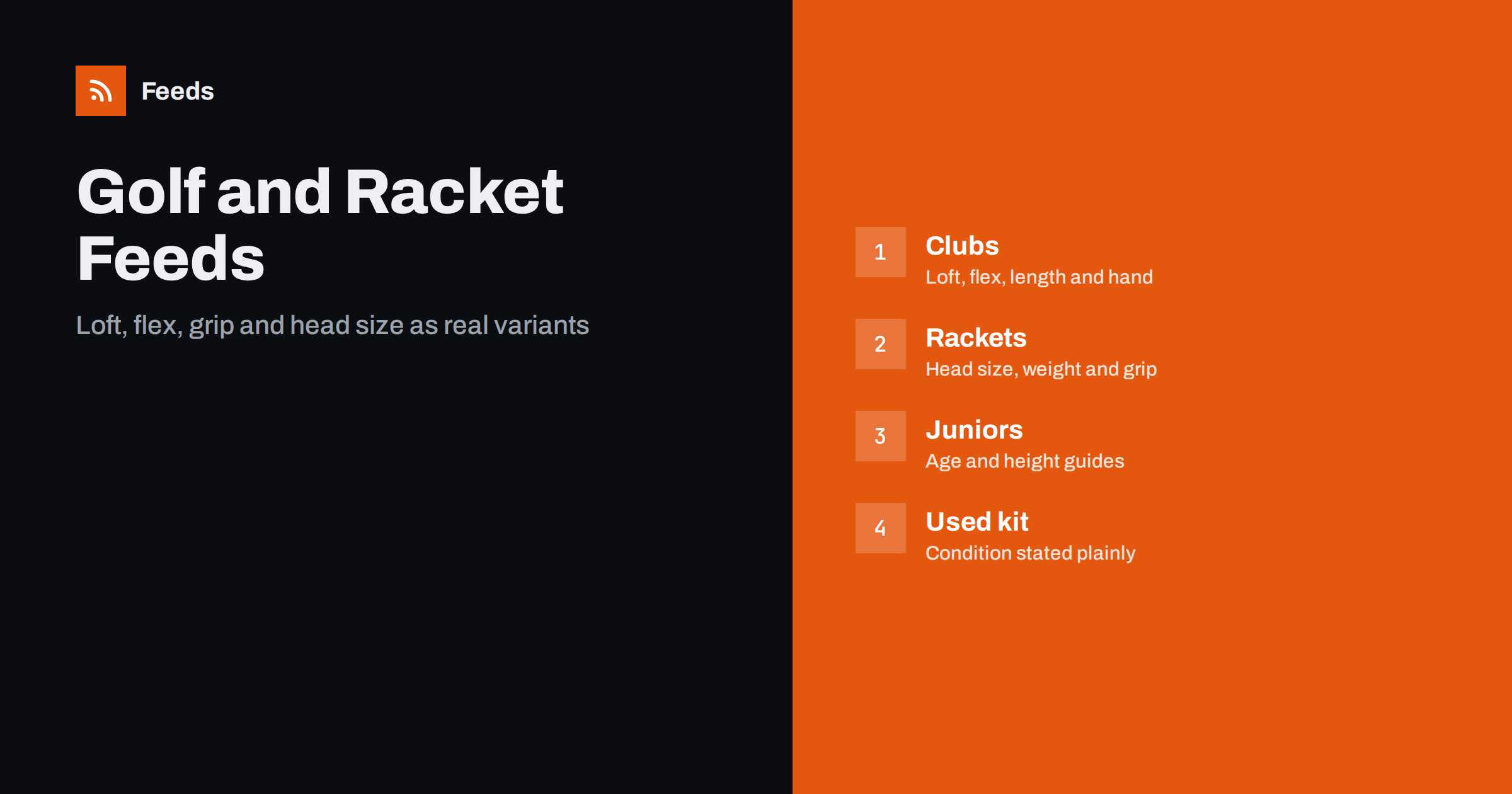
Short answer: Golf clubs and rackets look similar on the shelf and differ in the details that matter to players: loft, shaft flex, length and hand for clubs, head size, weight, balance and grip size for rackets. Each of these differences should be a variant with its own identifier and stock, and the main ones belong in the title. Add age and height guidance for juniors, state the condition of used equipment plainly, avoid unprovable performance promises and keep one consistent title pattern across the catalogue.
Why equipment is bought by detail
A golfer asking for a driver does not mean “any driver”. They want a certain model, a loft that suits their swing, a shaft stiffness and the right hand. A tennis, badminton or squash player is just as specific: a head size, a weight, a string pattern, a grip. Beginners may not know exactly what they need, and they rely on the shop’s description to guide them.
If the feed treats a club or racket as a single item with a colour, shoppers cannot find or compare what they need, and customers receive the wrong item. Treat the specifications as data, not as decoration. This is the same approach as for other equipment-heavy categories, such as cycling and sports and outdoor products, with the details of this sport.
Golf clubs: the variants that matter
A club may come in several lofts, lengths, shaft flexes and hands. A set of irons has a number of clubs in it, for example 5 to pitching wedge. Make each purchasable combination a separate product with its own identifier, price and stock, and link them with a shared group identifier. The way the grouping works is described in product variants in feeds.
- Title: club type, brand, model, year if relevant, and the key spec: “Driver Brand Model 2025, 10.5 Degree, Regular Flex, Right Hand”.
- Attributes: loft, shaft material and flex, length where it differs from standard, hand, and the set composition for irons.
- Sets: list what is included. “Complete beginner set: driver, fairway wood, hybrid, five irons, putter and bag” is a factual title.
Remember that model years matter. A shopper looking for the current model should not find last year’s version without knowing it. Put the year in the title and mark older models clearly, or remove them when you can no longer supply them.
Rackets: head size, weight, balance and grip
For tennis, squash, badminton and padel rackets the key data are different: head size, weight (often unstrung), balance, string pattern, length and grip size. Grip sizes are variants in the same way as shoe sizes: each has its own stock. Where the racket is sold strung or unstrung, treat that as a variant or state it clearly in the title.
Use the same units that your market uses: grams or ounces, square centimetres or square inches, and the grip sizing system your customers know. Say what the unit is, and be consistent in the feed. If you offer a stringing service, keep it as a separate product or a clear note on the page, not as a hidden condition in the title. For apparel, shoes and similar sizing issues, see apparel product feed attributes and product feeds for footwear.
Balls, grips and consumables
Balls, tees, grips, strings and overgrips are bought repeatedly, in packs. State the quantity exactly, such as a dozen balls, a tube of three, a reel of 200 metres, and make sure the price and the unit are clear. Where a barcode exists, as it does for most balls and many accessories, provide the GTIN with the brand. The rules on identifiers are in GTIN, MPN and brand in feeds, and the handling of packs is in bundles and multipacks in product feeds.
For items of the same kind in several colours or compounds, each colour or compound is a variant. If you sell a pack that mixes colours, say so in the title rather than choosing one colour for the image. Unit prices, such as price per ball, are a common expectation for these products in some markets; see unit pricing in product feeds.
Juniors and beginners
Children grow, and equipment for them is chosen by age, height or arm length. A feed that offers only “junior” without any guide leads to a second purchase or a return. Give the intended age range and height range, with a size guide on the page, and make the variants easy to tell apart. Specific junior sets, with clubs of different lengths, should list what is included and the height range they suit.
For adults who are new to the game, a short, honest description helps more than technical terms. “Forgiving clubs for beginners and occasional players” is useful if it is true. Do not promise that equipment will improve a handicap or add distance. Performance depends on the player, and a claim you cannot support invites disappointment and complaints.
Used, demo and refurbished equipment
Used clubs and rackets are a large market. If you sell them, state the condition plainly: new, used or refurbished, and describe wear, such as marks on the sole, grip condition and any replacement of parts. A photograph of the actual item is better than a stock image. Use the condition attribute correctly and do not mix new and used items under the same identifier. The guidance in used and refurbished products in feeds applies, and honesty about wear protects you from returns.
Demo and display items need the same care: say that they are demo items, with the reason for the discount, and make sure the price and the condition match the page. A used item priced as new, or a new item described as used, creates trouble with platforms and customers alike.
Seasons, custom fitting and campaigns
Golf and racket sports sell in seasons: clubs and balls rise in spring, indoor racket sports in autumn, and gifts before the holidays. Plan the feed around them. Add new models as soon as they are available, retire old ones when stock runs out and tell campaigns which products matter most using custom labels, such as best sellers, new models and clearance. The idea is explained in the guide to custom labels for shopping campaigns.
If you offer custom fitting, keep it as a service described on your own pages rather than as a hidden requirement of a product. A fitted club that is made to order should be described as such, with the lead time stated clearly, and should not appear as in stock if it is not.
Conformity claims, images and shipping
Governing bodies publish rules on equipment for competitive play, and shoppers sometimes ask whether an item is allowed. Only say that a product conforms to a rule if you have checked it against the current list of the body in question, and name the rule or list. Equipment changes, and so do rules.
Show the product as it is, from the angles that matter: the face and back of a club head, the shaft and grip, the racket head and frame. Keep images in line with the platform’s rules, as listed in product feed image requirements. Long boxes for clubs and bags are bulky and may cost more to ship; set the shipping to match, as explained in shipping in product feeds.
How RSS Feed Creator helps
RSS Feed Creator builds Google Merchant Center and Meta catalog XML straight from your store. WooCommerce and Shopify are read automatically, and any other store can use a CSV link. You can skip out-of-stock products, rewrite titles with rules so that the club or racket type, model, year and key specification appear in the same order every time, and adjust prices. The currency is detected automatically. Before you submit anything, check the preview and the Merchant Center diagnostics to confirm that lofts, flexes, grip sizes and used items arrive as you expect. The free plan includes product feeds with up to 50 products, and the Store plan covers one store with 3 product feeds and up to 2,000 products. The details are on the pricing page.
Related reading
- Product Feed Title Optimization: Formulas That Work
- Product Feed Checklist: What to Verify Before You Submit
- Custom Labels for Shopping Campaigns: How to Use Them
The bottom line
A golf and racket sports feed is a specification sheet that shoppers can search. Make loft, flex, hand, head size, weight and grip into variants, state the model year and the condition, give juniors proper size guidance, keep performance claims modest and support conformity statements with a source. Players who get the right spec the first time stay loyal.
FAQ
Should every club loft and shaft flex be a separate product?
Yes, each purchasable combination should have its own identifier, price and stock, and be linked to the others with a shared group identifier. State the key values in the title.
How do I list racket grip sizes?
As variants of the same racket, each with its own stock, using the sizing system your customers know. Say whether the racket is sold strung or unstrung.
What should I put in the title of a junior set?
The type of set, the brand, the intended age or height range and a short list of what is included. A size guide on the product page should agree with the feed.
How should I describe used clubs and rackets?
Mark them as used or refurbished, describe visible wear and any replaced parts, and photograph the actual item. Never list used equipment under the identifier of a new product.
Can I say that equipment is tournament legal?
Only if you have checked it against the current official list or rule and can name it. Equipment and rules change, so verify again when models or rules are updated.