ENEnglish
 LTLietuviškai
 DEDeutsch
 FRFrançais
 RUРусский
 ESEspañol
 PLPolski
 ITItaliano
 UKУкраїнська
 CSČeština
 PTPortuguês
 JA日本語
 LVLatviešu valoda
 ETEesti
 HUMagyar
 IDBahasa Indonesia
 TRTürkçe
 HIहिन्दी
 ELΕλληνικά
 ARالعربية
 THไทย
 VITiếng Việt
 RORomână
 MSBahasa Melayu
 BNবাংলা
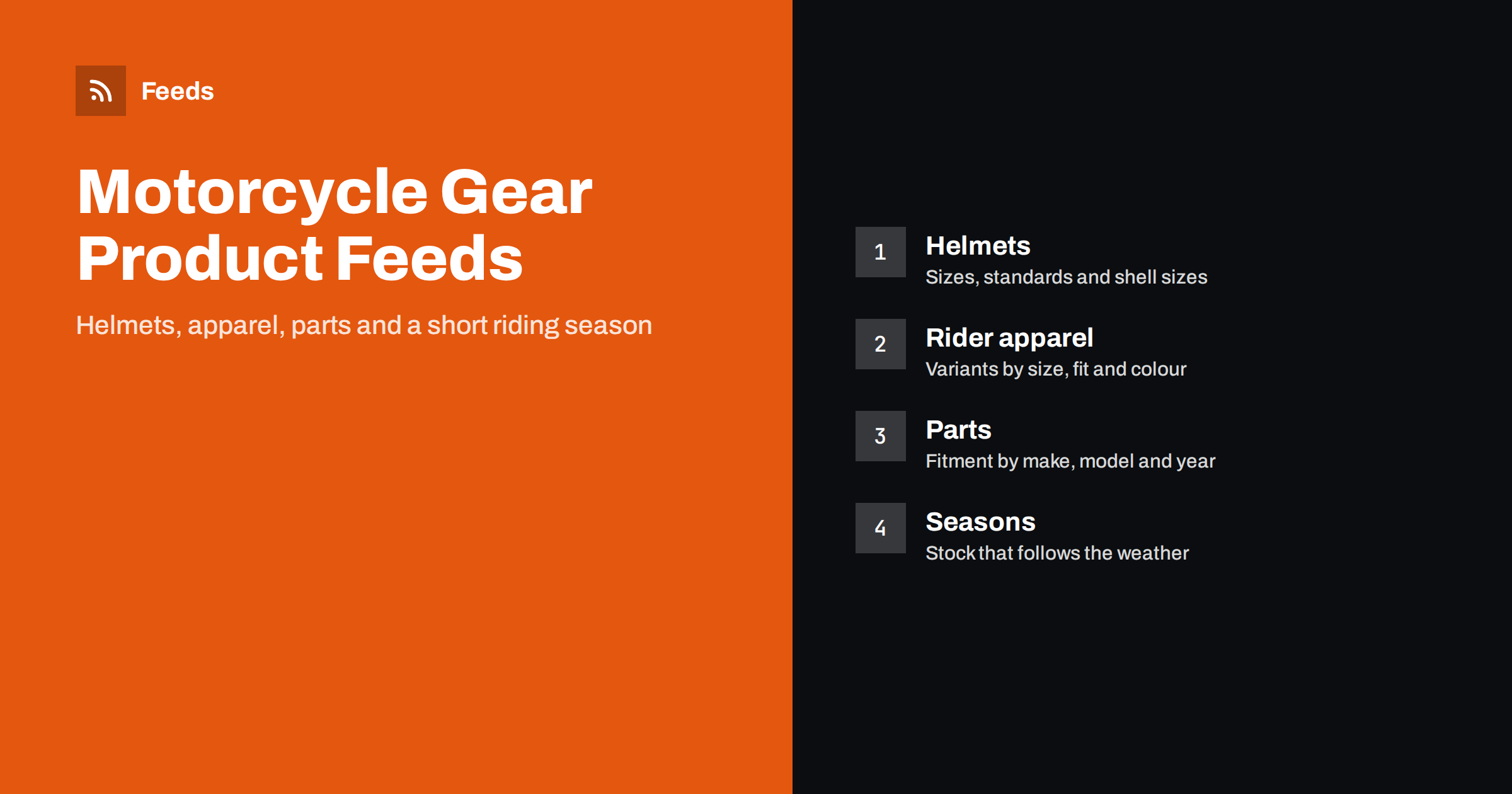
Short answer: A motorcycle and powersports store sells three very different kinds of product: protective gear with strict sizing and safety standards, apparel with many variants, and parts that only fit certain machines. A feed that works treats each group differently. Give helmets and apparel complete size, colour and variant data, put the fitment of every part into the title and the product type, keep identifiers accurate, and let stock and seasonality drive what is visible. Do that and Google Merchant Center and Meta have what they need to show the right rider the right item.
Why this niche is harder than it looks
On paper a motorcycle shop is just another store with a catalogue. In practice the catalogue mixes products that behave like clothing, products that behave like car parts and products that behave like safety equipment. A single jacket can come in six sizes, three colours and two fits. A brake pad is useless if it does not match the model and year. A helmet has a shell size, a head size and a safety rating, and a customer who buys the wrong one will return it.
Each of these has a different way of going wrong in a feed. Apparel fails on variants, parts fail on fitment, and helmets fail on missing data that shoppers expect to see. Before you touch the details, it helps to have the basics in place: the required attributes are listed in Google product feed attributes, and a quick audit of your own feed against the product feed checklist catches the obvious gaps.
Helmets: size, standard and shell
A helmet listing should answer the questions a rider would ask in a shop. What size is it, which standard does it meet, what type is it and what colour? In the feed, that means a size value for every variant (for example S, M, L or a head circumference range), a clear colour, and a title that carries the type: full face, modular, open face or off-road. Safety standards differ between markets, and a rider in Europe and a rider in the United States look for different marks, so state the standard that applies to the market you are selling in and keep it consistent between the page and the feed.
Many helmets are sold with several shell sizes and one name. Do not hide that behind one product. Use a shared group identifier for all variants of the same model and one row per size and colour, so that each variant has its own price, stock level and identifier. How the grouping works is explained in product variants in feeds.
Rider apparel: jackets, gloves, boots and trousers
Apparel is where most motorcycle feeds break, because riders’ clothing has more sizing systems than ordinary fashion. Jackets may use letters, numbers or both. Boots use shoe sizes that differ between men and women. Gloves are often sold by a letter size that does not match the hand measurements. In the feed, you need the same discipline as any apparel store: a size, a gender, an age group where relevant, a colour and a material, with the right size system for the target country.
Keep the title built the same way every time: brand, product type, model, the key feature and then the variant details. A title such as “Brand Name Waterproof Touring Jacket, Men, Black, L” gives the shopper more than “Touring jacket”. The general rules are in apparel product feeds and footwear product feeds, and the formulas behind good titles are in product feed title optimization.
Protective features deserve a place in the description and the title when they matter, such as removable armour, a waterproof membrane, reflective panels or a stated protection level. Only claim what the manufacturer states, and never imply a protection level the product does not have.
Parts and accessories: fitment is the product
For parts, the machine is part of the product. A chain that fits one model does not fit another, and a feed that omits this produces clicks from the wrong people and returns from the right ones. The practical approach is to put the make, model and year range into the title or the product type, and to repeat the manufacturer part number in the MPN field. The same logic is described in more detail for cars in auto parts product feeds, and most of it applies directly to motorcycles.
When one part fits many machines, do not list them all in the title. Use the product type to hold the category and the most common fitment, and put the full compatibility list on the product page, where it can be read in full. If one item is sold in different versions for different machines, make each a separate product with its own identifier. Mixing them under one listing is the fastest way to disapprovals and wrong orders.
Identifiers: GTIN, MPN and brand
Gear brands are well known, and most branded items have a barcode. Provide the GTIN where the manufacturer printed one on the box, the MPN as the manufacturer’s own number and the brand exactly as the manufacturer writes it. For parts, the MPN is often the most important identifier, because buyers search by it. Do not invent a GTIN for an item that has none, and do not reuse the code of another size or colour. The full picture is in GTIN, MPN and brand in feeds.
Bulky items, shipping and returns
Some powersports items are large or heavy: frames, exhaust systems, trailers, ramps, wheels and complete helmets in oversized boxes. Shipping costs vary, and a price that looks good in the listing but triggers a surprising delivery charge at checkout is a common cause of disapprovals and of unhappy customers. Make sure the shipping information that Google sees matches what your checkout charges; the choice between account settings and feed attributes is covered in shipping in product feeds. Free-shipping thresholds, weight bands and separate rates for large items belong there.
Return conditions matter more than usual in this niche, since sizes are hard to judge. A visible, honest returns policy helps the shopper and, for clothing and helmets, reduces the cost of exchanges.
Seasons and stock
Riding is seasonal in most climates, so stock moves in waves: gloves and heated gear in autumn, mesh jackets and visors in spring, tyres and chains at the start of the season. Mark products as out of stock as soon as they are, and keep the quantity in the feed in line with the shop. Showing an item that sold out last week costs a click, a refund of goodwill and sometimes a warning in Merchant Center; the reasoning is in out-of-stock products in your feed and in availability mismatch in Merchant Center.
Plan for the start of the season. Review titles and images a month earlier, check that last year’s discontinued products are gone and that new models are in the feed before the first warm weekend, not after it.
Images and pages
Show the product on a plain background, in its true colour, from the front, and add extra images for details such as armour, vents and visors. Do not use images with watermarks or promotional text. The product page must show the same price, size options and availability as the feed. The details are in product feed image requirements and product landing pages.
How RSS Feed Creator helps
RSS Feed Creator builds Google Merchant Center and Meta catalog XML straight from your store. WooCommerce and Shopify are read automatically, and any other store can use a CSV link. You can skip out-of-stock products, which keeps sold-out helmets and off-season stock out of the feed, rewrite titles with rules so that the brand, type, size and colour appear in the same order every time, and adjust prices. The currency is detected automatically. Before you submit anything, check the preview and the Merchant Center diagnostics to confirm that identifiers and variants arrive as you expect. The free plan includes product feeds with up to 50 products, and the Store plan covers one store with 3 product feeds and up to 2,000 products. The details are on the pricing page.
Related reading
- Product Feeds for Sports and Outdoor Stores: What to Include
- Product Feeds for Bicycle and Cycling Shops: A Guide
- 12 Product Feed Mistakes That Quietly Cost You Sales
The bottom line
A motorcycle gear feed succeeds when every product type gets the data it needs: complete sizes and variants for helmets and apparel, exact fitment and part numbers for parts, honest shipping for bulky items and live stock through the riding season. Build one clean title pattern, keep identifiers real and check the diagnostics after each change.
FAQ
How should I list a helmet that comes in several sizes and colours?
Create one row for each size and colour, give every row its own identifier, price and stock, and link them with the same group identifier. Include the type of helmet in the title, and state the safety standard that applies in your market.
Where do I put motorcycle fitment in a product feed?
For parts, put the make, model and year range in the title or the product type, repeat the manufacturer part number in the MPN field and keep the full compatibility list on the product page. Separate versions for different machines should be separate products.
Do rider clothes need the same attributes as normal clothing?
Yes. Jackets, gloves, boots and trousers need size, gender, colour, material and, where relevant, age group and size system. Riders’ clothing has more sizing systems than ordinary fashion, so consistency matters.
What should I do with seasonal stock?
Mark items out of stock as soon as they sell out, remove discontinued products and review titles and images before the season starts. Stock that is shown but not available causes availability mismatches.
Can I use one feed for Google and Meta?
Often yes. The Google product XML format is read by Meta as well, but check each platform’s diagnostics, since they can accept different values for the same attribute.