ENEnglish
 LTLietuviškai
 DEDeutsch
 FRFrançais
 RUРусский
 ESEspañol
 PLPolski
 ITItaliano
 UKУкраїнська
 CSČeština
 PTPortuguês
 JA日本語
 LVLatviešu valoda
 ETEesti
 HUMagyar
 IDBahasa Indonesia
 TRTürkçe
 HIहिन्दी
 ELΕλληνικά
 ARالعربية
 THไทย
 VITiếng Việt
 RORomână
 MSBahasa Melayu
 BNবাংলা
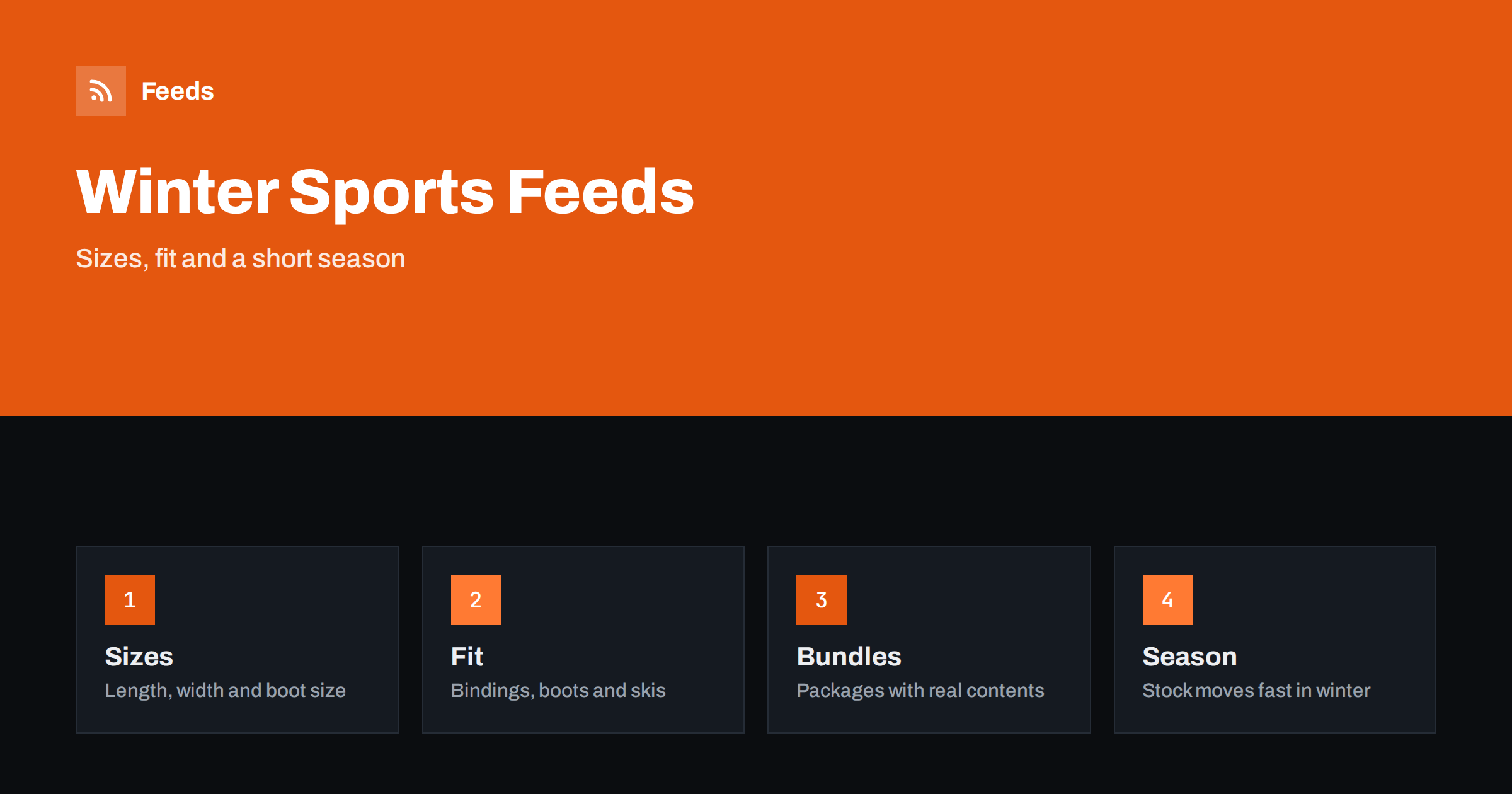
Short answer: Winter sports gear is sold in a short, intense season, and a lot of it only works as a system: skis need compatible bindings, boots need the right sole and flex, and helmets and goggles need to fit together. A good product feed shows the length, width, size and fit information in a consistent order, keeps each size as a separate variant, labels packages by what is actually included and tells the truth about stock while the season is moving fast. The feed will not fit a customer, but it can stop most mismatches before the click.
Why winter sports feeds are different
A winter sports shop often earns most of its income in a few months. Customers research early, ask detailed questions and buy in bursts when the first snow appears or a holiday trip is booked. Prices and stock change quickly: a popular size of a boot or a jacket can sell out in days, and last season’s models are discounted as the new range arrives.
The category also has a high cost of mistakes. A ski that is too short or too stiff for the skier, boots that do not match the bindings, a helmet that does not fit under a hood: these lead to returns and unhappy buyers. A feed cannot give advice the way a shop assistant can, but it can make sure that the facts that decide a purchase are visible in titles, attributes and landing pages. The foundations are explained in what a product feed is and Google product feed attributes.
Titles with the facts skiers compare
Use one title pattern per product group, built from the facts that customers search for. For skis that could be brand, model, type, length, and width underfoot where relevant. For boots, brand, model, type, flex and size system. For jackets, brand, model, gender and use, such as ski, touring or snowboard. Keep the exact model name and the model year if different years exist, because customers and review sites refer to them.
Avoid promotional text in titles, and do not pretend that an older model is new. If the same model comes with and without bindings, say so in the title: “ski only” and “with bindings” are different products with different prices. The reasoning behind a consistent pattern is covered in product feed title optimization.
Sizes, lengths and size systems
Every size is a separate variant. A ski in five lengths is five items, a boot in twelve sizes is twelve items, and they should be linked by a shared group identifier so that platforms understand they belong to one product. The details are in how item_group_id works. Make sure that each variant has its own stock, price and, where available, its own identifier.
Boots are the hardest case because several size systems exist. Mondopoint is the length of the foot in centimetres and is widely used for ski boots, while shoes and clothing use other scales and brands differ. State the system you use, add the shell size or last width if you have it, and keep the same convention for all products. The same issues appear in product feeds for shoe stores and apparel product feeds, where attributes such as size system, gender and age group matter.
Fit, compatibility and systems
Winter gear is full of parts that must work together. Bindings must match the boot sole type, and the brake width must suit the ski. Snowboard bindings must match the board’s mounting pattern and the boot size. Goggles are designed for certain helmets, and replacement lenses fit only particular frames. Where the standards are clear, state them in the title or in a labelled attribute, and repeat them on the product page.
Do not use the word “universal” unless you can list exactly what fits. For replacement parts and accessories, give the compatible models explicitly and keep the information up to date when new models appear. The same logic is used in auto parts product feeds, where a wrong fit is the main reason for returns. Safety equipment, such as helmets, back protectors and avalanche gear, needs particular care: copy the certification labels from the manufacturer exactly and never add safety claims of your own.
Packages, rentals and bundles
Shops often sell packages: a beginner snowboard set, a ski and binding package, a clothing set for children, a cross-country starter kit. Each package should be a separate product with its own identifier, a title that lists what is inside and a price that matches the checkout. Do not reuse the identifier of one component. The principles are covered in bundles and multipacks in product feeds.
If you also rent equipment, keep it out of the product feed unless your platform supports it, and make sure rental pages are not mixed with items for sale. Do not describe used or ex-rental gear as new; used and refurbished products in feeds explains how to mark condition properly.
Seasonal stock and honest availability
The season rewards fast data. When a size sells out, the feed should show it quickly; otherwise you pay for clicks that cannot convert and invite availability mismatches. Before the season, make sure that new arrivals have complete data and photos and that pre-season orders are labelled correctly, as described in preorder and backorder products in feeds. During the season, update more often. At the end, handle clearance carefully with sale prices tied to real dates, as in sale prices in product feeds.
Use custom labels to separate groups that need different handling, for example new season, last season, clearance or high margin; see custom labels in product feeds. Plan the peak well in advance, using the checklist in preparing your product feed for Black Friday and peak season, which also applies to the weeks before the first snow.
Children, growth and second seasons
Children’s winter gear has its own pattern. Families buy for the season and expect to resell or hand down the items, so size ranges are wide and the age or height guide matters more than a single number. Use age group and size attributes consistently, and give height ranges in the description, since children of the same age differ a lot. Skis and boots for growing children are often bought with a trade-in or a rental option, which should be explained on the product page and not hidden in the feed.
Take extra care with claims about safety and fit. Do not promise that a size will last two seasons. A short, practical size guide is more honest, and it also reduces returns after the first fitting at home.
Images and landing pages
Use a clean main image on a plain background, in the correct colour, without overlays or watermarks. For clothing, show the product on its own or on a model without text. Add images of the back, sole and details, which matter for boots and bindings. Rules for image quality are described in product feed image requirements for Google and Meta.
The landing page must match the feed. A shopper who clicks on a 170 cm ski should see that length selected, the correct price and a clear indication of stock. Add a size guide with practical instructions, such as how to measure the foot for a boot, and clear return conditions, because returns are more complicated for boots and skis that have been mounted. The requirements are summarised in what feed links must lead to.
How RSS Feed Creator helps
RSS Feed Creator builds Google Merchant Center and Meta catalog XML straight from your store. WooCommerce and Shopify are read automatically, and any other store can use a CSV link. You can skip out-of-stock products, rewrite titles with rules so that the product type, length, size system and fit information appear in the same order every time, and adjust prices. The currency is detected automatically. Before you submit anything, check the preview and the Merchant Center diagnostics to confirm that size variants, packages and seasonal stock arrive as you expect. The free plan includes product feeds with up to 50 products, and the Store plan covers one store with 3 product feeds and up to 2,000 products. The details are on the pricing page.
Related reading
- Product Feeds for Sports and Outdoor Stores: What to Include
- Product Feed Checklist: 25 Checks Before You Submit
- Out-of-Stock Products in Your Feed: Keep, Mark or Remove?
The bottom line
A winter sports feed works when each size is its own variant, titles state the facts skiers compare, compatibility is explicit, packages say what is inside and stock stays honest during a short, fast season. Prepare the data before the first snow, check it again in peak weeks and keep landing pages consistent with the feed.
FAQ
How should I list skis that come in several lengths?
List each length as a separate item with its own identifier, stock and price, linked by a shared group identifier. Make sure the product page opens on the correct length.
Which size system should I use for ski boots?
State the system clearly, for example Mondopoint in centimetres, and use the same convention across the catalogue. Add shell size or width where you have the data.
How do I list a ski with and without bindings?
As two different products with different identifiers, titles and prices. The title should say “ski only” or “with bindings” so that shoppers are not surprised.
Should I add safety claims to helmets and protectors?
No. Copy the certification labels and statements from the manufacturer exactly and never add safety claims of your own.
How do I handle clearance after the season?
Use sale prices tied to real dates, mark last season’s items with a custom label and do not describe older models as new.