ENEnglish
 LTLietuviškai
 DEDeutsch
 FRFrançais
 RUРусский
 ESEspañol
 PLPolski
 ITItaliano
 UKУкраїнська
 CSČeština
 PTPortuguês
 JA日本語
 LVLatviešu valoda
 ETEesti
 HUMagyar
 IDBahasa Indonesia
 TRTürkçe
 HIहिन्दी
 ELΕλληνικά
 ARالعربية
 THไทย
 VITiếng Việt
 RORomână
 MSBahasa Melayu
 BNবাংলা
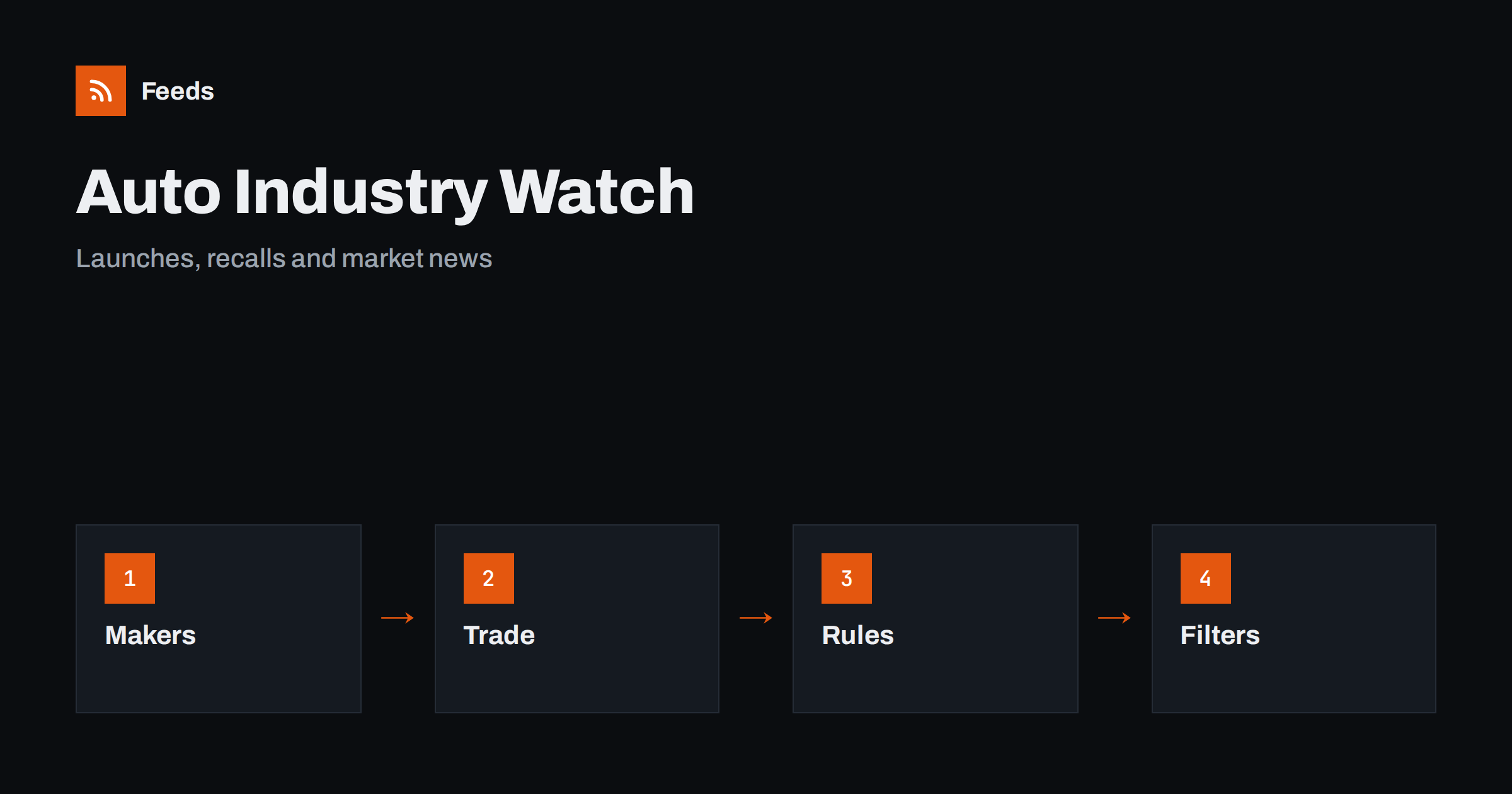
Short answer: Automotive news covers new models and launches, prices and incentives, recalls, safety ratings, emissions and tax rules, charging and fuel trends and the business of manufacturers and dealers. RSS lets you collect the press rooms of brands, trade publications, regulators and specialist blogs into one reader, filter them by brand, model or market, and read them in your own time. It suits dealers, fleet managers, journalists, buyers and enthusiasts, as long as you check the original page for prices, specifications and dates.
Why follow automotive news with a feed
The car market produces an enormous amount of news, and much of it is repeated on dozens of sites with small changes. A buyer wants to know whether a model is coming soon, whether a price has changed or whether a recall affects a car they own. A dealer wants to know about competitor launches and incentives. A fleet manager needs to follow rules and costs. A feed lets each of them read the original reports instead of scrolling through a general news site.
It also reduces the influence of rumours. Many “leaks” about future models turn out to be wrong, and sensational headlines about new technology often skip details. When you follow official press pages and a few reputable publications, you see the facts first and the commentary second. The same primary-source approach is explained in fact-checking with RSS.
Choose your sources by purpose
Start with what you need. Fans and buyers usually want manufacturer press rooms for the brands they like, a few review and news sites and the safety rating bodies. Dealers add competitors’ pages, local market news and used-car price commentary. Fleet and business users add rules on emissions, company car taxes, charging infrastructure and road charges. Journalists add industry associations and company results.
Keep the list short at the beginning, ten to fifteen sources are enough, and group them by purpose: launches, recalls, rules, market and local. Include at least a couple of sources that are critical of the industry, so that you see both promotion and scrutiny. If a source rarely publishes anything useful, remove it after a month.
Find feeds for brand press rooms
Many manufacturers have a media or press room with news, photos and releases, and some offer RSS feeds. Look for a feed icon or a link labelled RSS, and check the page source for a feed link. Local importers and national branches often have their own press pages with market-specific information, such as prices and availability, which differ from the global site.
Where a press room has no feed, create one from the list of releases on the page. Choose the page that lists items in date order, not the home page. The methods are in how to find the RSS feed of any website, and the page-based approach in how page-to-feed tools find the articles on a web page. Use official domains and check that the page is the right country version for you.
Merge and filter by brand, model and market
Once you have your sources, merge them into one reading list and filter. Brand and model names are the obvious keywords. Add topic words such as “recall”, “price”, “launch”, “facelift”, “electric”, “hybrid”, “charging” and “safety rating”, and add the country or region you care about. Exclude items about brands or segments that do not concern you, such as motorsport results if you want only road cars.
Review the filter after two weeks. Model names change with generations, and a model may carry different names in different markets, so check the terms you use. The mechanics are explained in merging multiple RSS feeds into one clean feed and RSS keyword alerts, and more ways to cut noise in how to reduce RSS alert noise.
A practical setup is to create three lists in your reader: “launches and models”, “safety and rules” and “market and business”. Check the safety list daily or whenever you receive an alert, the launch list a few times a week and the market list at your convenience. Separating them keeps urgent items from drowning in a stream of promotional news, and it makes it easier to share only the relevant list with colleagues.
Recalls and safety notices
Recalls matter more than almost any other automotive news, because they concern the safety of people and the value of cars. Vehicle safety authorities and consumer agencies publish recall notices, and manufacturers publish owner information. If you own, sell or manage vehicles, follow these pages and check the details against the vehicle identification number, since a recall often affects only a certain production period.
The general approach to such alerts is described in tracking product recalls and safety notices with RSS. A feed tells you that a notice exists; the notice tells you what to do. Contact an authorised dealer or the manufacturer through official channels, and do not rely on a summary posted elsewhere. Dealers should keep a record of which notices they have seen and how they responded.
Rules, taxes and charging
Business and private owners are affected by rules on emissions, low-emission zones, vehicle taxes, company car benefits, inspection requirements and charging infrastructure. These change often and differ by country and city. Ministries of transport, tax authorities, environmental agencies and local councils publish them, and many have feeds or news pages that can be turned into feeds.
For a business, follow the pages that concern your fleet and routes. The approach is similar to tracking regulator updates with RSS. Note the date a rule takes effect, read the official text and, where costs are significant, ask an adviser. Related infrastructure news, such as roadworks and closures, can be followed with road works and traffic disruption alerts.
Competitors, launches and pricing
If you sell cars or services, competitor news is useful: new models, updated price lists, incentives and changes to warranty or financing offers. Follow competitor press rooms, local dealer news pages and classified listings where it is lawful and sensible to do so. Be careful to use public information only and to avoid acting on rumours.
The general methods are in tracking new products on competitor online stores and alerts for new classified ads and auction lots. For new products that go through crowdfunding or early announcements, following crowdfunding campaigns and product launches may also help. Always check official price lists and specifications before you quote them to a customer.
Read launches and reviews critically
Launch announcements are marketing. They highlight strengths and use selected figures, and range, consumption and performance numbers are measured under standard test conditions that differ from real use. Compare the claims with independent tests, owner reports and official safety ratings. Note the date, the market and the version of the car, since specifications and prices differ between variants and countries.
Keep your own interpretation separate from the facts. A positive first drive is an opinion; a price list is a fact; a rumoured launch date is a guess. If you plan to buy or to advise others to buy, read the official specification sheet and visit a dealer. A feed helps you stay informed, but a purchase decision needs more than headlines.
How RSS Feed Creator helps
RSS Feed Creator turns the press room, news or recall page of a manufacturer, regulator or trade body into a clean RSS feed, even when the site has no feed of its own. It reads titles, images, summaries and dates, uses an existing feed when there is one, and shows a preview of the items before the feed is created. You can merge several sources into one feed (up to 10 with the PostRSS add-on), keep only the items that contain your keywords and have duplicates removed automatically, which suits a themed watch on brands, models or rules. Feeds refresh every 3 hours on the free plan and every 30 minutes on paid plans, and the PostRSS add-on sends an alert when a page changes and a feed stops finding items. The free plan allows up to 20 items per feed, and the details are on the pricing page.
Related reading
- Content Automation for Car Dealerships: Stock to Social
- How to Track New Book, Game and Music Releases with RSS
- Commodity Prices and Supply Chain News: Follow Them with RSS
The bottom line
To follow automotive news with RSS, pick a short set of official press rooms, trade sources and regulators, merge them, filter by brand, model and market and keep recalls and rules in separate lists. Read launches as marketing, check specifications and prices on the official page and act on safety notices through official channels. The feed brings the news to you, and your own judgment turns it into good decisions.
GYIK
Which sources should I follow first?
Start with the press rooms of the brands you care about, your national vehicle safety authority, a few reputable automotive publications and the transport pages that affect your area.
Do car manufacturers offer RSS feeds?
Some do. Where they do not, a page-to-feed tool can read the list of releases on the press page and build a feed. Check the preview and use the right country version.
How can I follow recalls for my own car?
Follow the safety authority and the manufacturer’s owner page, then check the notice against your vehicle identification number and contact an authorised dealer through official channels.
Can I trust rumours about upcoming models?
Treat them as guesses until the manufacturer confirms. Official press pages and reliable trade media are better sources for dates, prices and specifications.
Can dealers use feeds to watch competitors?
Yes, using public pages such as press rooms, price lists and news. Check details before quoting them to customers, and avoid acting on unverified information.