ENEnglish
 LTLietuviškai
 DEDeutsch
 FRFrançais
 RUРусский
 ESEspañol
 PLPolski
 ITItaliano
 UKУкраїнська
 CSČeština
 PTPortuguês
 JA日本語
JA日本語 LVLatviešu valoda
 ETEesti
 HUMagyar
 IDBahasa Indonesia
 TRTürkçe
 HIहिन्दी
 ELΕλληνικά
 ARالعربية
 THไทย
THไทย VITiếng Việt
 RORomână
 MSBahasa Melayu
 BNবাংলা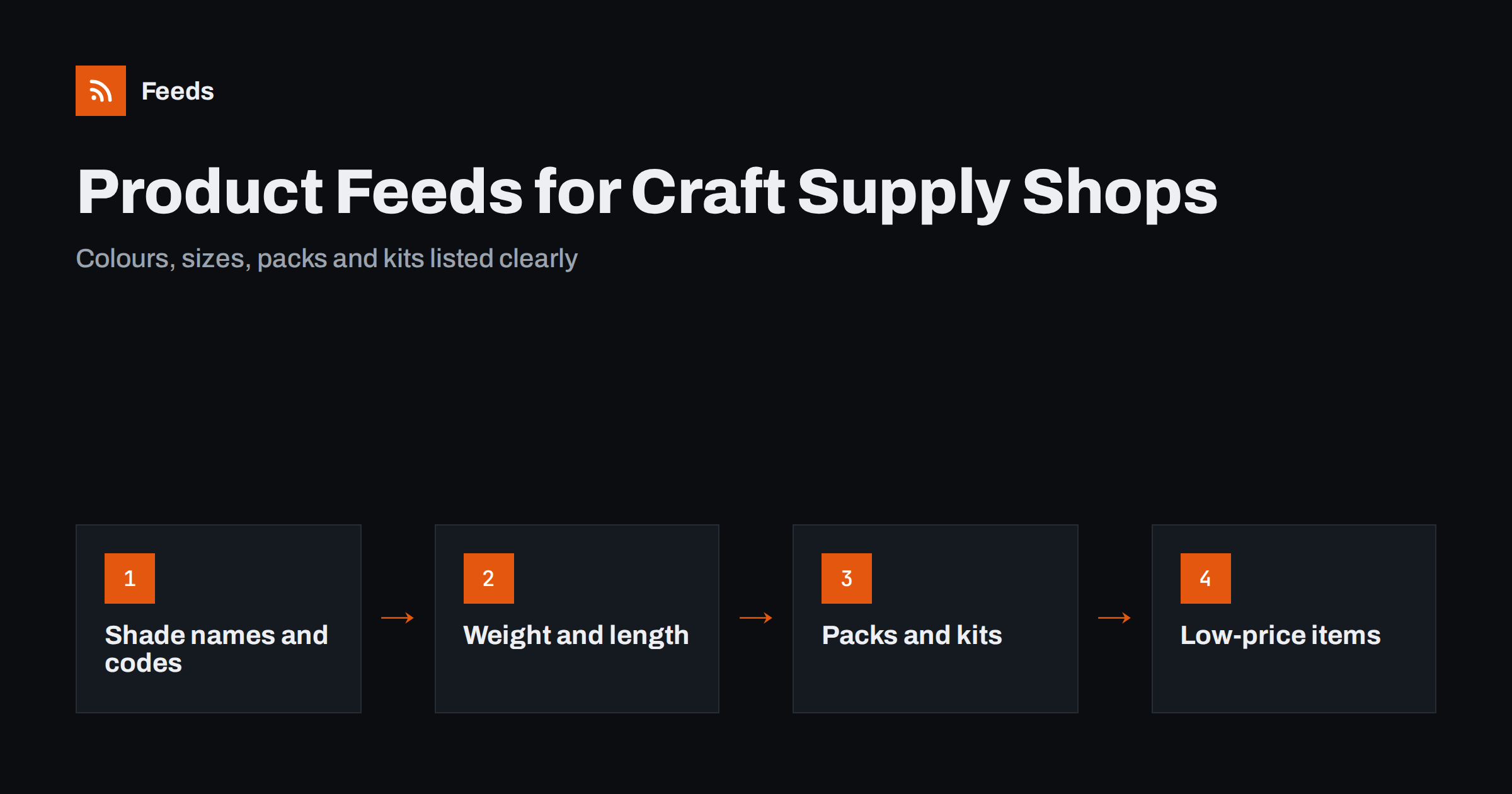
Short answer: Craft and hobby feeds work when each listing names the brand, product line, colour or shade code, and the amount, such as grams, metres or pieces. List each colour as its own item grouped under one item_group_id, use the brand’s GTINs where products have them, show unit prices for goods sold by weight or length, and describe packs and kits precisely. Because many items are cheap, focus advertising on products and bundles where the margin covers the click.
Why craft supply feeds are tricky
Craft and hobby shops, selling yarn, fabric, paints, beads, paper, model kits or sewing supplies, often have very large catalogs of very similar products. One yarn line may come in sixty colours; one acrylic paint range in a hundred shades; beads in dozens of sizes and finishes. Each one is a separate product to the buyer, and buyers know exactly which one they want.
Many products are also inexpensive. A skein of yarn or a tube of paint may cost less than a takeaway coffee, so an ad click that brings a single small order may not pay for itself. A good craft feed therefore needs both precise data and a clear plan for which products to promote.
Shoppers in this category are often experienced makers following a pattern or a project. They search for a brand and line, a colour name or number, a fibre or a size, and they need to be sure the item matches what the pattern requires.
Titles with brand, line, colour and amount
A practical title pattern is: brand, product line, product type, colour name and code, and amount or size. For example:
- “Example Yarns Merino DK Yarn, Colour 214 Forest Green, 50 g”
- “Example Paints Heavy Body Acrylic Paint, Cadmium Red Hue, 59 ml”
- “Glass Seed Beads Size 11/0, Matte Black, 20 g”
- “Cotton Quilting Fabric, Small Floral Blue, Price per 0.5 m”
Colour codes matter. Many makers search for or check the manufacturer’s shade number, because names vary between ranges and languages. Put both the name and the code in the title when the brand uses codes, and use the color attribute for the colour name. The general rules for titles are in product feed title optimization.
Include the amount every time. “Merino yarn” without the weight, or “acrylic paint” without the volume, makes prices impossible to compare and leads to wrong orders.
Colours and sizes as variants
Every colour, size or finish that the buyer chooses separately should be its own item with its own id, price, availability and image. Group the items of one product line with a shared item_group_id so platforms know they belong together.
- Yarn: one item per colour, with the weight per ball or skein.
- Paint: one item per shade and tube size.
- Beads: one item per size, colour and finish.
- Needles, hooks and tools: one item per size, using the size attribute.
With large colour ranges, grouping keeps shopping results tidy and lets shoppers switch colours on the product page. It is explained in product variants in feeds and how item_group_id works.
Images are especially important for colours. Each colour item should show that colour, photographed in neutral light, and the main image should be the product itself, not a finished project. Project photos are valuable as additional images. See product feed image requirements for Google and Meta.
Weight, length and unit prices
Many craft supplies are sold by weight, length or volume: yarn by the ball, fabric by the metre, paint by the tube, clay by the block. Buyers compare price per amount, and in many countries, including those in the European Union, shops are required to show unit prices for such goods.
The unit_pricing_measure and unit_pricing_base_measure attributes let shopping platforms show the price per 100 g, per metre or per 100 ml. Fabric sold by length needs particular care: decide what one feed item represents, for example 0.5 m or 1 m, set the price for exactly that amount, and say so in the title and description. The details are in unit pricing in product feeds: measures and base units.
| Termék | What one item should be | Useful unit price |
|---|---|---|
| Yarn | One ball or skein of one colour | Per 100 g |
| Fabric | A fixed length, such as 0.5 m or 1 m | Per metre |
| Paint | One tube or pot in one shade and size | Per 100 ml |
| Beads | One bag or tube of a fixed weight or count | Per 10 g or per piece |
| Craft kits | The complete kit | Not needed; list contents |
Packs, sets and kits
Craft shops sell many combinations: multipacks of the same item, colour sets, starter sets and complete project kits. Each needs to be described so that the buyer knows exactly what arrives.
- Multipacks. A pack of ten identical balls of yarn is a multipack. Set the multipack attribute to the number of items and the price for the whole pack.
- Colour sets. A set of 12 paint shades is a bundle or set. List the shades or the set name, and the size of each item.
- Project kits. A knitting or embroidery kit includes materials and a pattern. List the main contents and the skill level in the description.
- Kits for children. If a kit is aimed at children, use the age group attribute where it applies and follow safety labelling rules for your market.
The difference between bundles and multipacks, and how to mark each, is explained in bundles and multipacks in product feeds.
Identifiers, brands and dye lots
Branded craft supplies, such as paints, yarns, tools and kits from established manufacturers, usually have GTINs. Use them, together with the brand, so platforms can match your listing to searches and compare offers. Your own products, such as hand-dyed yarn, self-cut fabric pieces or kits you assemble, often have no GTIN; leave the field empty and set identifier_exists to “no”. See GTIN, MPN and brand explained.
Dye lots are a special case for yarn and fabric. Colours can vary slightly between production batches, and knitters often need several balls from the same lot. Feeds have no standard dye lot attribute, so mention on the product page how you handle lots, for example whether a single order is always sent from one lot. Hand-dyed products, which vary by nature, are covered in product feeds for handmade and custom products.
Making low-price items pay
A catalog of thousands of inexpensive items needs a clear advertising strategy, otherwise budget spreads across clicks that bring tiny orders.
- Segment with custom labels. Label products by margin, price band or bestseller status, so campaigns can bid more on items that pay and less on the rest. See custom labels in product feeds.
- Promote sets, kits and multipacks. They have higher order values and often better margins than single items.
- Know your real margin. Including cost of goods data helps you see which products are profitable to advertise, as explained in cost of goods sold in product feeds.
- Be clear about shipping. If you have a minimum order or free shipping above a threshold, show the costs correctly; surprise shipping charges on small orders cause abandoned checkouts. See shipping in product feeds.
- Exclude what never sells. Very cheap accessories may be better left out of paid campaigns entirely, while staying in free listings.
Keeping a large catalog in sync
With hundreds of colours and frequent restocks, manual feeds fall behind within days. The feed should be generated from the store and refreshed automatically, so new colours appear and sold-out shades disappear without manual edits.
RSS Feed Creator creates Google Merchant Center and Meta catalog XML feeds straight from a WooCommerce or Shopify store, or from a CSV file link for other platforms. It can skip out-of-stock products, apply title and price rules, and detects the currency automatically. You see a preview before the feed is created, and it refreshes on its own. The product limits of each plan are on the pricing page.
Related reading
- Which products to exclude from your feed and how to do it
- How to write product descriptions for shopping feeds
- Out-of-stock products in your feed: keep, mark or remove
The bottom line
Craft and hobby feeds succeed when each item is unambiguous: brand, line, colour name and code, and amount in the title, one item per colour and size, grouped by item_group_id, with GTINs where they exist and unit prices for goods sold by weight or length. Describe packs and kits exactly, use true-colour images, and focus advertising on sets, bestsellers and products whose margin covers the click.
GYIK
Should every yarn or paint colour be a separate product in the feed?
Yes. Each colour has its own availability and image, and buyers search for specific shades. List each colour as its own item and group the whole range with one item_group_id.
How do I list fabric sold by the metre?
Decide what one item represents, such as 0.5 m or 1 m, and set the price for exactly that length. Say it in the title and description, and use the unit pricing attributes so the price per metre is shown.
Do craft supplies need GTINs?
Branded supplies from manufacturers usually have GTINs and should include them. Products you make or assemble yourself, such as hand-dyed yarn or your own kits, often have none; leave GTIN empty and set identifier_exists to no.
How should I describe a craft kit in a feed?
Name the kit and the project in the title, list the main contents and skill level in the description, and show the finished project and the contents in the images. If the kit is for children, use the age group attribute where it applies.
Is it worth advertising very cheap craft items?
Often not on their own. Focus paid campaigns on sets, kits, multipacks and bestsellers with good margins, and use custom labels to bid less on low-value items, while keeping them in free listings.