ENEnglish
 LTLietuviškai
 DEDeutsch
 FRFrançais
 RUРусский
 ESEspañol
 PLPolski
 ITItaliano
 UKУкраїнська
 CSČeština
 PTPortuguês
 JA日本語
 LVLatviešu valoda
 ETEesti
 HUMagyar
 IDBahasa Indonesia
 TRTürkçe
 HIहिन्दी
 ELΕλληνικά
 ARالعربية
 THไทย
 VITiếng Việt
 RORomână
 MSBahasa Melayu
 BNবাংলা
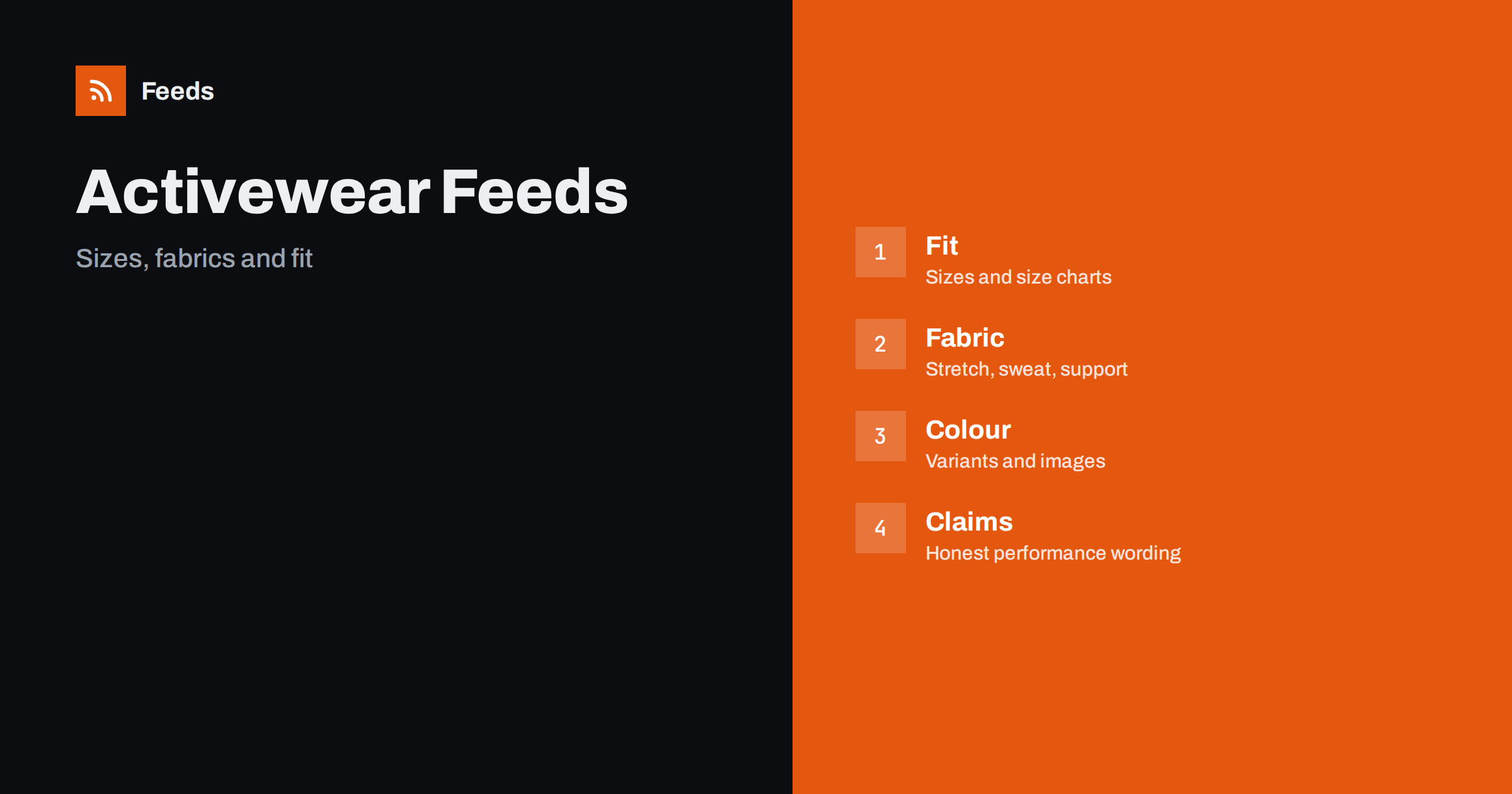
Short answer: Activewear and yoga clothing sell on fit, fabric and function, and a feed that leaves out any of the three produces returns and disapprovals. Lead the title with the garment type, the activity and the fit, give every size and colour its own variant, state the fabric and the support level clearly, and keep performance claims honest. A clear feed helps the shopper to find the right size on the first try.
Why activewear feeds need care
Sports clothing is bought for a purpose: running, yoga, the gym, cycling or a walk. The shopper wants to know whether the leggings are opaque when bending, whether the top supports the activity and whether the size fits a body that moves. Photos help, but the feed and the product page must say the same, in words, in the same order for every item.
It is also an apparel category, which means size, colour, gender and age group are required in many markets. The general rules are in apparel product feed attributes, and this article adds what is specific to sports and yoga clothing.
Titles that lead with garment, activity and fit
Start the title with the product type and add the activity, the fit and the key feature, for example high-waist yoga leggings or a seamless sports bra with medium support. Add the brand according to your catalogue rule and put the colour near the end. Avoid a title that is a list of search words, because it reads badly and often breaks the rules.
Keep the order the same for every product so that the catalogue is easy to check. The title is the line that shoppers read first, and a clear one reduces the questions to your customer service. Product feed title optimization explains the pattern, and writing product feed descriptions covers the text below it.
Sizes, size charts and fit
Size is where most returns begin. Give every size its own variant with its own stock, use the size system of your target market and add the system to the feed where it is requested, for example US, EU or UK. Link a size chart on the product page with real measurements in centimetres or inches, and state the model’s height and the size shown in the photo.
Fit words should be consistent: slim, regular, relaxed or oversized, and the same word should mean the same thing in every product. If a product runs small or large, tell the customer. Group all sizes and colours of one product with the same item group, as explained in product variants and item_group_id.
Plus sizes and extended ranges deserve the same care. Show the full range in the feed, include the measurements for the larger sizes and avoid titles that treat them as an afterthought. Product feeds for plus size and maternity clothing covers this segment in more detail.
Fabric, stretch and support
Sports clothing is chosen for its material. State the fibre content as the maker declares it, for example the blend of polyester and elastane, and add the properties that matter: stretch, moisture wicking, breathability, brushed interior or a compression feel. Use plain words instead of brand names for technologies, or explain them in a sentence.
For tops and sports bras, support level is a main factor. Use a consistent scale, such as low, medium and high, and say for which activities it is meant. For leggings, mention the rise, the length, whether there is a pocket and whether the fabric is squat proof only if you have tested it. A claim that cannot be backed up leads to returns and to unhappy customers.
Think about seasons as well. Thermal layers, windproof jackets and reflective details sell in autumn, and light fabrics and shorts sell in spring. Use a custom label for each season, as described in custom labels for shopping campaigns.
Think about how the shopper compares products. Someone looking for yoga leggings will open several tabs, and the details that differ between them are the rise, the length, the fabric weight and the price. Put those four facts near the top of the description in the same order for every product, so that the comparison is easy and your product is not skipped because a figure was hard to find.
Colours, patterns and images
Use a plain colour name that shoppers recognise, such as black, navy or sage, and add the maker’s name in the description if you wish. Each colour should have its own variant and its own photos. Images should show the garment on a plain background, with extra shots of the back, the waistband and the fabric, and, if possible, a photo of the item worn in a yoga pose or a run.
Avoid text, logos of other brands and promotional badges on the main image. For items that come in many colours, the image of the variant must match the colour in the title, because a mismatch is a common reason for rejection. Product feed image requirements lists the details.
For patterns and prints, add a pattern value and keep the colour description honest, since a leopard print or a tie dye is not simply multicoloured. The shopper should see in the feed what they will see in the box.
Bundles and sets are common in this category, such as a top and leggings in a matching colour, or a pack of three socks. Treat a set as its own product with its own identifier and price, and list its contents in the title or the description. If the pieces are also sold separately, make sure that each has its own stock count, as explained in bundles and multipacks in a product feed.
Gender, age group and identifiers
Apparel feeds usually require gender and age group. Use unisex only when the product truly is made for all, and use the age group that matches the sizes. Children’s sports clothing has its own rules and safety points, such as cords and small parts, so check the requirements of your market before listing it.
Most known brands assign a barcode to each size and colour. Use the right GTIN for the exact variant, and do not reuse one code for several sizes. If you sell your own brand without a code, follow the guidance in GTIN, MPN and brand: product identifiers explained. Keep the brand name identical in every product.
Honest claims and returns
Words such as sweat proof, anti odour, sun protection or recycled must be true and supported by a document from the maker. If a garment offers UV protection, say which standard applies, and if it is made from recycled fibres, say what share. Health claims about muscle recovery or fat burning are risky and should be avoided unless they are properly supported.
Returns are a larger cost in apparel, and the policy belongs in the feed settings and on the website. State the return window and conditions clearly, and note hygiene rules for items such as underwear and swimwear. A clear policy builds trust, and the landing page must match the feed, as described in product landing page requirements.
A small routine before each submission helps. Choose five products at random: a pair of leggings in two sizes, a sports bra, a jacket, a set and an item that is sold out. Compare the title, price, size, colour and availability in the preview with the product page. If all five match, the rest of the catalogue is probably right, and if one fails, find the rule that caused it and fix the rule, not only the product.
How RSS Feed Creator helps
RSS Feed Creator builds Google Merchant Center and Meta catalog XML straight from your store. WooCommerce and Shopify are read automatically, and any other store can use a CSV link. You can skip out-of-stock products, rewrite titles with rules so that garment types, activities and fits appear in the same order every time, and adjust prices. Before you submit anything, check the preview and the Merchant Center diagnostics to confirm that prices, sizes, colours and stock arrive as you expect. The free plan includes product feeds with up to 50 products, and the Store plan covers one store with 3 product feeds and up to 2,000 products. The details are on the pricing page.
Related reading
- Apparel Product Feeds: Color, Size, Gender and Age Group
- Product Feeds for Fitness Equipment and Home Gym Stores
- Product Variants in Feeds: How item_group_id Works
The bottom line
Activewear and yoga feeds work when the garment, the activity, the fit, the fabric and the size are clear. Lead the title with type and activity, give every size and colour its own variant, state support levels and materials plainly, avoid claims you cannot prove, and keep price and stock identical in the shop and the feed.
FAQ
What should the title of a sports legging include?
The garment type, the activity, the rise or fit and a key feature, with the colour near the end. Keep the order the same for all products.
Do I need a size chart in the feed?
Link one on the product page, and set size values in the feed with the size system of your market. Real measurements reduce returns.
Can I use unisex for sports clothing?
Only when the product is made for all and sized that way. Otherwise use the gender that matches the cut and the sizes.
Which claims should I avoid?
Health claims, and any performance claim that you cannot back up with a document from the maker, such as sun protection or recycled content.
Should each colour be its own variant?
Yes, with its own images, stock and identifier, grouped with the other colours and sizes of the same product.