ENEnglish
 LTLietuviškai
 DEDeutsch
 FRFrançais
 RUРусский
 ESEspañol
 PLPolski
 ITItaliano
 UKУкраїнська
 CSČeština
 PTPortuguês
 JA日本語
JA日本語 LVLatviešu valoda
 ETEesti
 HUMagyar
 IDBahasa Indonesia
 TRTürkçe
 HIहिन्दी
 ELΕλληνικά
 ARالعربية
 THไทย
THไทย VITiếng Việt
 RORomână
 MSBahasa Melayu
 BNবাংলা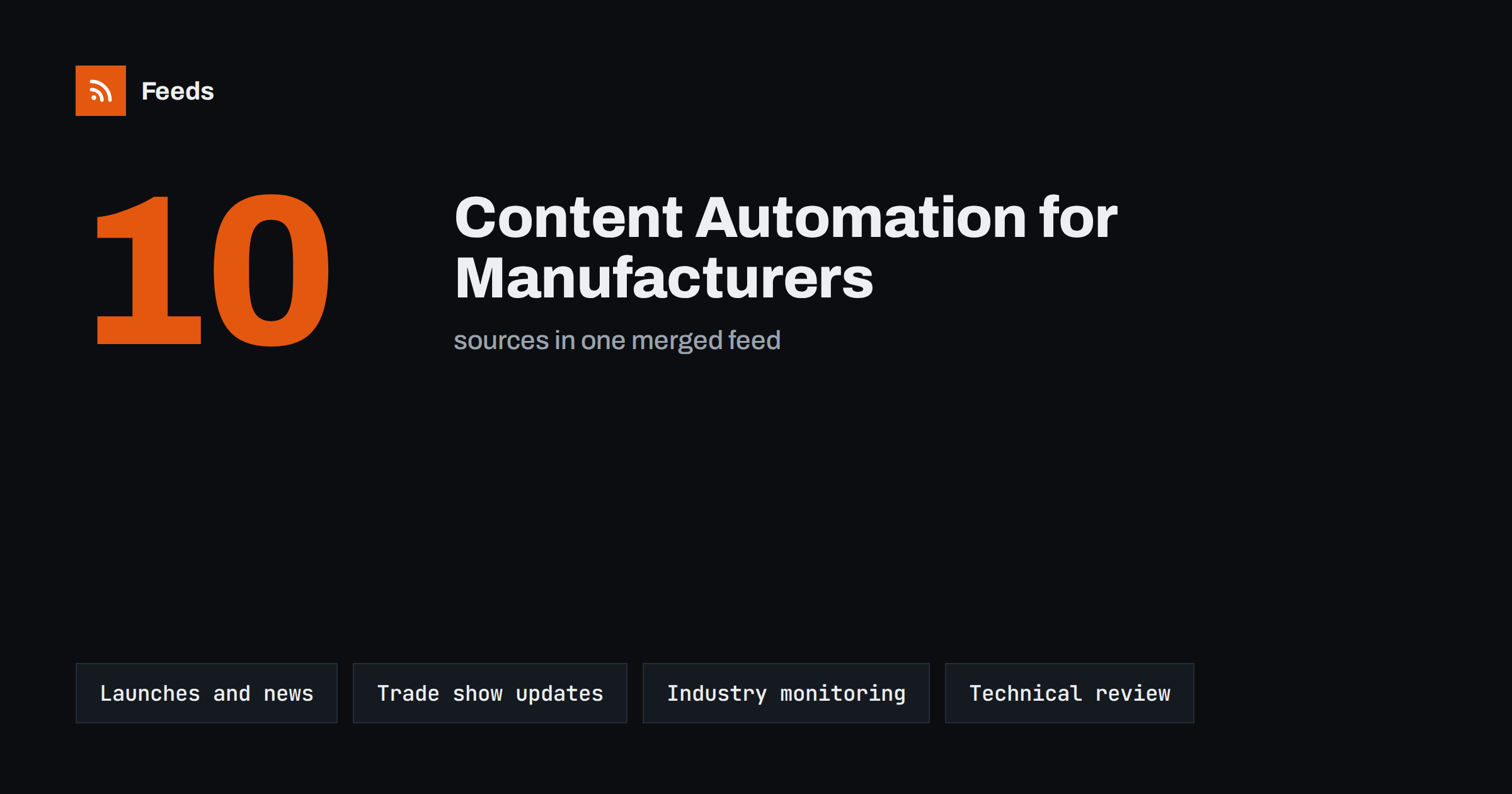
Short answer: Manufacturers and industrial B2B brands get the most from content automation when it handles the repetitive parts: sharing news, product launches and trade show updates from one source, and collecting industry news in one place. Technical claims, specifications and compliance statements should stay under human review. A small set of well-chosen sources, a clear approval step and consistent templates is usually enough to start.
Why industrial brands struggle with consistent content
Manufacturers often have plenty to say and very little time to say it. The product range is wide, the audience is specialised, and the people who know the details, engineers and product managers, are not the people who run social channels or write newsletters. News from the factory floor, a new certification, a product change or a trade show stand stays inside the company because nobody has time to turn it into posts.
The result is a company website that looks quiet and social profiles that update twice a year. Buyers in B2B markets research suppliers carefully, often long before they contact anyone, and a silent channel can look like a silent company. Content automation does not replace the expertise, but it removes the manual copy-and-paste work that stops expertise from being shared.
What is worth automating
Not everything in an industrial company should be automated. The best candidates are tasks that are regular, rule-based and low-risk.
- Company news. When a news item or press release is published on the website, the same item can be shared to your other channels with a standard template.
- New product and range announcements. A product page or catalogue entry can trigger a short announcement with the name, a one-line description and a link.
- Trade show and event updates. Dates, booth numbers and talks can be scheduled ahead of an event and repeated at sensible intervals.
- Distributor and partner news. If partners publish news about your products, a filtered feed can bring it together for resharing.
- Job openings. Vacancies from your careers page are a natural fit for automatic sharing, as covered in sharing job openings automatically.
Keep the first version small. Pick two or three of these, get them running reliably, and add more once the team trusts the results.
Start with one source of truth
The foundation of any automation is a single place where content is published first. For most manufacturers that is the company website: a news section, a blog and product pages. If that source produces a feed, everything else can read from it. If it does not, there are two options: add a feed to the website, or create one from the pages that already exist.
The second option matters for companies with older websites or a catalogue system that offers no feed. A tool that reads a news page from the outside and turns it into a clean feed means you do not have to change the website at all. The principle is the same one described in creating an RSS feed for a website without RSS.
Monitoring the industry around you
Automation is not only about publishing. A large part of the value for a manufacturer is knowing what is happening around the business, and feeds are well suited to that. Useful sources include:
- trade associations and standards bodies, whose announcements can affect your products;
- regulators and safety authorities, for rule changes and notices;
- trade press and industry news sites;
- competitor news pages and blogs;
- supplier and raw material news that could affect cost or availability.
The guides to following industry associations and standards bodies and tracking product recalls and safety notices show how to set up the first two. Merge related sources into a single feed and filter by the product names and terms that matter to you, so that your team reads a short daily list instead of a dozen websites.
Templates that keep a technical voice
Automated posts for an industrial audience should sound like an engineering company, not like a generic marketing tool. That is mostly a matter of templates. Decide in advance how each post type looks:
- News post: the headline, one sentence of context, the link.
- Product launch: product name, the main application, the most important specification, the link to the data sheet or product page.
- Event post: event name, dates, location, the stand number, a reason to visit.
Avoid vague language such as “revolutionary” or “game-changing”. Buyers in technical fields respond to specifics: materials, tolerances, certifications, lead times, applications. Pull those from the source item rather than letting the post become generic. The article on writing post templates for automated social media feeds goes into more detail.
Where human review must stay
Industrial products carry responsibility. A wrong specification, an outdated certification claim or an incorrect safety statement can cause real problems for a customer and for your company. Decide which content may go out automatically and which must be checked by a person first.
- Safe to automate: news headlines from your own website, event dates, job openings, links to published articles.
- Review first: new product specifications, certification and compliance statements, safety notices, anything with performance figures.
- Never automate: responses to complaints, recall communications and anything involving legal or regulatory language.
An approval queue is the simple answer. Items arrive in a queue, a named person approves or edits them, and only then do they go out. The trade-offs between full automation and an approval step are covered in full auto vs approval queue. For anything sensitive, also read brand safety for automated posting.
Handling multiple languages and markets
Many manufacturers sell in several countries. Publishing the same English post everywhere is rarely the best option, but writing everything separately is slow. A workable approach is one feed per language, each fed from the matching version of your website, and each connected to the channel for that market. This keeps the languages apart and avoids mixing them in one stream. The approach is explained in automating multilingual content distribution with feeds.
How RSS Feed Creator helps
RSS Feed Creator turns a news or product page that has no feed into a clean RSS feed with titles, images, summaries and dates, and shows a preview before anything is created. It can merge up to ten sources into one feed, remove duplicates and keep only the items that contain, or do not contain, the words you choose. Manufacturers can use this both for their own site and for monitoring industry sources. If you sell online, it can also build Google Merchant Center and Meta catalog feeds from WooCommerce, Shopify or a CSV link. Plan limits are on the pricing page.
A simple plan for the first month
A first month does not need to be ambitious. In the first week, choose the single source where company news is published and confirm that it produces a working feed, or create one from the page. In the second week, write the three templates and connect one channel, with an approval step on every item. In the third week, add one monitoring feed, for example your trade association and two competitors, and read it daily. In the fourth week, review what went out, what needed fixing and what the team actually used.
At the end of the month you will know which parts save time and which do not. Keep the ones that do, drop the rest and expand slowly. Companies that try to automate everything at once usually end up with a noisy channel and a team that stops trusting the system.
Keep measurement simple. Track how many items were published automatically, how many needed correction, and whether visits from your channels to the news and product pages changed. If posts regularly need manual fixing, the template or the source needs work, not more automation. A short monthly review is enough. Use tracking parameters on the links so that you can see which channels bring visitors, as described in tracking traffic from automated posts with UTM tags.
Related reading
- Automating press release distribution from your newsroom
- Product feeds for B2B and wholesale stores
- Content automation checklist: 30 checks before you go live
The bottom line
For a manufacturer, content automation is a way to share what already exists and to watch the market, not a way to write technical content from nothing. Start from the website as the single source, automate news, launches, events and vacancies with clear templates, monitor industry sources in merged feeds, and keep a person in the loop for specifications and compliance statements. Small and steady beats ambitious and unreliable.
BUJ
What should a manufacturer automate first?
Start with sharing company news and event updates from your website to your other channels. They are regular, low-risk and need no technical review. Add product announcements and monitoring once the basics work.
Is it safe to automate product specifications in posts?
Only if they come directly from a trusted, reviewed source and a person approves new items. Specifications and compliance statements carry real consequences, so use an approval step for them.
Do we need a blog to use content automation?
Not necessarily, but you need a place where content is published first, such as a news page. If that page has no feed, you can create one from the page itself.
How can we monitor competitors and industry news without extra work?
Collect their news pages, trade press and association announcements as feeds, merge them into one and filter by your product terms. Your team then reads one short list a day.
How do we keep different markets and languages apart?
Use one feed per language, fed from the matching version of your website, and connect each feed to the channel for that market. This avoids mixing languages and lets each market have its own schedule.