ENEnglish
 LTLietuviškai
 DEDeutsch
 FRFrançais
 RUРусский
 ESEspañol
 PLPolski
 ITItaliano
 UKУкраїнська
 CSČeština
 PTPortuguês
 JA日本語
 LVLatviešu valoda
 ETEesti
 HUMagyar
 IDBahasa Indonesia
 TRTürkçe
 HIहिन्दी
 ELΕλληνικά
 ARالعربية
 THไทย
 VITiếng Việt
 RORomână
 MSBahasa Melayu
 BNবাংলা
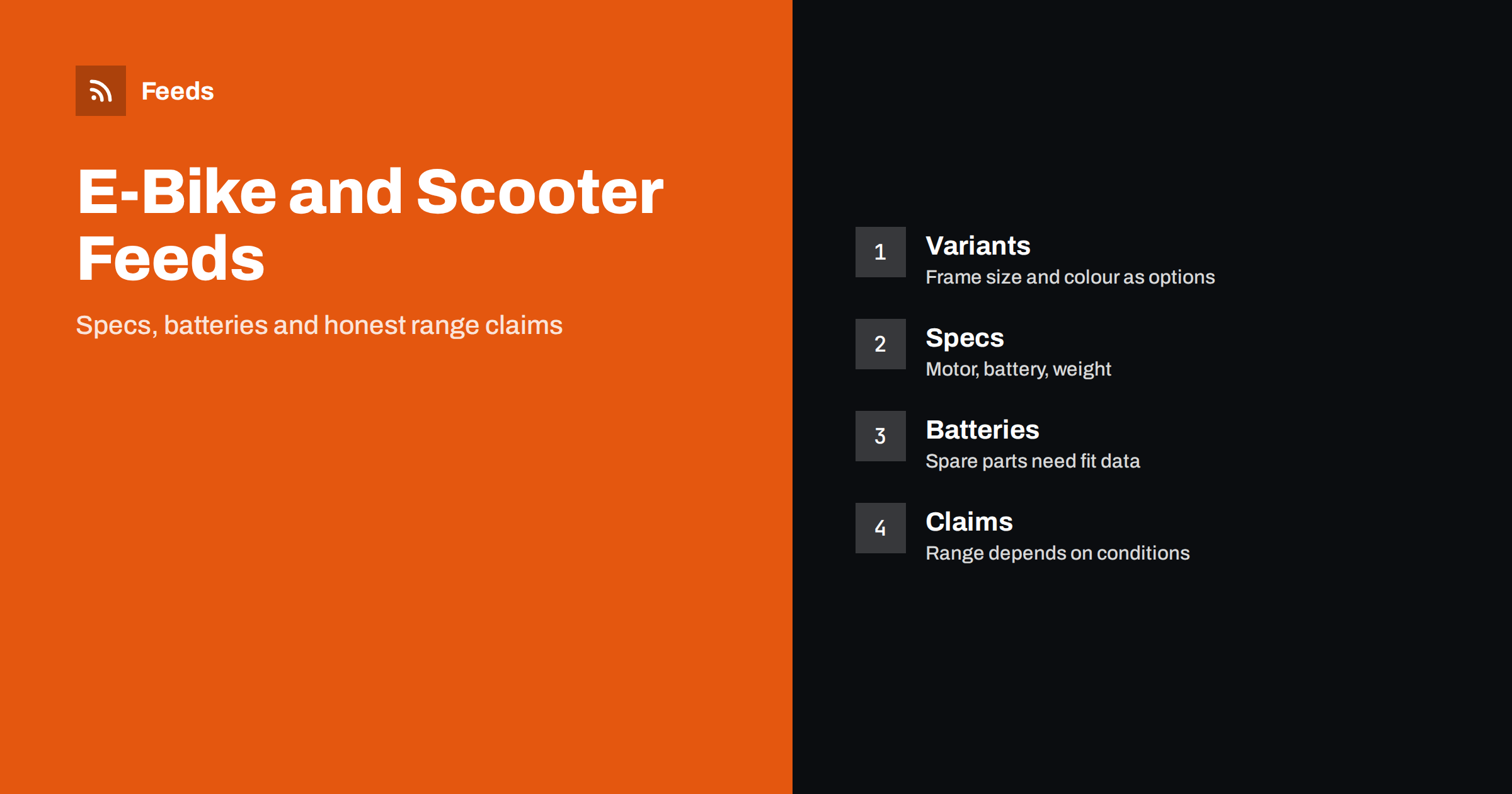
Short answer: E-bikes, electric scooters and their batteries are expensive, heavy and full of specifications, so a weak product feed costs more here than in most categories. A good feed names the product type and the deciding specification in the title, separates frame sizes and colours into proper variants with unique identifiers, treats batteries, chargers and motors as spare parts that must state what they fit, supplies accurate weight and dimensions for shipping, and avoids range and speed claims that depend on conditions you cannot control. Do those things and you will see fewer disapprovals, fewer wrong-size orders and fewer returns of bulky parcels.
Why this category is demanding
A shopper looking for an electric bike compares motor position, battery capacity, frame style, number of gears, brakes, weight and price. A shopper looking for a scooter compares weight, folding mechanism, wheel size and the rider weight it supports. The same shopper may also be looking for a replacement battery or charger for a model they already own. All of that has to fit into a feed, which is a flat list of products with a limited set of attributes.
The products are also large and valuable. A wrong order is not a small inconvenience; it is a heavy box that has to travel back. That makes accuracy the main goal. The basics are the same as in product feeds for bicycle and cycling shops, with extra care for electrical specifications and safety.
Titles that carry the deciding facts
A good title tells the shopper what the product is and what separates it from similar ones. For an e-bike, the type, brand, model, motor or battery size and frame size or colour usually belong in the title. For a battery, the capacity, voltage and the models it fits matter more than any marketing word. For example: brand, “folding electric scooter”, model, wheel size, colour. Keep the most useful words in the first part of the title, because longer titles are cut off in some placements.
Avoid shouting words, promotional phrases and claims such as “best” or “fastest”. Put the facts in the same order for every product so that your catalogue looks consistent and so that the feed can be generated by a rule instead of by hand. More about this approach is in product feed title optimization.
Variants: sizes, colours and battery options
Many e-bikes come in several frame sizes and colours, and some in more than one battery capacity. Each real combination is a separate item in the feed with its own identifier, price, stock status and image, tied together by a group identifier. If you list only the parent product, the shopper may buy a size you do not have. If you list every variant under the same identifier, the platform will see duplicates. The mechanics are explained in how item_group_id works.
A battery option is a good example of a variant that changes the price and the specification. A larger battery adds range, weight and cost. Show it as a variant, not as a note in the description, and make sure the title and the price match what the shopper will see on the product page.
Batteries, chargers and motors as spare parts
Replacement batteries, chargers, displays, tyres and brakes are a large part of the business. They are also the products most often ordered by mistake, because the shopper believes a part fits when it does not. State clearly which models or connectors a part fits, and keep the compatibility list on the product page as well as in the title. Use the manufacturer part number as the MPN where there is one. See GTIN, MPN and brand: product identifiers explained.
Do not publish “universal” parts unless they really are. If a charger works only with a specific plug and voltage, say so. The same discipline is described in product feeds for auto parts stores, where fitment is the key problem, and it applies equally here.
Shipping, weight and dimensions
E-bikes and scooters are heavy and bulky, and batteries are often treated as restricted goods by carriers. Make sure the weight and the package dimensions in the feed are accurate, and that your shipping settings reflect what you actually charge. Carriers and countries have their own rules for shipping lithium batteries, so check them with your carrier before you promise delivery in a particular region, and do not offer a shipping method you cannot use. The balance between account settings and attributes is described in shipping in product feeds.
If some items cannot be shipped abroad, or only by a special service, exclude them from feeds for those countries instead of letting shoppers find out at checkout. A mismatch between the promised and the real shipping terms is a common reason for complaints.
Claims about range, speed and safety
Range is one of the most misleading numbers in this market. It depends on rider weight, terrain, temperature, assistance level and tyre pressure. If you quote a range, use the manufacturer’s figure, say how it was measured and avoid promises such as “up to” without a condition. Do the same with top speed, which is also limited by local law in many places. Never write that a product is “safe”, “fully legal” or “approved” unless you hold the documents that prove it for the market where you sell.
Put legal and safety information where shoppers will read it: helmets, rider age, where the vehicle may be used, battery care. Honest information lowers returns and protects you. If you are unsure about the rules, ask your supplier or an adviser in your market and keep the answer on file.
Accessories, bundles and what is included
Shoppers rarely buy only the vehicle. They add a lock, lights, a helmet, a rack, panniers or a second battery. Decide how you will present these. If a bundle is a real product with its own price, give it its own identifier and a title that says what is included, as described in listing bundles and multipacks in product feeds. If accessories are optional extras, keep them as separate items and link them from the product page, so that the feed price always matches the price of the main product.
Say what is in the box. Does the scooter come with a charger? Is a key or an app required? Are pedals, mudguards or a kickstand included? The most common complaints in this category come from shoppers who assumed something was included. A short “in the box” list in the description removes the guesswork and is easy to generate from your product data.
Images, condition and stock
Use clear images on a plain background that show the whole product, plus extra images for the display, the battery and the folding mechanism. Follow the rules in product feed image requirements, and do not add overlays or logos that the platforms do not accept. If you sell demo, returned or refurbished units, mark the condition correctly, as covered in used and refurbished products in feeds.
Stock needs special care for heavy items with long lead times. If a model is sold out, do not leave it as available. Either mark it out of stock or use the pre-order approach when the delivery date is known. See out-of-stock products in your feed.
How RSS Feed Creator helps
RSS Feed Creator builds Google Merchant Center and Meta catalog XML straight from your store. WooCommerce and Shopify are read automatically, and any other store can use a CSV link. You can skip out-of-stock products, rewrite titles with rules so that the product type, motor or battery size and frame size appear in the same order every time, and adjust prices. The currency is detected automatically. Before you submit anything, check the preview and the Merchant Center diagnostics to confirm that frame-size variants and spare-part titles arrive as you expect. The free plan includes product feeds with up to 50 products, and the Store plan covers one store with 3 product feeds and up to 2,000 products. The details are on the pricing page.
Related reading
- Product Feeds for Bicycle and Cycling Shops: A Guide
- Product Feed Checklist: 25 Checks Before You Submit
- Product Feeds for Motorcycle and Powersports Gear Stores
The bottom line
For e-bikes, scooters and batteries, accuracy beats cleverness. Put the deciding specification in the title, split sizes and battery options into real variants, state exactly what each spare part fits, keep weight and shipping honest and treat range and legal claims with care. A feed built this way sells fewer wrong products and returns fewer heavy boxes.
FAQ
Should every frame size and colour be a separate item?
Yes. Each real combination needs its own identifier, price, stock status and image, linked by a shared group identifier, so that shoppers see the size they can actually buy.
How do I list replacement batteries and chargers?
As spare parts with capacity, voltage and a clear list of the models they fit, plus the manufacturer part number as MPN where available. Never describe a part as universal unless it is.
Can I quote a range in the product description?
Use the manufacturer’s figure, explain the conditions and avoid unqualified promises. Range depends on rider weight, terrain, temperature and assistance level, so a single number can mislead.
Why does shipping matter so much for this category?
The products are heavy and batteries are restricted by many carriers. Wrong weights or shipping promises lead to extra costs, delays and complaints, so check the rules for each destination before you publish.
What should I do with sold-out models?
Mark them as out of stock or exclude them, or use a pre-order approach if you know the delivery date. Leaving them as available causes mismatch warnings and unhappy customers.