ENEnglish
 LTLietuviškai
 DEDeutsch
 FRFrançais
 RUРусский
 ESEspañol
 PLPolski
 ITItaliano
 UKУкраїнська
 CSČeština
 PTPortuguês
 JA日本語
 LVLatviešu valoda
 ETEesti
 HUMagyar
 IDBahasa Indonesia
 TRTürkçe
 HIहिन्दी
 ELΕλληνικά
 ARالعربية
 THไทย
 VITiếng Việt
 RORomână
 MSBahasa Melayu
 BNবাংলা
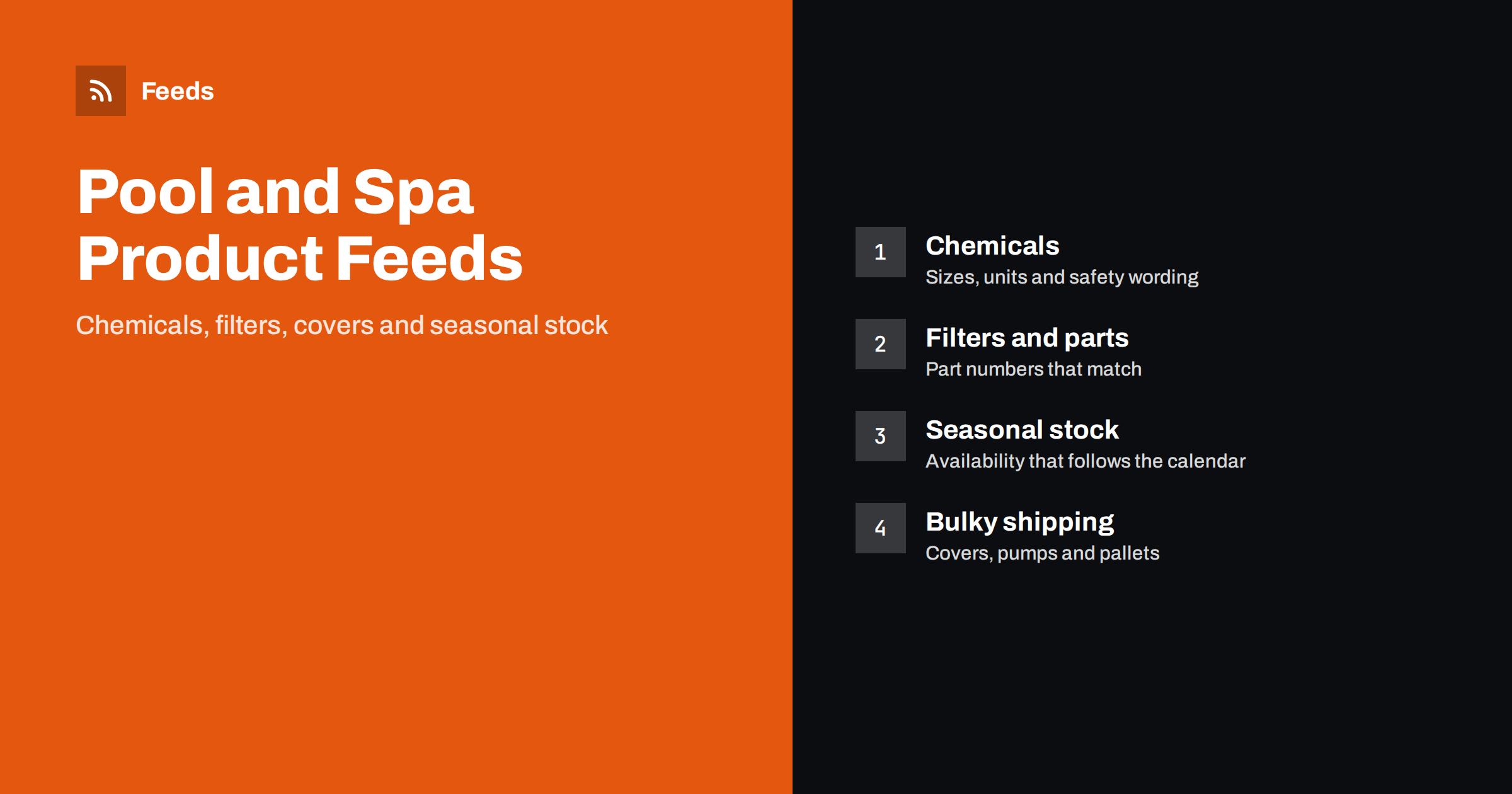
Short answer: A pool and spa supply catalogue is a mix of consumables, replacement parts and large equipment, and each group needs different handling in a product feed. Chemicals need exact sizes, unit prices and careful wording; filters, pumps and parts need manufacturer part numbers and compatibility in the title; covers, heaters and spas need honest shipping costs and lead times; and the whole catalogue swings with the season, so availability must come from live stock rather than a spreadsheet exported in spring. Get those four things right and most feed rejections disappear.
What makes this catalogue different
A pool store sells a 25 kg bucket of chlorine granules next to a €3 test strip pack and a €6,000 hot tub. The same feed has to describe all three correctly, and the shopping platforms apply the same rules to each. The buckets fall under rules about units and, in some markets, about hazardous goods. The parts live or die by part numbers, because a customer searching for a filter cartridge types the model code, not a description. The large equipment raises questions about delivery, installation and returns that a feed cannot answer, but the landing page must.
On top of that, demand is seasonal. Opening chemicals sell in spring, algaecides and shock treatments in high summer, winterising kits and covers in autumn, and spa supplies all year. Stock levels and prices move with that cycle, so a feed that updates slowly will advertise products that sold out weeks ago. If you are new to feeds in general, start with what a product feed is and come back; this guide assumes you know the basic shape of a feed.
Chemicals: sizes, units and wording
Chlorine, bromine, pH adjusters, algaecides, clarifiers and salt all come in several sizes, and the size is the single most important fact in the title. “Chlorine Granules 5 kg” and “Chlorine Granules 25 kg” are different products to a shopper, and if the title does not say which, the click goes to someone else. Put the brand, the product type, the size and the form (granules, tablets, liquid) in the title, in that order, and keep it consistent across the range. The patterns that work are set out in product feed title optimisation.
Chemicals sold by weight or volume often need unit pricing in the feed, so that a 5 kg bucket and a 25 kg bucket can be compared per kilogram. The attributes for this, and how to fill them when the pack size is already in the title, are covered in unit pricing in product feeds. Wording also matters: claims about killing bacteria or making water “safe” can trigger review, so stick to what the product does (“raises free chlorine”, “lowers pH”) and leave medical-sounding language out of titles and descriptions. Check the current policy of each platform for hazardous or regulated goods in your country before you submit the chemical range, because restrictions vary by market and change over time.
Filters, pumps and parts: part numbers first
Replacement filter cartridges, pump seals, skimmer baskets, heater elements and spa jets are searched by part number. The feed should carry the manufacturer part number (MPN) and the brand, and the GTIN where the manufacturer provides one. A title such as “Pleatco PRB50-IN Replacement Filter Cartridge” matches a search exactly; “Replacement Filter for Spa” matches nothing specific. What the identifier attributes are and when each is required is explained in GTIN, MPN and brand in product feeds.
Compatibility is the second question. A cartridge fits a list of filter housings, and a pump seal fits a list of pump models. Put the most common compatible models in the description and, where the catalogue supports it, in a product detail attribute. Avoid stuffing dozens of model numbers into the title; the title should name the part, and the description should list what it fits. Where you sell both the branded original and a compatible aftermarket version, make the difference clear in the title and never use the original brand name on the aftermarket item as if it were the brand.
Covers, heaters and spas: bulky shipping
Large items are where feed and reality diverge most often. A safety cover for an 8 by 4 metre pool, a heat pump or a six-seat hot tub ships on a pallet, with a surcharge, a lead time of days or weeks and sometimes a kerbside-only delivery. If the feed says free shipping because the account default says so, the price shown in the ad will not match the checkout and the product will be flagged. Set shipping for these items at the product level, or group them with a shipping label and a dedicated rate, as described in shipping in product feeds.
Lead time belongs in the feed too, through the availability and availability date attributes where the item is on order, and on the landing page in plain words. Installation services, if you sell them, should be separate products or options on the page, not folded into the price of the spa. For hot tubs, make sure the landing page shows the same model, seat count and price as the feed, because the review for a high-value item is often manual.
Seasonal availability and price
The spring rush empties shelves quickly, and a feed built from a file exported in March will keep advertising opening kits in June after they have gone. Availability must come from live stock. Decide how to treat the off-season range: a winterising kit in May can stay in the feed as out of stock, be removed until autumn, or be marked for preorder if you know the date. The trade-offs are discussed in out-of-stock products in your feed. Removing them cleanly in the off season is usually the best choice for consumables, while equipment that is available all year should simply reflect the real stock count.
Prices change with the season as well, and some stores run early-bird offers on covers or end-of-season sales on chemicals. The feed must carry the current price and, for promotions, the sale price with its dates, so that the advertised figure always matches the page. A refresh interval measured in hours, not days, keeps the two aligned during a sale.
Variants, bundles and kits
Many pool products come in variant sets: a cover in six sizes, a liner in three colours, a chemical in four pack sizes. Each size or colour is its own item with its own identifier, price and stock, grouped under one parent so the shopping platform shows them as one product with choices. The mechanism is explained in product variants and item_group_id. Pack sizes of a chemical are variants only if the product is otherwise identical; a different formulation is a different product.
Starter kits, opening kits and maintenance bundles are a strength of this category. A bundle is listed as one product with its own identifier and a title that says what it contains, and a multipack of the same item is listed with the multipack attribute rather than as a bundle. The rules differ, and getting them mixed up causes rejections; see bundles and multipacks in product feeds.
Images that pass review
Chemical buckets photograph well on a plain background and that is what the platforms want: the product, filling most of the frame, no promotional text, no watermark, no “sale” badge. Covers and liners are harder because the product is a sheet of material; a clean studio shot of the folded product or a clear rendering of the shape works better than a lifestyle photo of a whole pool, which may be rejected for showing many products at once. Hot tubs are usually shown in a lifestyle setting, which is acceptable as long as the tub is clearly the subject. Size and format requirements are listed in product feed image requirements.
Checks before you submit
Run through this short list for a pool and spa catalogue, then the general product feed checklist:
- Every chemical title includes brand, type, size and form, and unit pricing is filled where the platform expects it.
- Every part has a brand and MPN, and GTIN where one exists; compatible models are in the description, not the title.
- Bulky items have product-level or labelled shipping rates and a realistic lead time.
- Availability comes from live stock, and off-season consumables are removed or marked rather than left as in stock.
- Variants are grouped, bundles are listed as bundles and multipacks as multipacks.
- Images show one product on a clean background, with no overlaid text.
- No health or safety claims in titles or descriptions that the platform’s policies would question.
After the first submission, read the diagnostics every day for a week. Pool catalogues typically throw up a handful of price mismatches from sale items and a few image rejections from lifestyle shots, both of which are quick to fix once you see them; the common causes are listed in Merchant Center disapproved products.
How RSS Feed Creator helps
RSS Feed Creator builds Google Merchant Center and Meta catalog XML straight from your store. WooCommerce and Shopify are read automatically, and any other store can use a CSV link. You can skip out-of-stock products, which keeps off-season kits out of the feed automatically, rewrite titles with rules so that the size and form appear in every chemical title, and adjust prices. The currency is detected automatically. Before you submit anything, check the preview and the Merchant Center diagnostics to confirm that identifiers and shipping details arrive as you expect. The free plan includes product feeds with up to 50 products, and the Store plan covers one store with 3 product feeds and up to 2,000 products. The details are on the pricing page.
Related reading
- Product Feeds for Garden, DIY and Hardware Stores
- Google Product Feed Attributes: Required and Recommended
- How to Fix Price Mismatch Errors in Google Merchant Center
The bottom line
Treat the pool and spa catalogue as three catalogues in one. Chemicals need sizes, units and careful wording; parts need part numbers and compatibility; large equipment needs honest shipping and lead times. Feed availability from live stock so the seasonal swing never leaves sold-out kits in the ads, group variants properly and keep images clean. The rest is the same discipline as any other feed: submit, read the diagnostics, fix the few items that fail.
FAQ
Can I advertise pool chemicals through a product feed?
In most markets, yes, but some chemicals fall under hazardous or regulated goods rules that vary by country and platform. Check the current policy for your market before submitting, use plain functional wording and avoid medical-sounding claims in titles and descriptions.
What should a filter cartridge title contain?
The brand and the manufacturer part number, followed by the product type, for example “Pleatco PRB50-IN Replacement Filter Cartridge”. Shoppers search by part number. Put the list of compatible filter housings in the description rather than the title.
How do I handle winter products in summer?
Let availability come from live stock and decide a policy: remove off-season consumables from the feed, keep them as out of stock, or mark them for preorder with a date. Removing them is usually cleanest for items that will not be restocked until autumn.
Why was my hot tub flagged for shipping?
Usually because the feed inherited a free or flat shipping rate from the account settings while the checkout added a pallet surcharge. Set shipping at the product level or with a shipping label for bulky items so the advertised total matches the page.
Is a pool opening kit a bundle or a multipack?
A kit of different products sold together is a bundle and is listed as one product with its own identifier and a title that says what it contains. Several units of the same product sold together is a multipack and uses the multipack attribute instead.