ENEnglish
 LTLietuviškai
 DEDeutsch
 FRFrançais
 RUРусский
 ESEspañol
 PLPolski
 ITItaliano
 UKУкраїнська
 CSČeština
 PTPortuguês
 JA日本語
JA日本語 LVLatviešu valoda
 ETEesti
 HUMagyar
 IDBahasa Indonesia
 TRTürkçe
 HIहिन्दी
 ELΕλληνικά
 ARالعربية
 THไทย
THไทย VITiếng Việt
 RORomână
 MSBahasa Melayu
 BNবাংলা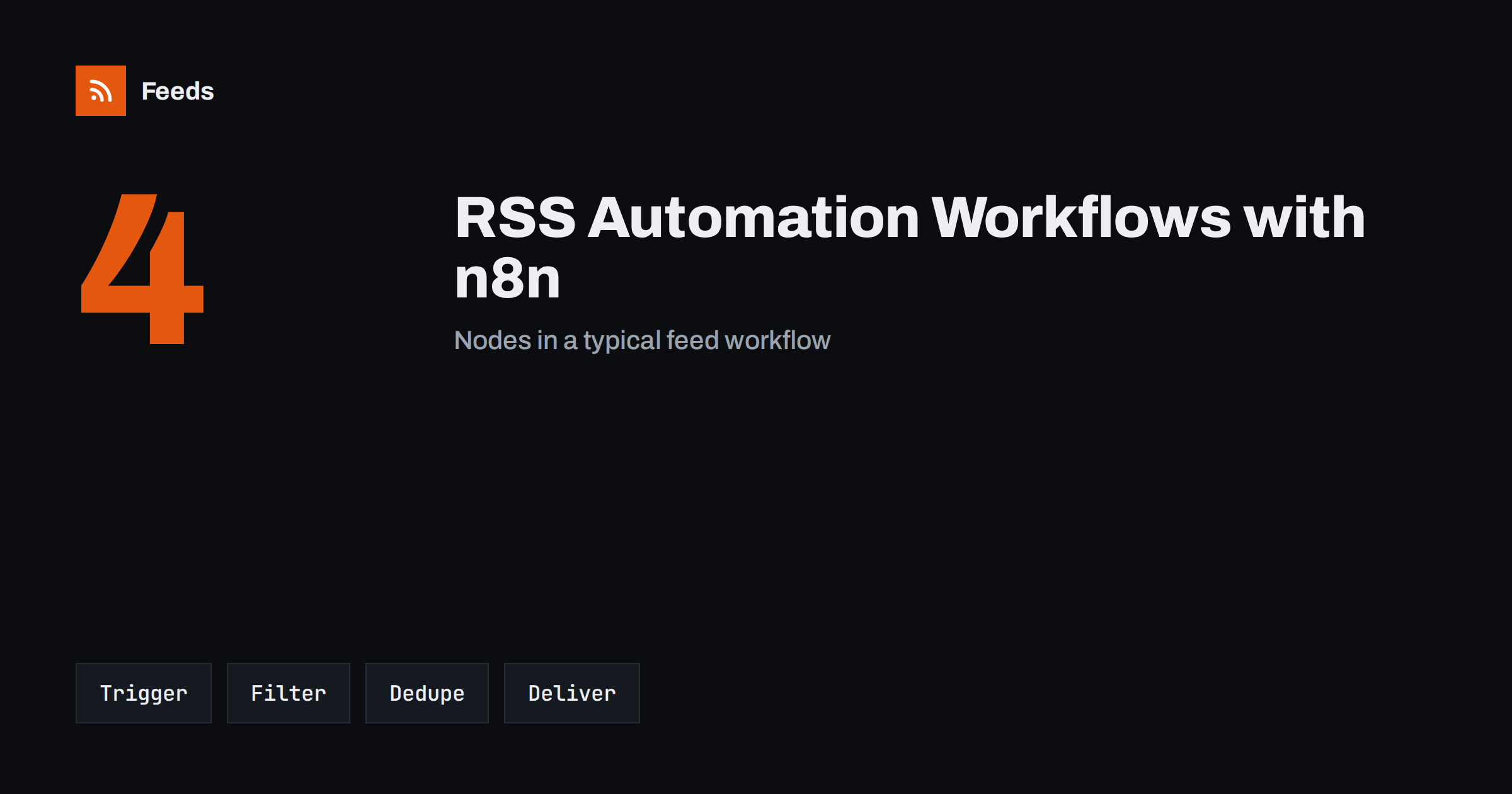
Short answer: In n8n, an RSS workflow usually starts with the RSS Feed Trigger node, which polls a feed and emits new items, or with a Schedule Trigger plus an RSS Read node for more control. You then add a Filter or IF node to keep relevant items, optionally a Remove Duplicates node or your own stored IDs, and finish with an action node such as Slack, Discord, Telegram, email, an HTTP request or a spreadsheet. Self-hosting gives full control over data and costs, but you are responsible for updates, backups and monitoring.
Why teams choose n8n for feed workflows
n8n is a workflow automation tool that can be self-hosted or used as a cloud service. It appeals to technical teams for a few reasons that matter especially for feeds.
- Volume without per-task fees. Feeds generate many items. On a self-hosted instance, running thousands of items a month costs the same as running ten: your server.
- Flexibility. Code nodes let you write JavaScript or Python to clean titles, strip tracking parameters, reformat dates or apply complex filters.
- Data control. When self-hosted, feed content and credentials stay on your infrastructure, which can matter for client work or internal policies.
- Many integrations. Hundreds of built-in nodes cover chat tools, email, databases, spreadsheets and social platforms, and the HTTP Request node covers anything with an API.
The trade-off is responsibility. A self-hosted n8n instance is a server application that needs updates, backups, secure credentials and monitoring. If nobody on the team is comfortable with that, a hosted automation platform may be the better choice. Check n8n’s licence terms for your specific use case as well, particularly if you plan to offer workflows as a service to others.
Two ways to start: trigger or schedule
RSS Feed Trigger node
The RSS Feed Trigger node polls a feed URL at an interval you choose and starts the workflow for new items. It keeps track of what it has already seen, so each item triggers only once. This is the simplest way to build “new item, then do something” workflows.
Schedule Trigger with RSS Read
For digests or more control, use a Schedule Trigger, for example every weekday at 8:00, followed by an RSS Read node that fetches the full feed. You then decide in later nodes which items are new, for instance by comparing publication dates with the last run or by looking up stored IDs. This pattern is ideal for “one message per day with all new items” and for reading several feeds in one run.
Both work with RSS and Atom feeds. The RSS Read node can also be placed inside a loop to process a list of feed URLs stored in a spreadsheet or database, which is handy when the list of sources changes often.
Step by step: new feed items to a chat channel
- Create a workflow and add the RSS Feed Trigger node. Paste the feed URL and set the poll interval, for example every 15 minutes.
- Test the trigger to fetch sample items and inspect the fields: title, link, pubDate, content, contentSnippet, guid and others, depending on the feed.
- Add a Filter node. Keep items where the title or contentSnippet contains any of your keywords. Use case-insensitive matching.
- Add a Code or Edit Fields node to build the message: source name, linked title, a shortened snippet.
- Add the destination node, such as Slack, Discord, Microsoft Teams or Telegram, and map the message fields.
- Activate the workflow and wait for a real new item. Check the message in the channel itself.
- Add an error workflow in the workflow settings that notifies you when an execution fails.
Filtering and cleaning items
Feed data is often messy. A few cleaning steps make every downstream action better.
- Strip HTML from descriptions before sending them to chat or social tools. The contentSnippet field often already contains a plain-text version.
- Truncate summaries to a fixed length, ending at a word boundary.
- Normalise links by removing tracking parameters that the source added, then add your own UTM parameters where needed.
- Handle missing fields. Some items lack images or summaries. Use expressions with fallbacks so the message still looks fine.
- Exclude noise with negative keyword rules, such as “sponsored” or “webinar”.
It is worth testing cleaning logic against several different feeds, not just one. Feeds from different CMSs format dates, encodings and summaries differently, and a cleaning step that works for one source can produce odd results for another. Pin sample data in the editor so you can re-run nodes against the same items while you adjust expressions.
Keep filters readable. A list of keywords in one place, perhaps a small spreadsheet the workflow reads, is easier for colleagues to maintain than a long expression hidden in a node.
Deduplication across feeds and runs
The RSS Feed Trigger handles “have I seen this item from this feed?”. Two other duplicate problems need extra care.
Across feeds: when several sources report the same link, use the Remove Duplicates node on the link field within a run, or store sent links in a database or spreadsheet and check new items against it.
Across runs with RSS Read: when you use a schedule instead of the trigger, you must remember what was sent. The simplest reliable method is a table of sent GUIDs or links. Before sending, look up each item; after sending, insert it. n8n’s Remove Duplicates node can also compare against items from previous executions, which is convenient for simpler setups.
Whatever method you choose, back up the store of sent items. If it is lost, the next run may resend everything still in the feeds.
Building a daily digest
For busy feeds, a digest is kinder than a stream of single messages.
- Schedule Trigger at a fixed time.
- RSS Read for each source, or a loop over a list of feeds.
- Filter items by publication date within the last 24 hours, and by keywords.
- Remove duplicates by link.
- Sort by date and limit to, say, ten items.
- Aggregate the items into one message with a Code node or the Aggregate node.
- Send the message to chat or email. Skip sending if the list is empty.
A digest workflow also makes a good testing ground. Because it runs at a fixed time, you can execute it manually during setup, look at the aggregated message and adjust filters and formatting before activating the schedule. Once the digest looks right for a week of real data, you can reuse the same filter and cleaning nodes in instant workflows for your most important sources.
Running n8n reliably
- Persist data. Use a proper database and persistent storage, so workflows, credentials and trigger state survive restarts and upgrades.
- Back up the database and the encryption key used for credentials. Without the key, restored credentials are useless.
- Update regularly, reading release notes for breaking changes.
- Secure access with HTTPS and strong authentication, and keep the editor off the public internet if you can.
- Monitor executions. Error workflows and a periodic look at failed executions catch problems early.
- Prune execution history so the database does not grow endlessly.
Where Feeds helps an n8n setup
n8n can fetch any feed, but it cannot create feeds for sites that have none, and building scrapers inside workflows is fragile. Feeds fills that gap. It turns any page that lists articles into an RSS feed, uses the site’s own feed where one exists, merges several sources into one feed, keeps or drops items by keyword and removes duplicates automatically. Feeds refresh on their own, and paid plans alert you if a page changes and a feed stops finding items. In n8n, you then point the RSS Feed Trigger or RSS Read node at one clean feed instead of maintaining scraping logic. The free plan covers one website; the pricing page explains the paid plans.
Related reading
- Zapier vs Make vs IFTTT vs n8n for RSS Automation
- Webhooks vs RSS Polling: Which to Use for Automation
- How to Post RSS Feed Items to Discord Automatically
- How to Stop Duplicate Posts in Automated Content Workflows
The bottom line
n8n is a strong choice for technical teams who want full control of feed automation. Start with the RSS Feed Trigger for simple item-by-item workflows or a schedule with RSS Read for digests, clean and filter items, deduplicate across feeds and runs, and deliver to wherever your team or audience is. Treat the instance like any production service, with backups, updates and monitoring, and feed it clean sources so workflows stay simple.
FAQ
Does n8n have a built-in RSS trigger?
Yes. The RSS Feed Trigger node polls a feed and starts the workflow for new items, and the RSS Read node fetches a feed on demand inside any workflow.
Can n8n read Atom feeds?
Yes. The RSS nodes handle both RSS and Atom formats and return items with fields such as title, link, date and content.
How do I stop n8n from sending the same item twice?
The RSS Feed Trigger tracks items it has seen. For scheduled workflows or multiple feeds, use the Remove Duplicates node or store sent links or GUIDs in a database and check each item before sending.
Is self-hosted n8n free?
Self-hosting avoids per-execution fees, but you pay for the server and the time to maintain it. Review n8n’s licence terms for your specific use case.
Can n8n post feed items to social networks?
It has nodes for several platforms and can call any platform API with the HTTP Request node. Social APIs require app setup and permissions, so check each network’s requirements first.
What if a source website has no RSS feed?
Create a feed from the page that lists the site’s articles, then use that feed URL in the RSS nodes. This is more robust than scraping the page inside the workflow.