ENEnglish
 LTLietuviškai
 DEDeutsch
 FRFrançais
 RUРусский
 ESEspañol
 PLPolski
 ITItaliano
 UKУкраїнська
 CSČeština
 PTPortuguês
 JA日本語
JA日本語 LVLatviešu valoda
 ETEesti
 HUMagyar
 IDBahasa Indonesia
 TRTürkçe
 HIहिन्दी
 ELΕλληνικά
 ARالعربية
 THไทย
THไทย VITiếng Việt
 RORomână
 MSBahasa Melayu
 BNবাংলা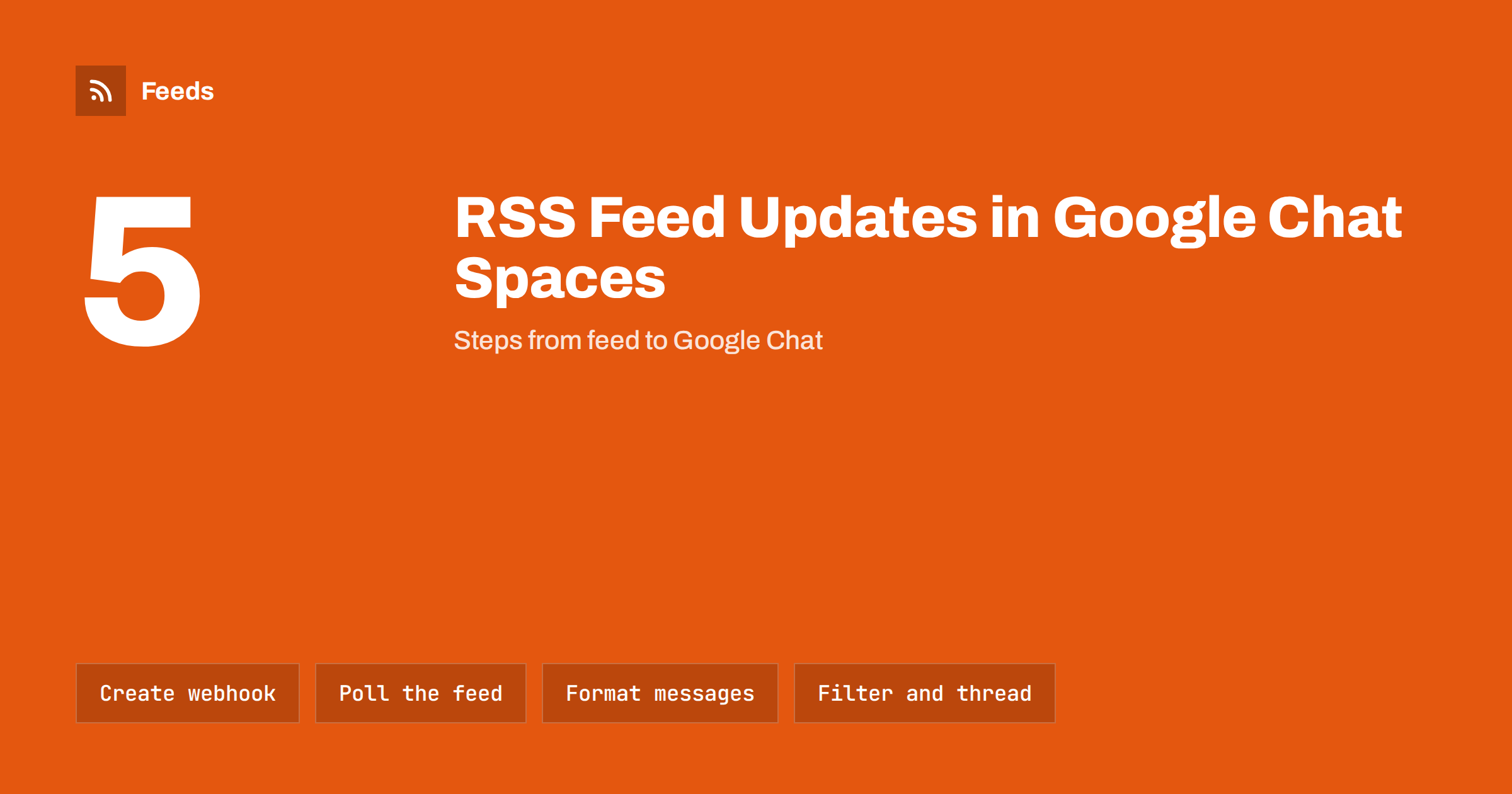
Short answer: Google Chat does not read RSS feeds by itself, but a space can receive messages through an incoming webhook. Create a webhook in the space, then use an automation platform or a small scheduled script that checks the RSS feed and posts each new item to the webhook URL as a short message with the title and link. Add keyword filters, duplicate protection and threading, and keep the webhook URL secret, because anyone who has it can post into the space.
Why send feeds to Google Chat
Teams that live in Google Workspace often use Chat spaces as their daily hub. Bringing relevant updates into those spaces means people see them without checking another tool. Typical uses include:
- Company news and blog posts shared automatically with all staff.
- Competitor and industry news for marketing, sales or product teams.
- Service status and security advisories for IT and development.
- Mentions and press coverage for communications teams.
- New tenders, job postings or regulations for the people who act on them.
If your organisation also uses other chat tools, the approach is much the same. We cover the details for Slack channels and Microsoft Teams channels in separate guides.
How the pieces fit together
Three components are involved:
- The feed: an RSS or Atom feed with the items you want to share.
- A watcher: something that checks the feed on a schedule and notices new items. This can be an automation platform or your own script.
- The incoming webhook: a special URL created inside a Chat space. Anything sent to it in the right format appears in the space as a message from the webhook’s name and avatar.
The webhook only receives messages; it cannot read feeds or reply to people. That is why you need the watcher in the middle. If you are unsure whether to poll a feed or wait for pushes, our comparison of webhooks and RSS polling explains the trade-offs.
Step 1: create an incoming webhook in the space
- Open the Chat space that should receive updates.
- Open the space menu and look for the apps and integrations settings, then the webhooks option.
- Give the webhook a clear name, such as “Industry news” or “Blog updates”, and optionally an avatar image URL.
- Save and copy the webhook URL.
Incoming webhooks are a feature of Google Workspace, and administrators can restrict or disable them. If you cannot find the option, ask your Workspace administrator whether webhooks are allowed for your organisation or for that space.
Treat the webhook URL as a secret. It contains the credentials needed to post, so anyone with the URL can write messages into the space. Store it in your automation tool’s credential store or an environment variable, not in a shared document or a public code repository. If it leaks, delete the webhook and create a new one.
Step 2: choose how to watch the feed
| Option | Effort | Good for |
|---|---|---|
| Automation platform | Low | Non-developers; RSS trigger plus a Google Chat or generic webhook action |
| Self-hosted workflow tool | Medium | Teams already running their own automation server |
| Small scheduled script | Medium | Developers who want full control and no extra subscription |
| Third-party Chat app for feeds | Low | Where your admin allows such apps |
Most automation platforms offer an RSS trigger (“new item in feed”) and either a dedicated Google Chat action or a generic HTTP request action, which works with the webhook. A script needs only three things: fetch the feed, compare item GUIDs with a stored list of those already sent, and send new ones to the webhook. Run it every 10 to 30 minutes with a scheduler.
Step 3: format the message
The simplest message is a JSON body with a text field. Google Chat supports basic formatting in text messages: bold with asterisks, italics with underscores, and links written in angle brackets with a pipe between the address and the label. A clear, compact format might be:
- the source name in bold,
- the item title as a link,
- optionally one sentence of summary.
Chat also supports richer card messages with headers, images and buttons. Cards look polished but take more work to build and maintain, and they can be too large when many items arrive. For busy feeds, plain text messages are usually better; reserve cards for low-volume, high-importance updates such as incident notices.
Keep summaries short. Feed descriptions may contain HTML, which will not display well; strip tags and cut the text at a sentence boundary. Your team will scan dozens of messages, so the title and source should say enough to decide whether to click.
Step 4: use threads to keep spaces tidy
When several feeds post into one space, conversations can drown in automated messages. Two techniques help:
- Thread by source or by day. Webhook messages can include a thread key, so all messages with the same key are grouped into one thread. Use the feed name, or the date for a daily thread.
- Use separate spaces for separate audiences. A “News” space for everyone and a “Security alerts” space for IT is clearer than one space for everything.
Discussion can then happen as replies under a specific item, which keeps context together. If your team prefers one message a day instead of a stream, consider a digest; our guide to building an automated daily news digest shows how.
Step 5: filter, deduplicate and pace
An unfiltered feed in a busy workspace quickly becomes noise that people mute. Before switching on the workflow:
- Filter by keywords so only relevant items arrive, for example only news mentioning your products, markets or competitors.
- Merge related sources and remove duplicates, so the same story from three sites appears once.
- Prevent repeats. Track which GUIDs or links have been sent. Our guide to stopping duplicate posts in automated workflows explains the common causes.
- Pace bursts. Webhooks have rate limits, and a feed that suddenly delivers fifty items should not produce fifty messages in a minute. Send a limited number per run and queue the rest, or send a single summary message.
- Skip the backlog. On the first run, mark existing items as seen instead of posting them all.
Troubleshooting
- Nothing appears: check that the webhook still exists and the URL is complete, then test it with a single manual message.
- Error responses from the webhook: the message body is probably malformed JSON or too large. Log the body your tool sends and validate it.
- Some items missing: the feed may show only a few recent items while your check interval is long. Poll more often or use a feed with more items.
- Webhooks suddenly stop working: an administrator may have changed the policy. Check with your Workspace admin.
- The source has no RSS: create a feed from its news or updates page first.
Finally, give the workflow an owner. Automated messages often keep running long after the person who set them up has moved on, and nobody knows where they come from or how to change them. Write a short note in the space description or pinned message: which feed is used, which tool sends it, who maintains it and how to request changes. Review the setup every few months. Remove feeds nobody reads, adjust filters that let through too much, and check that the webhook still belongs to an active integration. A space that people trust to contain only relevant updates is one they keep reading.
Getting a clean feed to send
A chat workflow is only as good as the feed behind it. Feeds creates RSS feeds from web pages that have none, merges several sources into one feed, keeps only items with or without your keywords, and removes duplicates automatically. The resulting feed link works with any automation platform or script that can post to a Google Chat webhook. You can start on the free plan; see the pricing page for limits on sources and refresh intervals.
Related reading
- How to Post RSS Feed Items to Discord Automatically
- How to Automate an Internal Company News Feed
- How to Set Up Keyword Alerts Using RSS Feed Filters
The bottom line
Google Chat receives feed updates through incoming webhooks. Create a webhook in the right space, keep its URL secret, and connect it to an automation platform or a small script that checks the feed and sends each new item as a short text message. Filter and deduplicate the feed, group messages in threads, pace bursts and skip the backlog, and the space stays useful instead of noisy.
FAQ
Can Google Chat subscribe to an RSS feed directly?
Not natively. Google Chat spaces can receive messages through incoming webhooks, so you need an automation tool, a script or a third-party app to read the feed and send new items to the webhook.
Are Google Chat webhooks available on free Google accounts?
Incoming webhooks are a Google Workspace feature, and administrators can restrict them. If the option is missing in your space, ask your Workspace administrator.
How do I post links with a title in Google Chat?
In a text message, write the link in angle brackets with the address, a pipe character and the label. Card messages can also include buttons that open links.
How can I stop old feed items being posted?
On the first run, record existing items as already sent without posting them. After that, only items with new GUIDs or links are sent.
Is it safe to share a Google Chat webhook URL?
No. Anyone with the URL can post messages into the space. Keep it in a secure credential store, and if it is exposed, delete the webhook and create a new one.