ENEnglish
 LTLietuviškai
 DEDeutsch
 FRFrançais
 RUРусский
 ESEspañol
 PLPolski
 ITItaliano
 UKУкраїнська
 CSČeština
 PTPortuguês
 JA日本語
JA日本語 LVLatviešu valoda
 ETEesti
 HUMagyar
 IDBahasa Indonesia
 TRTürkçe
 HIहिन्दी
 ELΕλληνικά
 ARالعربية
 THไทย
THไทย VITiếng Việt
 RORomână
 MSBahasa Melayu
 BNবাংলা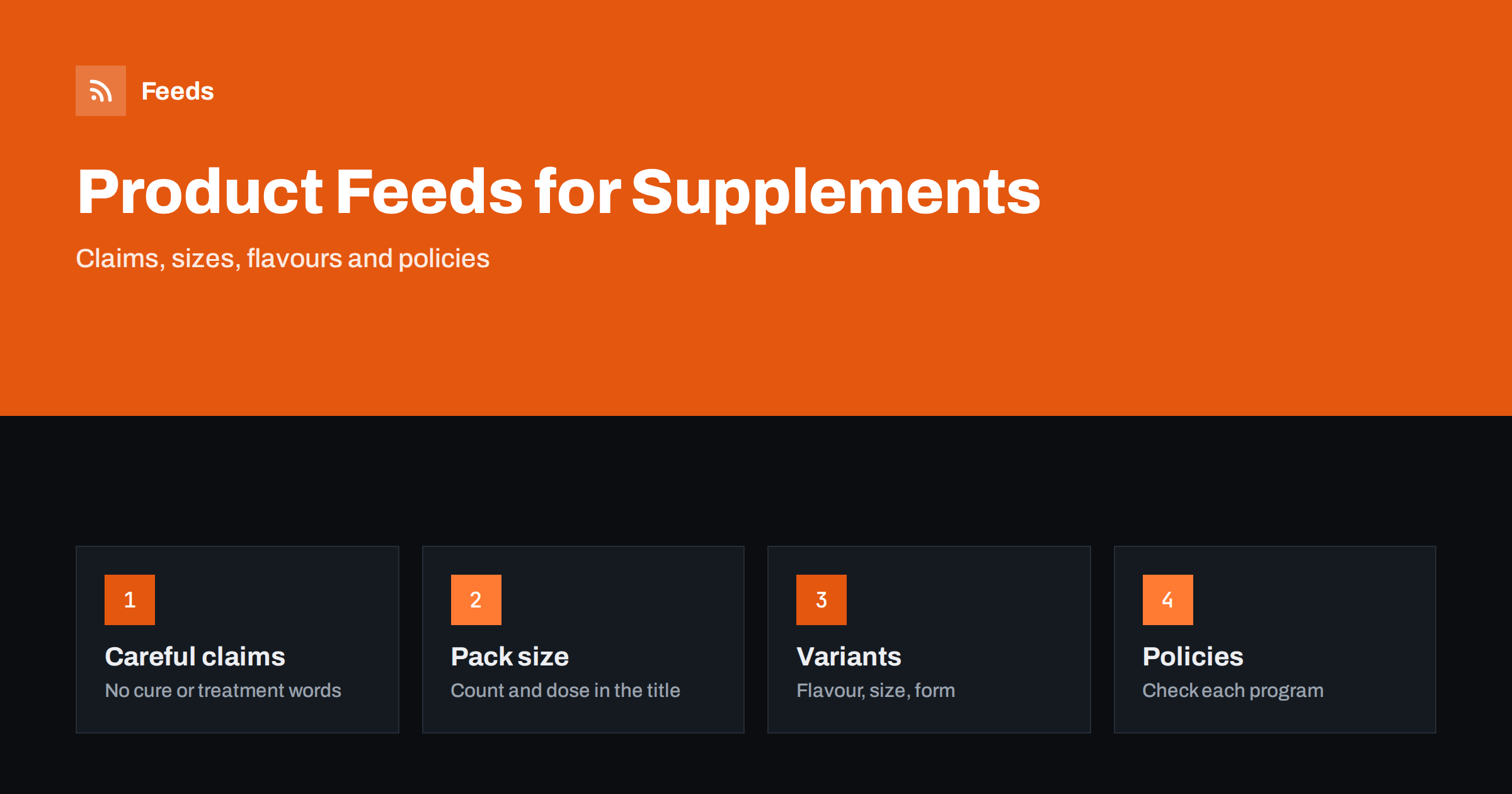
Short answer: Supplements are a regulated and sensitive category, so the feed must be written more carefully than for most products. Keep claims modest and factual, put the form, the count and the size in the title, use the correct barcode for each pack, group flavours and sizes as variants and read the current health and medicine policies of every program before uploading. A clear, plain feed is approved more often and builds trust with shoppers.
Why this category is different
Vitamins, minerals, protein powders and herbal products sit between food and medicine, and both shopping programs and national regulators watch them closely. A claim that sounds harmless on a product page, such as a promise to cure, prevent or treat a disease, can be enough to have an item or a whole account restricted. Rules also differ by country, and what is allowed in one market may be forbidden in another. This guide is not legal advice. It collects the feed practices that help, and you should always check the current rules of each program and the law in the countries where you sell.
The reward for care is real. People search by need and by product type, and a clean, well structured listing is easier to match to those searches. The basic attributes are listed in Google product feed attributes: required and recommended, and the points below add what is specific to supplements.
Titles that say what is in the pack
A buyer compares packs by the form, the amount and the number of servings, so these facts belong in the title. A useful pattern is the brand, the product name, the form, the strength or flavour and the count: “Brand Vitamin D3 1000 IU, 120 Softgels”. For powders, include the weight and the flavour, for example “Brand Whey Protein Chocolate, 900 g”. Use the same pattern across the whole catalog, so that rules and reports work for every product. The wider logic of titles is discussed in product feed title optimization.
Avoid words that promise results, such as “miracle”, “cure” or “detox”, and avoid superlatives you cannot prove. A title that only describes the product is both safer and more useful. Keep the title within a reasonable length as well, so that the key facts, the form and the count, are still visible when a shopping result cuts it off.
Claims and descriptions
The description should explain what the product is, how it is taken, what it contains and what the pack includes. State the ingredients and the serving size in plain words, and add the usual notices that your market requires, for example that a supplement is not a replacement for a varied diet. Write in the same calm tone that you would use on a product label. Do not say or imply that a product treats or prevents a disease, and do not repeat unproven claims from a supplier’s marketing material without checking them.
The same standard applies to images and landing pages. If a page shows before-and-after pictures or health promises that the feed avoids, the program may still judge the product by the page. Shopping programs compare what your feed says with what the page shows, and that mismatch is a common reason for the problems described in Merchant Center misrepresentation: causes and how to recover.
Policies and restricted items
Both Google and Meta have policies that restrict some health products, certain ingredients and some kinds of claims. Weight-loss items, products with banned substances and unapproved medicines are examples of areas where the rules are strict, and some countries require additional approvals. Policies are updated from time to time, so do not rely on a rule you read last year. Read the current text of the policy for each program and country, and remove products that do not qualify instead of trying to disguise them. If an item is disapproved, the causes and the fixes are described in Merchant Center disapproved products: causes and fixes.
It is also a good idea to keep a short internal list of ingredients and claims that you never use in the feed. A new team member who writes descriptions can then follow it without a long training. Review the list when a program updates its policy, and re-check the products that touch the changed rule.
Identifiers, sizes and variants
Most supplement packs have a barcode, and each pack size, flavour and count has its own. Use the barcode of the exact pack you sell, and do not reuse one code across sizes. The brand is the manufacturer or label owner, and a manufacturer part number helps when it exists. The rules are explained in GTIN, MPN and brand: product identifiers in feeds.
Flavours, sizes and counts of the same product should be grouped with a shared group identifier, so that shoppers can choose a variation on one page. This matters especially for supplements, because the same product often comes in many sizes and flavours and a catalog without grouping looks cluttered and repeats the same photo dozens of times. The method is covered in product variants in feeds: how item_group_id works. Each variant is a real product that a person can buy, so give it its own title, image, price and stock, and make sure the link opens the page with that variant selected.
Unit prices and multipacks
Shoppers often compare supplements by the price per serving or per 100 grams. In many countries the unit price is also a legal requirement for some products. Use the unit pricing attributes where they apply, as explained in unit pricing in product feeds: measures and base units, and state the pack count and the weight clearly. Multipacks and bundles, such as three bottles for one price, need an accurate count and a clear title, which is covered in bundles and multipacks in product feeds.
Images and shelf life
Use a clear photo of the actual pack on a plain background, showing the label, with no overlays or promotional text, and follow the size rules in product feed image requirements for Google and Meta. Check that the photo shows the current packaging, since brands change labels often. Shelf life matters too. Do not advertise products close to the end of their date as if they were fresh, and keep your stock status accurate, because nothing damages trust as quickly as an order that cannot be sent. Photos of the pack from two angles, with the ingredient panel visible on one of them, help shoppers who want to check what they are buying before they order.
Sell-by dates are not a feed attribute, but your process should handle them: remove or discount items that are near expiry, and update the feed so that the old price does not stay online.
Keep stock and price in sync
Popular products sell out and prices change with promotions. If the feed shows a price or an availability that differs from the product page, the item can be disapproved, and the typical cases are described in how to fix price mismatch errors in Google Merchant Center. Refresh the feed often enough for your changes, and decide in advance what happens to out-of-stock items, as explained in out-of-stock products in your feed.
How RSS Feed Creator helps
RSS Feed Creator builds Google Merchant Center and Meta catalog XML straight from your store. WooCommerce and Shopify are read automatically, and any other store can use a CSV link. You can skip out-of-stock products, rewrite titles with rules and adjust prices, and the currency is detected automatically. The free plan includes product feeds with up to 50 products, enough to test a first set of supplements before you upload the whole catalog. The Store plan covers one store with 3 product feeds and up to 2,000 products, and the details are on the pricing page.
Related reading
- Product feed checklist: 25 checks before you submit
- Product feeds for grocery and food stores: what to include
- 12 product feed mistakes that quietly cost you sales
The bottom line
A supplement feed should be plain, modest and exact. Describe what the product is and how much of it is in the pack, avoid health promises, use the right barcode for each size and flavour, group real variants, show unit prices where they apply and keep stock and price in line with your site. Read the current policies before you upload, and remove what does not qualify.
FAQ
Can I say that a supplement helps with a health condition?
It is safest not to. Claims about treating or preventing a disease can lead to restrictions and may be against the law in your country. Describe the product and its ingredients, and check the policy of each program.
What should be in the title of a supplement?
The brand, the product name, the form, the strength or flavour and the count or weight. Do not add promotional words or health promises.
Do I need a barcode for every pack size?
Yes, each size, flavour and count normally has its own barcode. Use the code printed on the pack you actually sell and do not reuse one code across different packs.
How do I show the price per serving?
Use the unit pricing attributes where the program supports them, and state the count and weight clearly in the title and description, so that shoppers can compare packs.
Are supplements allowed in every shopping program?
Not always, and not in every country. Both programs restrict some ingredients and claims, so read the current health and medicine policies before you upload and keep a list of products you exclude.