ENEnglish
 LTLietuviškai
 DEDeutsch
 FRFrançais
 RUРусский
 ESEspañol
 PLPolski
 ITItaliano
 UKУкраїнська
 CSČeština
 PTPortuguês
 JA日本語
 LVLatviešu valoda
 ETEesti
 HUMagyar
 IDBahasa Indonesia
 TRTürkçe
 HIहिन्दी
 ELΕλληνικά
 ARالعربية
 THไทย
 VITiếng Việt
 RORomână
 MSBahasa Melayu
 BNবাংলা
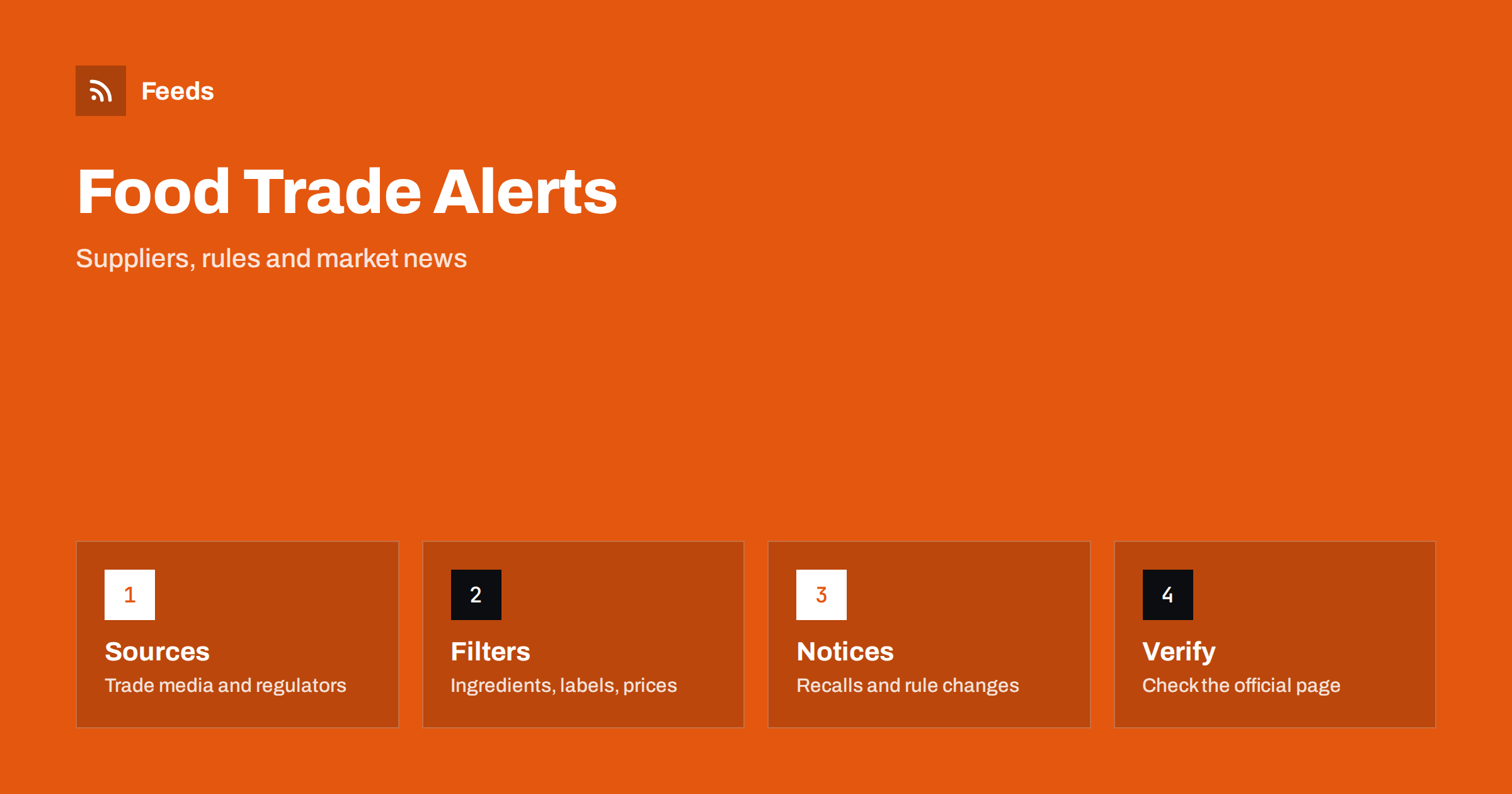
Short answer: Trade publications, food safety authorities, industry associations, wholesalers and suppliers publish market news, rule changes, recalls, price notices and product launches on their own pages. RSS lets you collect those pages in one reader, keep only the topics that affect your kitchen, shop or brand and see a new announcement soon after it appears. A feed is a good way to follow the trade without opening a dozen sites. For anything that affects safety or compliance, read the official notice and follow the instructions of the authority.
Why trade news is easy to miss
Restaurateurs, caterers, food producers and shop owners work long hours, and news arrives from many places. A supplier announces a price change by email, a trade magazine reports on a new labelling rule, a food safety authority publishes a recall and an industry body updates guidance on allergens. Each piece appears in a different place and at an unpredictable time.
Missing a notice can cost money or trust: a menu printed with old allergen information, a product on the shelf that was recalled or a price list that does not reflect a supplier increase. A calm, central reading list collects the primary sources in one place. The same habit is described in fact-checking with RSS, and it fits this topic because official notices carry exact product names, dates and instructions.
Decide what your business needs to know
Start by listing what you buy, make and sell, the markets you operate in and the rules that apply to you, such as hygiene, labelling, allergens, alcohol or organic claims. A restaurant may follow ingredient prices, new openings in the area, hospitality labour rules and review trends. A food producer may follow retailer news, export rules and packaging regulations.
Write down the topics, the suppliers and the authorities that matter. That list becomes your filter, and it keeps the reading list short. If you also want to follow the supply side, commodity prices and supply chain news with RSS covers a related workflow.
Find the official sources and feeds
Look at the news pages of food safety authorities, industry associations, chambers of commerce and the wholesalers or distributors you use. Many publish RSS or Atom feeds, and trade magazines usually have feeds for sections such as news, ingredients, packaging or hospitality. Others publish a dated list of announcements without a feed, which is where a page-to-feed tool helps.
If a page has no feed, choose the page that lists items in date order and avoid home pages with changing banners. The methods are described in how to find the RSS feed of any website and how page-to-feed tools find the articles on a web page. Use official domains for rules and recalls, and use trade media for context and trends.
Filter by ingredient, rule and region
Merge the sources into one reading list and add keyword filters. The names of your main ingredients, product categories and suppliers, together with words such as “recall”, “label”, “allergen”, “price”, “regulation”, “hygiene” and “shortage”, keep the relevant items. Be careful with broad words: “sustainability” or “trends” appear in countless articles, so combine them with a category you care about.
Review the filter after two weeks. If you missed an item, check how the source wrote it: some use scientific or product-code names instead of everyday ones. Widen the filter first, and add exclusions later, for example for trade show promotions. The mechanics are covered in merging multiple RSS feeds into one clean feed and RSS keyword alerts.
Recalls, safety notices and compliance
The most important items are safety notices and recalls. Follow the food safety authority of each market where you buy or sell, and set a filter on your ingredients and products. When a recall matches something in your kitchen or shop, act on the official instructions at once: remove the product, check lot numbers and record what you did. Tracking product recalls and safety notices with RSS explains how to set up alerts for this.
Rule changes deserve a regular review. Labelling, allergen information, packaging, hygiene and alcohol rules change from time to time, usually with a transition period. Read the effective date and scope, note what you must update, such as a menu or a label, and set a task with a deadline. A feed helps you learn early, but a qualified adviser or the authority should confirm how a rule applies to you.
Keep records of what you did. After a recall or a rule change, note the date you read the notice, the product or process affected and the steps you took. Inspectors and customers value a clear record, and it is easier to write it at the time than to reconstruct it later. A short template in a shared document is enough for most small businesses.
Prices, suppliers and market signals
Prices of ingredients, energy and packaging affect margins quickly. Follow supplier announcements and market reports so that you can adjust menus and price lists before costs hit your accounts. A simple log with the date, the item, the change and the source helps you see patterns, such as seasonal peaks or repeated increases from one supplier.
Also watch for signals about supply: shortages, harvest reports and shipping delays. Read the source and the date, and avoid reacting to every rumour. Suppliers may announce changes only to their customers, so keep your own contact with them, and treat the feed as an addition to those conversations.
Trends, competitors and local news
Trade media are also a source of ideas: new concepts, ingredients, packaging and customer habits. Follow a few good publications, and save articles that give you a concrete idea to test. Competitors’ news pages and local news can show openings, closures and events, as explained in tracking competitor blogs and news with RSS and local news monitoring with RSS.
Keep trends in perspective. A list of ten trends rarely matters for a small business, while a change in the neighbourhood or a supplier’s price does. Use a separate folder for inspiration, and read it when you have time to think, not when you are in the middle of a service.
Teams in a busy kitchen or shop need a simple routine. Pick one person to read the filtered list each morning, forward only what needs action and post the key points on a board or in a shared channel. Once a month, check that every source still produces items and that new suppliers or products have been added. Without this small amount of upkeep, a feed slowly becomes either empty or noisy, and people stop trusting it.
Limits and cautions
A feed shows what a source has published and how often it refreshes. It does not know that a recall was announced an hour ago, and some authorities publish urgent notices on social media or by email first. For safety-critical items, use the authority’s alert service as well as your feed.
Be careful with sensational headlines and with articles that present opinions as facts. Check the publication date and web address before you act on a notice or pass it on. When you share news with staff or customers, link to the official page instead of copying the text, so that everyone sees the latest version.
How RSS Feed Creator helps
RSS Feed Creator turns the news, notices or announcements page of a food authority, trade body or supplier into a clean RSS feed, even when the site has no feed of its own. It reads titles, images, summaries and dates, uses an existing feed when there is one, and shows a preview of the items before the feed is created. You can merge several sources into one feed (up to 10 with the PostRSS add-on), keep only the items that contain your keywords and have duplicates removed automatically, which suits a feed for your own ingredients and suppliers. Feeds refresh every 3 hours on the free plan and every 30 minutes on paid plans, and the PostRSS add-on sends an alert when a page changes and a feed stops finding items. The free plan allows up to 20 items per feed, and the details are on the pricing page.
Related reading
- How to Track Product Recalls and Safety Notices with RSS
- Commodity Prices and Supply Chain News: Follow Them with RSS
- Local News Monitoring: Follow Your Town’s Sources with RSS
The bottom line
Following food industry and restaurant trade news with RSS means listing what you buy, make and sell, collecting official and trade sources in one reader, filtering by ingredient, rule and region and reading dates and instructions carefully. Use the feed to learn early, and rely on the authority and qualified advisers for compliance decisions. A small, well-filtered list is more useful than a large one.
SSS
Which sources should I follow first?
Start with the food safety authority in your market, the trade association for your sector and the news pages of your main suppliers. Add one trade magazine for context.
What if a supplier has no RSS feed?
A page-to-feed tool can read the list of news items on the page and build a feed from it. Check the preview to confirm that it shows real items with titles and dates.
Can a feed replace recall alerts from the authority?
No. Use the feed as an addition. For safety-critical notices, also subscribe to the authority’s own alert service and check official notices directly.
How do I keep the list manageable?
Filter by your ingredients, products and suppliers, exclude promotions and trade show news and archive items after a week.
Can restaurants and shops use the same setup?
Yes. The sources and filters differ, but the method is the same: choose your topics, collect the official notices, filter and review the list each week.