ENEnglish
 LTLietuviškai
 DEDeutsch
 FRFrançais
 RUРусский
 ESEspañol
 PLPolski
 ITItaliano
 UKУкраїнська
 CSČeština
 PTPortuguês
 JA日本語
 LVLatviešu valoda
 ETEesti
 HUMagyar
 IDBahasa Indonesia
 TRTürkçe
 HIहिन्दी
 ELΕλληνικά
 ARالعربية
 THไทย
 VITiếng Việt
 RORomână
 MSBahasa Melayu
 BNবাংলা
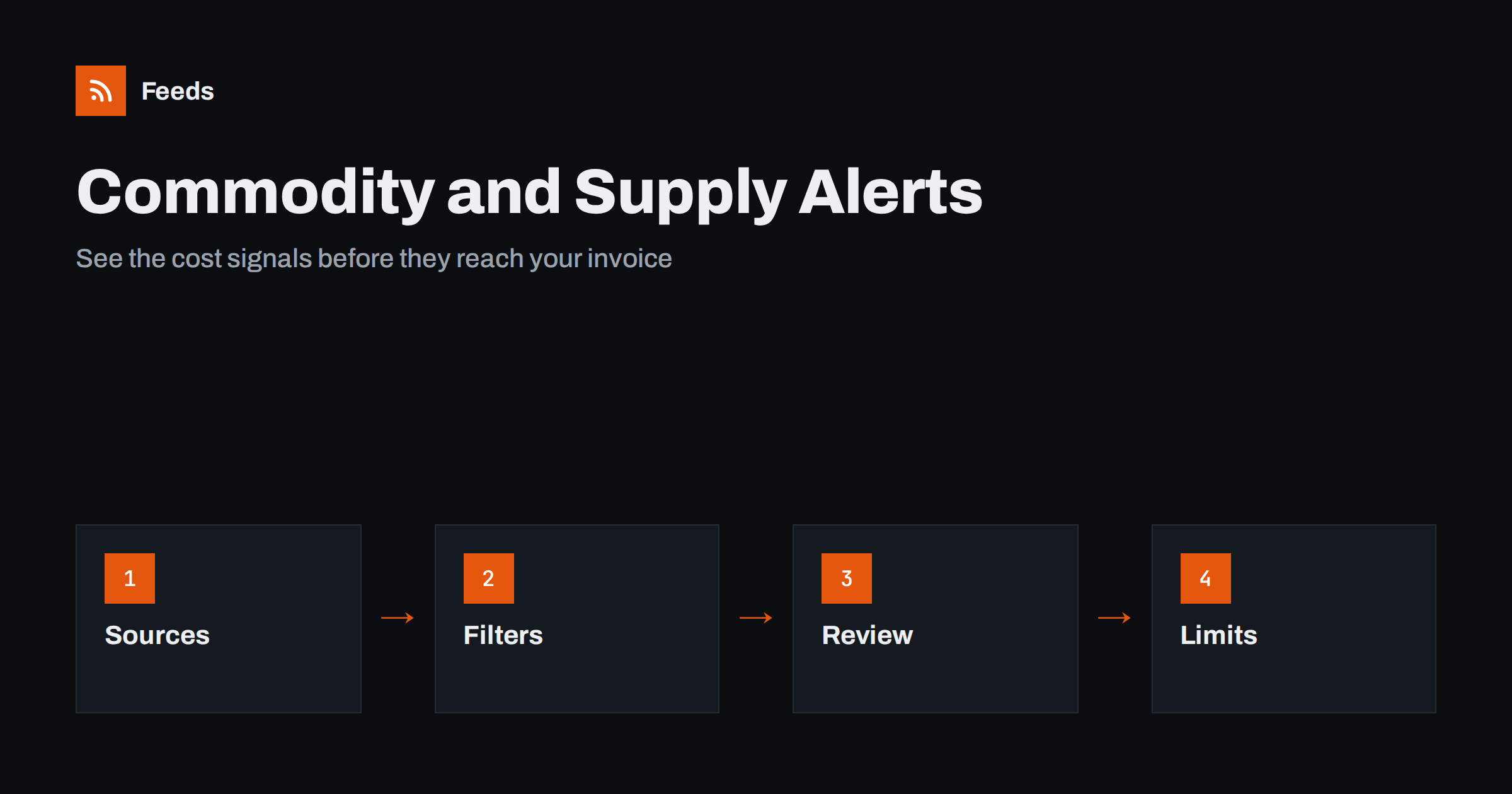
Short answer: If your costs depend on materials such as metals, grain, timber, energy, packaging or freight, price news arrives long before it shows up on a supplier’s invoice. RSS lets a buyer, a small manufacturer or a shop owner collect the relevant sources into one reader, filter them by material, region and keyword, and review them in a weekly routine. A feed will not forecast prices and does not replace a market data service or professional advice, but it gives you an early, calm view of the signals that matter to your business.
Why small businesses need an early view
Large companies employ analysts to watch commodity markets and supply routes. A small business usually learns about a price change when a supplier writes that prices will rise next month. By then the decision window has narrowed: you cannot easily change your price list, find another supplier or order ahead.
The information often existed earlier. Industry bodies published a note about a shortage, an agency reported a poor harvest, a port announced congestion, a government changed a duty. Each of these items is public, but it sits on a different page. If you buy materials or sell goods that depend on them, the habit of reading a short, well-chosen list of sources can give you weeks of notice. It is not prediction, just a better chance of not being surprised.
Decide what you actually need to know
Start with your own bill of costs. List the five materials or services that make up most of your spending: for a bakery it may be flour, butter and energy; for a furniture maker timber, fabric and freight; for a shop imported goods and shipping. For each, ask what would change your decisions: a price move of a certain size, a shortage, a change in duties, a disruption of a route or a supplier.
This list tells you which sources to follow. It also protects you from information overload. A feed of “everything about commodities” is useless; a feed about the three inputs that decide your margin is something you can read in ten minutes. Compare the approach in monitoring suppliers and partners for early risk signals.
Where signals come from
Good sources are close to the facts and open to the public. Typical categories are:
- Statistical offices and public agencies that publish price indices, harvest estimates and trade data. See alerts for new statistics and open data releases.
- Trade associations and industry bodies that publish market notes for their members’ materials; following industry associations and standards bodies with RSS explains how to find them.
- Regulators and customs authorities announcing duties, quotas and rule changes, as in tracking government and regulator updates with RSS.
- Ports, carriers and logistics providers that post notices about delays and routes; see tracking carrier and shipping disruptions.
- Your own suppliers, whose news pages often announce price lists and lead time changes first.
Commercial market reports and data services are often paid and have their own alerts. Use free public sources for early signals and check any price data against your own quotes.
Turning pages into feeds and merging them
Many agencies and associations publish news on pages without a feed. A page-to-feed tool reads the list of items on the page and builds a feed with titles, summaries and dates. How such tools find the items is explained in how page-to-feed tools find the articles on a web page. Check the preview before you rely on a feed, since a good preview shows real news items, not menus and cookie banners.
Once you have several feeds, merge them into one reader or one combined feed and filter it by the words that matter: the material names, the regions, the ports, the words “shortage”, “tariff”, “quota”, “delay”, “price increase”. The steps are in merging multiple RSS feeds into one clean feed and setting up keyword alerts using RSS feed filters. Start with wide filters and narrow them later.
Thresholds and a weekly review
Instant alerts are rarely useful for slow-moving costs. A good routine is one fixed weekly review, perhaps on Monday morning, in which you read the filtered list, note the two or three items that matter and decide whether any action is needed. Put a short line in a shared document: what happened, what it could mean for cost and what you will do or check. After a few weeks you will see patterns, such as which sources are early and which only repeat the news.
Keep thresholds for urgent action: a duty change that affects your imports, a supplier failure, a port closure that blocks a delivery. For those, use a narrow feed that goes to your phone or to the team channel; see RSS alerts as push notifications on your phone. If a filter keeps producing noise, tighten it rather than muting it, using the ideas in reducing noise in RSS alerts without missing anything.
Turning signals into decisions
A signal helps only if you can act on it. Possible actions include asking suppliers for a fixed price over a period, ordering earlier, holding a little more stock of an item that is hard to replace, finding a second supplier, adjusting your own prices at a planned time or telling customers early about a likely change. Each has costs, so decide in advance what kind of signal justifies which action.
Write down your reasoning when you decide. If a rise does not materialise, you can learn from it; if it does, you can show that the decision was based on evidence. Do not treat one news item as a trend. Look for confirmation from a second, independent source, and be sceptical of headlines that say prices will “soar” or “collapse” without data.
Sharing the picture with your team and customers
Cost signals are useful only when the people who make decisions see them. Share the weekly note with purchasing, sales and management, and agree who owns the follow-up. A shared reading list, rather than separate lists on each desk, keeps everyone on the same sources, and a channel for urgent items prevents the situation in which one person knows and nobody acts.
If you sell to business customers, early and honest communication about likely price changes builds trust. Explain what is happening in the market, show the sources you follow and give notice before changing prices. Customers forgive increases that they understand and dislike surprises. Take care not to make promises about future prices that you cannot guarantee, and do not disclose confidential supplier terms.
Limits and cautions
News is not a forecast. Markets react to events in ways that nobody predicts reliably, and public sources can lag behind private information. A feed gives you awareness, not an advantage over professional traders, and it must not be the sole basis for large financial commitments. If you hedge, buy futures or sign long contracts, take professional advice.
Be careful with units and currencies: a price per tonne is not a price per kilogram, and a figure in another currency needs conversion. Check the date and the definition of every price index you rely on. Respect the rules of the sites you read, and do not republish paid data. If you use external pages as sources, see is it legal to create RSS feeds from other websites?.
How RSS Feed Creator helps
RSS Feed Creator turns the news page, index release page or notice page of an agency, port or trade body into a clean RSS feed, even when the site has no feed of its own. It reads titles, images, summaries and dates, uses an existing feed when there is one, and shows a preview of the items before the feed is created. You can merge several sources into one feed (up to 10 on paid plans), keep only the items that contain your keywords and have duplicates removed automatically, which suits a themed watch on materials and routes. Feeds refresh every 3 hours on the free plan and every 30 minutes on paid plans, and paid plans send an alert when a page changes and a feed stops finding items. The free plan allows up to 20 items per feed, and the details are on the pricing page.
Related reading
- Monitoring Hundreds of Sources with RSS Without Chaos
- How to Track Product Recalls and Safety Notices with RSS
- How to Track Competitor New Products Automatically
The bottom line
Following commodity prices and supply chain news with RSS is a habit of reading a short list of public sources that bear on your costs. Choose the materials and routes that matter, merge the sources, filter by the right words, review weekly and decide in advance what each kind of signal should trigger. It will not predict the market, but it will make surprises on the invoice less frequent.
SSS
Can RSS predict commodity prices?
No. It delivers news and announcements from the sources you choose. You still need to interpret them, confirm with independent sources and, for large financial decisions, take professional advice.
Which sources should a small business follow?
Statistical offices, trade associations, regulators and customs authorities, ports and carriers, and your own suppliers’ news pages. Choose them from the materials and routes that make up most of your costs.
How often should I review the feed?
Once a week is enough for most businesses. Use a narrow feed sent to your phone only for urgent matters such as duty changes, supplier failures or route closures.
What if a source has no RSS feed?
A page-to-feed tool can read the list of items on the page and build a feed. Check the preview so that it shows real news items.
How do I avoid overreacting to one headline?
Look for confirmation from a second independent source, check the date and definition of any figure and decide in advance which signals justify action.