ENEnglish
 LTLietuviškai
 DEDeutsch
 FRFrançais
 RUРусский
 ESEspañol
 PLPolski
 ITItaliano
 UKУкраїнська
 CSČeština
 PTPortuguês
 JA日本語
 LVLatviešu valoda
 ETEesti
 HUMagyar
 IDBahasa Indonesia
 TRTürkçe
 HIहिन्दी
 ELΕλληνικά
 ARالعربية
 THไทย
 VITiếng Việt
 RORomână
 MSBahasa Melayu
 BNবাংলা
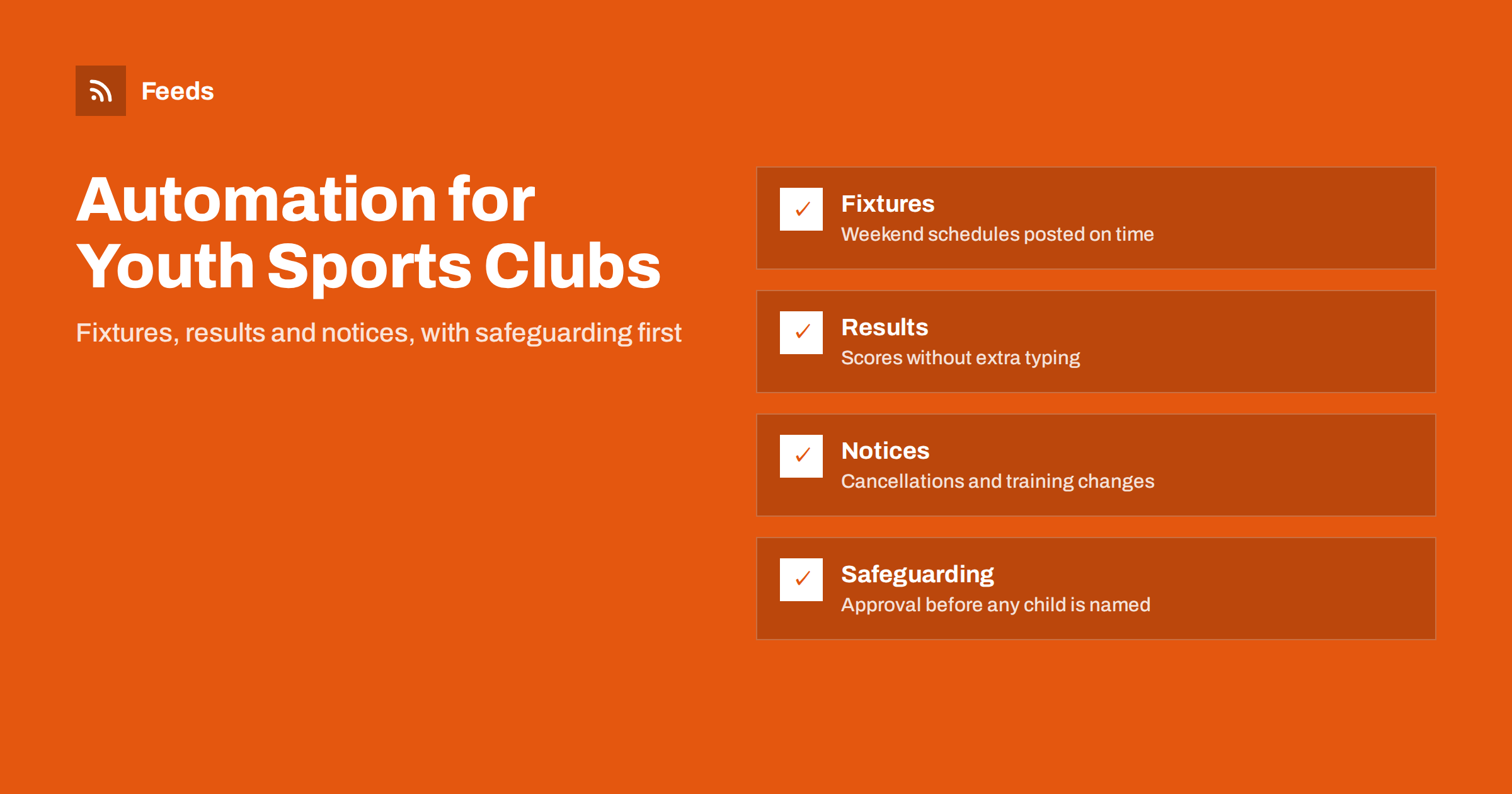
Short answer: A youth sports club runs on volunteers who are already stretched, and the weekly news (fixtures, results, training changes, cancellations, sponsor thanks) competes with coaching, kit and transport for their time. Content automation can take over the routine part by turning the league’s fixtures page, the club calendar and a few local sources into feeds that post on a schedule. The sensitive part, anything that names or shows a child, should always go through a person who checks consent and safeguarding rules before it is published.
What a youth club needs to say every week
Look at the noticeboard or the parents’ group chat of any junior club and you will see the same weekly list. Which teams play where and at what time. Who won. Whether training is on, moved or cancelled because the pitch is flooded. Which parent is bringing the oranges. A call for volunteers, a registration deadline, a fundraising evening, a thank-you to a sponsor. All of it is useful and almost all of it is repetitive.
It is usually spread over a league website, a booking system, a messaging group and the head of a volunteer secretary. Automation does not replace the secretary. It connects the places where the information already lives to the places where parents and players look for it. The general idea is explained in what content automation is.
Fixtures and results from the league
Most leagues publish fixtures and results on a website, often as a table or a list by team and date. If that page has no feed, one can be made from the page, so that each new fixture or result becomes an item. A weekly post on Thursday listing the weekend’s fixtures for every team, and a Sunday evening post with the results, covers the most requested information with no typing at all.
Check the output with a human eye the first few weeks. League pages vary, and a feed built from a table can mix up home and away or read a postponed match as played. Once the pattern is confirmed, a light check before each weekly roundup is enough. The method is described in how to follow sports clubs, leagues and fixtures with RSS, which covers the reader’s side of the same sources, and in how page-to-feed tools work.
Training times, cancellations and weather
Changes and cancellations are the messages parents care about most and the ones that should never be left to a slow schedule. Treat them differently from the routine flow. A cancellation should be posted by a person, immediately, to the channel parents actually watch, whether that is a messaging group or a notice on the site. Automation can still help in two ways: a standing weekly post with the training timetable, drawn from the club calendar, and a prompt to the coach when the weather service issues a warning for the area.
Weather and local disruption feeds, such as the council’s pitch closures or severe-weather warnings, can be merged into one stream and filtered by the name of your town. A warning prompts the human to decide; it does not announce a cancellation by itself. Sources and filters of this kind are covered in weather and natural hazard alerts with RSS.
Safeguarding comes first
Children make this niche different from every other small business. Before you automate anything that mentions players, agree the rules and write them down. The details depend on the country, the sport and the league, so check the guidance of your national governing body and your own data protection rules. Common principles include these:
- Do not publish children’s full names, photographs or videos without clear, recorded parental consent.
- Prefer team photos and first names or initials where the rules allow, and avoid linking names to schools or home areas.
- Never publish contact details of children or of volunteers who have not agreed to it.
- Keep an easy way for a parent to withdraw consent, and remove content quickly when they do.
- Put every post that contains a name or an image of a young person through an approval step, even if everything else is automatic.
Automation makes it easy to publish quickly, which is exactly why a person has to stay in the loop here. The practical difference between full automation and a checking step is laid out in full auto vs approval queue, and safe handling of accounts and access in securing content automation.
Match reports and sponsor posts
Match reports written by a volunteer, such as a coach or a parent, are the best content a junior club produces. Do not automate the writing. Do automate the delivery: let reports be sent to a single address or form, collect them in a queue, and release them on a schedule, one a day, rather than a pile on Monday morning.
Sponsors deserve regular, predictable visibility, since they pay for the kit. A standing rhythm helps: a monthly thank-you post, a sponsor name in the weekly fixtures post and a note when a new one joins. Do not let a scheduled template state prices, offers or claims on behalf of a sponsor that the sponsor has not approved.
Surviving volunteer turnover
Junior clubs lose their secretary or communications volunteer every few years, often when a child moves up to the next age group. A system that lives in one person’s head or personal accounts disappears with them. Write a one-page description of what is automated, which pages feed it, who approves what and where the logins are kept, and store it with the club’s other records. Use a shared club account, not a personal one, and give at least two adults access.
That page also makes it easy to answer a parent who asks why a message did or did not appear. The idea is covered in how to document your content automations so they last.
Where the posts go
Parents are not on the same channels as teenage players. A reasonable setup is a website news page and a Facebook page for parents and the wider community, a messaging group or an email list for urgent matters, and, if the club uses it, a separate older-teen channel managed by an adult. Keep urgent and routine messages apart so that parents do not learn to ignore the channel. The same feed items can drive each with a different template; guidance on wording is in writing post templates for automated social media feeds.
Frequency should be modest. A weekly fixtures post, a weekly results post and one or two extras is a good rhythm, and the balance between visibility and noise is discussed in how often should automated feeds post to social media.
A weekly rhythm for volunteers
- Monday: approve last weekend’s results post and any match reports in the queue.
- Thursday: the weekend’s fixtures, posted from the league page and checked by the secretary.
- Saturday and Sunday: cancellations or changes posted by hand and at once.
- Monthly: a sponsor thank-you and a volunteer call.
- Each term: a review of consent records and a check that every feed still finds items.
How RSS Feed Creator helps
RSS Feed Creator turns the fixtures page, results page or news list of a website into a clean RSS feed, even when the site has no feed of its own. It reads titles, images, summaries and dates, uses an existing feed when there is one, and shows a preview of the items before the feed is created. You can merge several sources into one feed (up to 10 on paid plans), keep only the items that contain your keywords, such as your club or team name, and have duplicates removed automatically. Feeds refresh every 3 hours on the free plan and every 30 minutes on paid plans, and paid plans send an alert when a page changes and a feed stops finding items. The free plan allows up to 20 items per feed, and the details are on the pricing page.
Related reading
- Content Automation for Gyms, Fitness Studios and Coaches
- Content Automation for Nonprofits and Community Groups
- Brand Safety for Automated Posting: Filters That Protect You
The bottom line
A youth club can automate the routine and keep the human parts human. Turn the league page and the club calendar into feeds, schedule the weekend roundup, keep urgent changes in a person’s hands and send anything that names or shows a child through an approval step. Volunteers get their evenings back, and parents get the news on time.
FAQ
What can a youth sports club safely automate?
Weekly fixtures and results from the league page, the standing training timetable, reminders of registration deadlines and regular sponsor thanks. Anything that names or shows a child should be checked by a person first.
Should cancellations be automated?
No. A cancellation should be posted by a person, immediately, to the channel parents watch. Automation can bring weather warnings to the coach’s attention, but the decision and the message stay human.
Can we post photos of the players?
Only in line with your governing body’s rules and with recorded parental consent. Prefer team photos, avoid linking names to schools or addresses and remove images quickly if consent is withdrawn.
Our league website has no RSS feed. Can we still use it?
Yes. A feed can be created from the fixtures or results page itself, provided the information is on a public page. Check the first few weeks of output to confirm it reads home, away and postponed matches correctly.
How much time does this save?
The routine weekly posts no longer need to be typed, so volunteers mainly approve and add the human parts. The time saved depends on the number of teams, but the weekly roundups are usually the biggest gain.