ENEnglish
 LTLietuviškai
 DEDeutsch
 FRFrançais
 RUРусский
 ESEspañol
 PLPolski
 ITItaliano
 UKУкраїнська
 CSČeština
 PTPortuguês
 JA日本語
 LVLatviešu valoda
 ETEesti
 HUMagyar
 IDBahasa Indonesia
 TRTürkçe
 HIहिन्दी
 ELΕλληνικά
 ARالعربية
 THไทย
 VITiếng Việt
 RORomână
 MSBahasa Melayu
 BNবাংলা
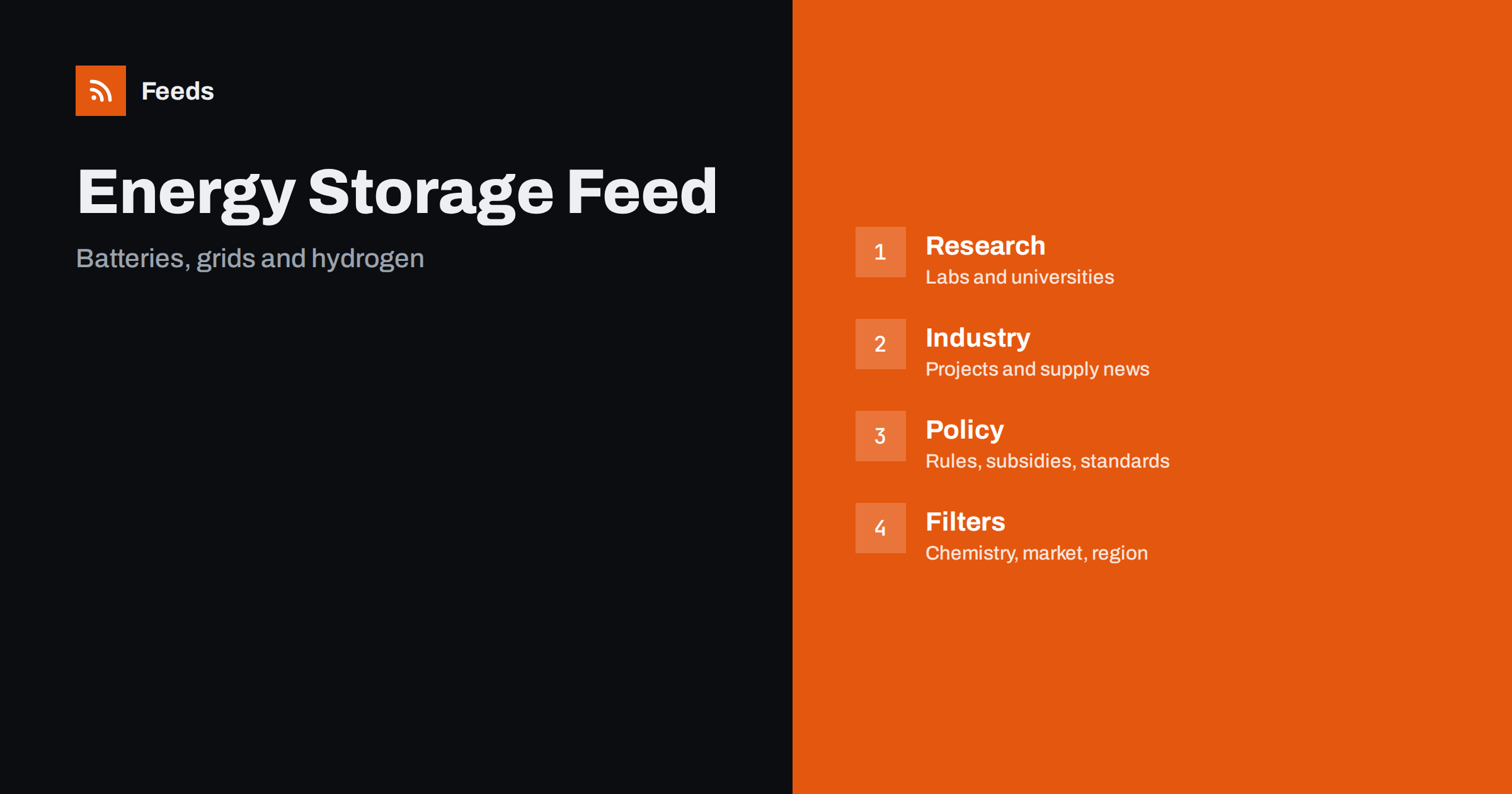
Short answer: Energy storage news comes from research labs, universities, grid operators, regulators, industry associations, manufacturers and trade media. RSS gathers them in one reader, so engineers, investors, students and journalists can follow batteries, grid storage and hydrogen without checking dozens of websites. Start with research and policy sources, add industry news, filter by technology or region and treat company announcements as claims until independent sources confirm them.
Decide which part of the field matters to you. Someone who installs home batteries needs different news from someone who studies chemistry or invests in grid projects. Defining your focus in a sentence keeps your feed sharp and stops it from turning into a general technology feed that you never finish.
A fast-moving field with many voices
Storage is central to the energy transition. Batteries for vehicles and homes, large systems that support the grid and hydrogen as a fuel or a feedstock all attract investment and attention. News arrives from many directions: scientific papers about new chemistries, factory announcements, regulatory decisions, subsidy programmes, standards updates and market reports.
The flow is too fast and varied to follow by hand. A feed lets you choose sources, keep them in folders and read items in order. If you are new to the tool, what is an RSS feed explains it in a few minutes. It is especially useful in a field where announcements and corrections follow each other quickly.
Add the websites of leading research groups you respect. Their news pages and blogs often explain methods in simple words. Over a year you will learn which groups publish careful work and which tend to overstate, and that knowledge will help you read every future headline.
Research and technology sources
Universities and national laboratories publish news about new materials, cell designs, recycling methods and system tests. Journals and preprint servers publish papers, and some provide feeds by topic. Standards bodies and testing organisations publish updates on safety and performance rules. These sources give the technical base for understanding claims.
When you see an exciting result, check what was tested: a laboratory cell, a prototype or a product in use. Note the conditions, the number of cycles and the cost, since a result in a lab may need years before it reaches the market. How to follow academic journals and research with RSS alerts explains the setup, and follow manufacturing and Industry 4.0 news with RSS covers the factory side.
Keep a calendar for consultations and auctions. Many storage projects depend on market rounds with fixed dates, and missing a date can delay a project by a year. Put these dates in a shared calendar, and share the link with your team so that everyone can see what is coming.
Grids, regulators and policy
Storage depends on rules: how it is connected to the grid, how it is paid for services, what subsidies exist and what safety standards apply. Regulators, grid operators and ministries publish consultations, decisions and market rules. These items often have deadlines for comments, and they shape which projects are viable.
Follow them in a separate folder and write each deadline in your calendar. Follow energy market and electricity price news with RSS and track regulator updates with RSS list useful sources. Policies differ by country, so make sure that an item applies to your market before acting on it.
Track a few projects over time. Pick five announced projects and follow each through permits, financing, construction and operation. This shows how many plans reach completion and how long it takes, a lesson that no single headline can give you.
Industry, projects and supply chains
Manufacturers, developers and utilities announce projects, partnerships, factory plans and contracts. Trade media report on them with commentary. Supply chain news, such as the availability of raw materials, prices and trade rules, can affect costs and timelines. A feed of these sources helps buyers, installers and investors plan.
Read announcements with care. A planned factory is not a running factory, and a megawatt-hour figure in a press release may describe capacity that will be built over several years. Compare the announcement with permits, financing news and later updates. Commodity prices and supply chain news with RSS and follow mining and metals industry news with RSS show where the materials side is covered.
Create a separate folder for terms that you only want to hear about rarely, such as a new chemistry that is not yet commercial. Check this folder monthly instead of daily. It keeps rare but important news from drowning in the daily flow and from being lost.
Filter by technology, market or region
The subject is wide, so use filters. A battery engineer may follow “solid-state”, “sodium-ion”, “thermal management” and “recycling”. A grid analyst may follow “frequency response”, “capacity market” and “interconnection”. A hydrogen specialist may follow “electrolyser”, “storage”, “pipeline” and “fuel cell”. A homeowner may follow “home battery”, “solar” and “tariff”.
Add synonyms and spelling variants, such as “accumulator” or “BESS”. Exclude words that bring unrelated results, such as shares tips or job adverts, if you do not need them. Set up keyword alerts using RSS feed filters explains the method, and how to reduce RSS alert noise helps when the feed grows too fast.
Share safety lessons responsibly. When an incident happens, wait for the investigation instead of guessing the cause, and share official findings. Clear and calm communication helps homeowners and installers to act sensibly and reduces fear.
Safety, incidents and recalls
Batteries and hydrogen systems carry safety risks, and incidents and recalls are published by regulators and manufacturers. Following these helps installers, fleet managers and homeowners. Treat official safety notices as priority items, and read them even if they seem to concern a product you do not own, since they may reveal patterns.
Product recalls are covered by many agencies, and product recall alerts with RSS shows how to follow them. If you work in the field, keep a list of standards and codes that apply to your work, and watch for updates.
A practical habit is to keep a comparison table of claims and results. Write what a company said it would deliver and when, and what actually happened. After a year, the table is the most useful part of your feed, because it shows which announcements deserve trust.
Money, markets and caution
Storage companies attract investors, and news about funding rounds, listings and valuations is common. Treat it as business news, not as technical evidence. Share prices and forecasts change, and enthusiasm is often higher than reality. If you make financial decisions, rely on audited reports and professional advice, not on feed headlines alone.
Consider the date of each source. Costs in this field fall quickly, and a report from three years ago may be out of date. When you quote a number, state its date and source. A calm, evidence-based approach is the best protection against hype and against unnecessary fear.
If you work in a team, share a list of sources with notes on why each is included and who owns it. When someone leaves, the list stays useful. A shared list of fifteen well-chosen sources is worth more than a private list of a hundred.
Sources without a feed
Many grid operators, local projects and small manufacturers publish news pages but no feed. A page-to-feed tool turns the news list into a feed. How to create an RSS feed for a website without RSS explains the process, and monitor websites for new content shows how to keep watch on pages that matter.
Always check the preview. Titles should read well, dates should be right and links should open the correct pages. Revisit these feeds every few months, since projects end and sites change.
How RSS Feed Creator helps
RSS Feed Creator turns regulator, grid operator and industry association news pages into clean RSS feeds, even when the site has no feed of its own. It reads titles, images, summaries and dates, uses an existing feed when there is one, and shows a preview of the items before the feed is created. Keyword filters keep only the items that contain your words, and the paid add-on lets you merge up to 10 sources into one feed with duplicates removed automatically, which suits a feed of rules, projects and research by technology. Feeds refresh every 3 hours on the free plan and every 30 minutes on paid plans. The free plan allows up to 20 items per feed, and the details are on the pricing page.
Related reading
- How to Follow Energy Market and Electricity Price News with RSS
- How to Follow Academic Journals and Research with RSS Alerts
- How to Follow Climate and Environment News and Reports with RSS
The bottom line
A feed makes energy storage, battery and hydrogen news manageable: research and policy first, then industry and markets, filtered by technology and region. Read claims with care, watch deadlines and safety notices and keep sources fresh.
الأسئلة الشائعة
Which sources should I add first?
A national laboratory or university, your energy regulator, an industry association and one or two trade media outlets.
How do I judge a battery breakthrough?
Check whether it was tested in a lab cell or in a product, how many cycles and at what cost, and whether others have repeated it.
Can I follow a grid operator without a feed?
Yes. A page-to-feed tool can create a feed from its news page, and you should check the preview.
How do I avoid too much noise?
Use specific technology keywords, exclude unrelated words and review your sources every few months.
Are company announcements reliable?
Treat them as claims and look for permits, financing news and independent confirmation.