ENEnglish
 LTLietuviškai
 DEDeutsch
 FRFrançais
 RUРусский
 ESEspañol
 PLPolski
 ITItaliano
 UKУкраїнська
 CSČeština
 PTPortuguês
 JA日本語
JA日本語 LVLatviešu valoda
 ETEesti
 HUMagyar
 IDBahasa Indonesia
 TRTürkçe
 HIहिन्दी
 ELΕλληνικά
 ARالعربية
 THไทย
THไทย VITiếng Việt
 RORomână
 MSBahasa Melayu
 BNবাংলা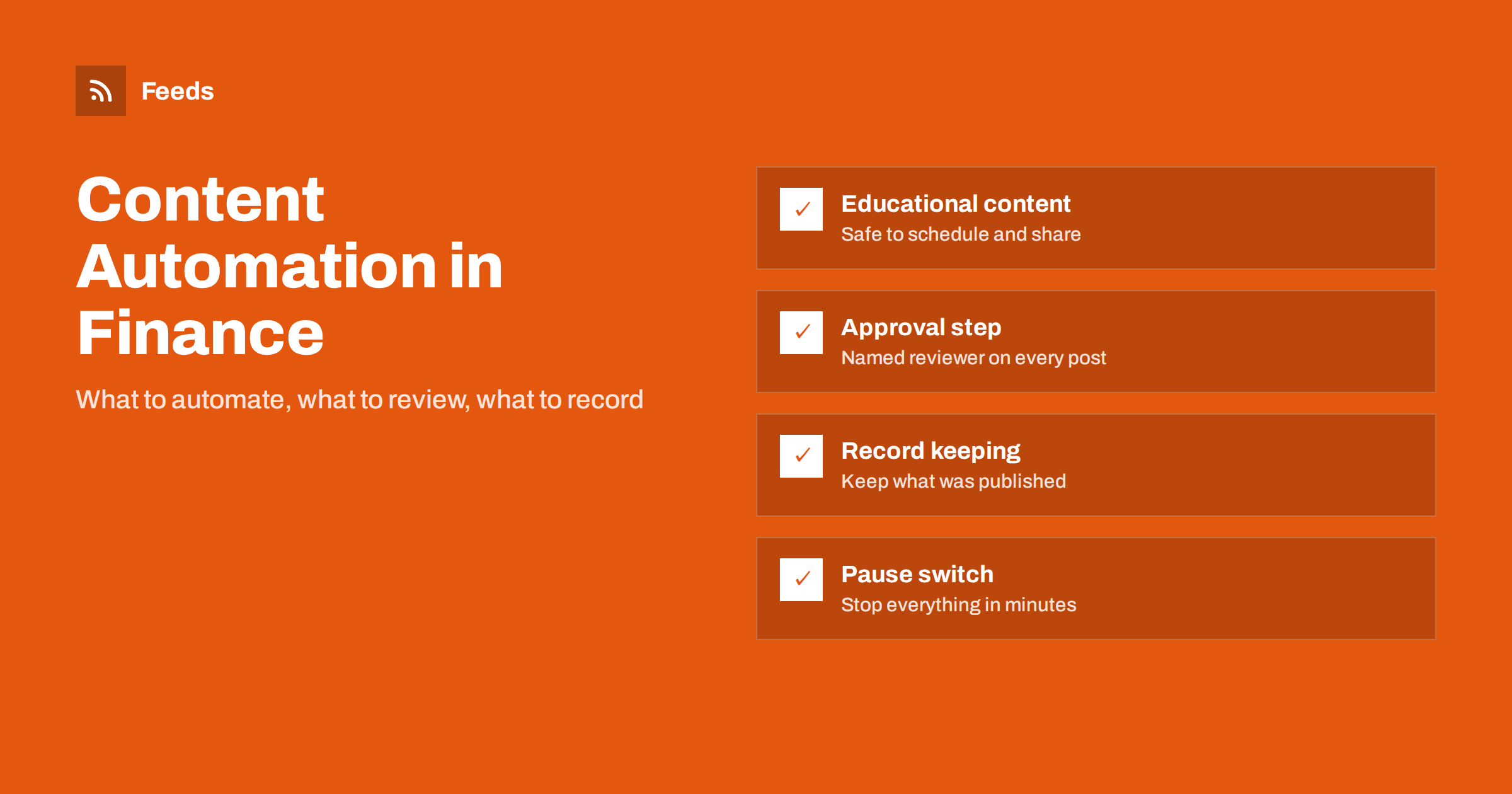
Short answer: Financial services firms can use content automation for educational articles, market-neutral news and event announcements, as long as every post that makes a claim, mentions performance or could be read as advice goes through a human approval step first. Keep a record of what was published and when, restrict who can change the automation, and agree the rules with your compliance officer before you switch anything on. Rules differ by country and by type of firm.
Why finance needs a different approach
In most industries a wrong social post is an embarrassment. In financial services it can be a regulatory problem. Rules about financial promotions, investment advice, performance claims and customer communications apply to social media and websites as much as to brochures, and they are usually stricter than people expect. A casual line such as “our fund beat the market again” can be a breach if it lacks the required context or disclosure.
Automation adds speed, and speed is the enemy of caution. A system that publishes a post the moment a source changes can publish a mistake just as fast. The answer is not to avoid automation, but to decide what it may do alone, what must be reviewed and how you will prove afterwards what happened.
This article is a practical guide, not legal advice. Regulations differ between countries and between types of firm, so confirm every point with your compliance officer or legal adviser.
Content that is usually safe to automate
Some content carries little risk because it is educational, factual and neutral. Typical examples include:
- new articles from your own blog or knowledge centre that have already been approved for the website;
- explanations of general concepts, such as how a mortgage works or what a pension fee covers;
- announcements of webinars, events and office opening hours;
- job openings and company news;
- links to official public information, such as a regulator’s consumer warnings.
The key idea is a single point of approval. If an article has been reviewed before it is published on your website, sharing its headline and link to your channels adds little new risk. The review happens once, at the source, and the automation only repeats it.
Content that must be reviewed first
Other content needs a person to approve it before it goes out, every time. This group includes anything that:
- mentions returns, performance, rates, fees or prices;
- recommends or appears to recommend a product, a security or a course of action;
- comments on market movements or a named company;
- uses testimonials or customer stories;
- involves a promotion, an offer or a call to action to invest or borrow.
Many firms add required wording, such as risk warnings or the statement that past performance is not a guide to the future. If a post template cannot carry the required wording, do not automate that type of post. An approval queue, in which items wait for a named reviewer, is the simplest control. The trade-offs are explained in full auto vs approval queue.
Using feeds to monitor, not to broadcast
Much of the value of automation for a financial firm is monitoring, which carries no publishing risk. Feeds can bring together:
- regulator and supervisory authority announcements, as in tracking government and regulator updates with RSS;
- official statistics and open data releases;
- investor relations news from companies you follow, as in tracking investor relations announcements;
- mentions of your firm and competitors in the press;
- consumer warnings and fraud alerts that affect your customers.
Merge these into one filtered feed and send the results to an internal channel for the team. Nothing leaves the firm, nobody has to check twenty websites, and the compliance team can see what the business is tracking.
Records and audit trail
Many financial regulators expect firms to keep records of public communications, including social media posts, for a set period. What exactly must be kept, and for how long, depends on your jurisdiction and your licence, so ask. From the automation side, make sure you can answer these questions at any time:
- What was published, on which channel and at what time?
- Which source item and which template produced it?
- Who approved it, if approval was required?
- Who changed the rules, the sources or the templates, and when?
Keep the settings of each automation documented, with a date and an owner, as described in how to document your content automations. If your tools do not keep a history, export it regularly or keep a simple log yourself.
Access control and account security
An automation that can publish on behalf of a financial firm is a valuable target for attackers. A hijacked account that posts a fake investment offer causes damage fast. Use unique strong passwords and multi-factor authentication on every account involved, give access only to people who need it, and remove it as soon as someone leaves the team. Review connected apps and tokens regularly and revoke those you no longer use. The checklist in securing content automation: accounts, tokens and access goes through the steps.
Separate roles where possible: one person sets up sources and templates, another approves what goes out. This reduces the chance of a single error or a single compromised account causing harm.
A pause plan for market events
Financial news can change quickly. A market shock, a data breach, a product problem or a public holiday message that suddenly looks tone-deaf are all reasons to stop scheduled posts at once. Agree in advance who can pause the automation, how they do it and who is told. Test the pause before you need it. The practical steps are in when to pause automated posting: a crisis and holiday plan, and the filters that keep unwelcome content out are in brand safety for automated posting.
How RSS Feed Creator helps
RSS Feed Creator turns pages that have no feed, such as a regulator’s announcement list or a company news page, into clean RSS feeds with titles, summaries and dates, and shows a preview before anything is created. It can merge up to ten sources into one feed, remove duplicates and keep only items that contain, or do not contain, the words you choose. That makes it useful for the monitoring side of a compliance-conscious workflow. It reads public pages from the outside and does not need access to the source site. Plans are on the pricing page.
Templates and wording for regulated content
Templates are your friend in a regulated setting, because they make wording predictable. Write each post type once, have it approved, and let automation fill in only the variable parts, such as the headline and the link. A typical template for a blog article might be: the article title, one neutral sentence describing what the article explains, and the link. It contains no claim that could be wrong.
Avoid templates that pull free text from the source into the post, such as a long excerpt, unless the source text has itself been approved for that use. Be careful with hashtags and automatic mentions, which can attach your post to topics or companies you did not intend. Review the wording at least once a quarter and whenever your rules or products change. The guide to writing post templates for automated social media feeds shows how to build templates that stay safe.
Finally, think about tone. Financial topics are sensitive for customers, and an automated post that sounds cheerful next to bad news can do harm. Keep the language calm and factual, avoid urgency such as “act now”, and review the schedule around days when markets or the news are unusually volatile. A small team that reviews the queue each morning is usually enough to catch problems before they reach the public.
Related reading
- Content automation for law, accounting and consulting firms
- Content automation checklist: 30 checks before you go live
- 12 content automation mistakes and how to avoid them
The bottom line
Financial firms can benefit from content automation if they separate the safe from the sensitive. Automate educational, already approved content and internal monitoring, put every post that touches performance, advice or offers behind a named approver, keep a record of what was published, secure the accounts and prepare a pause plan. Agree all of this with compliance first, because the rules that apply to you may be stricter than any general guide.
FAQ
Can a bank or adviser publish automatically to social media?
Often yes, for content that has already been approved on the website and carries no promotion or advice. Anything that mentions returns, recommendations or offers should be approved by a person first. Check your specific obligations with your compliance team.
What records should we keep of automated posts?
Keep what was published, where, when, from which source and who approved it, and keep a history of changes to the automation settings. The retention period depends on your regulator, so ask your compliance officer.
Is it safe to share market news automatically?
Sharing a headline and link can still be read as a comment on a security or market. Use neutral wording, avoid anything that looks like advice and put sensitive topics through an approval step.
How can we use feeds without publishing anything?
Use them for monitoring: collect regulator announcements, press mentions and company news into one filtered feed and send it to an internal channel. This gives the team the information with no publishing risk.
Who should be able to change the automation settings?
Only a small named group, with multi-factor authentication on their accounts. Separate the person who sets up sources and templates from the person who approves posts, and review access whenever staff change.