ENEnglish
 LTLietuviškai
 DEDeutsch
 FRFrançais
 RUРусский
 ESEspañol
 PLPolski
 ITItaliano
 UKУкраїнська
 CSČeština
 PTPortuguês
 JA日本語
 LVLatviešu valoda
 ETEesti
 HUMagyar
 IDBahasa Indonesia
 TRTürkçe
 HIहिन्दी
 ELΕλληνικά
 ARالعربية
 THไทย
 VITiếng Việt
 RORomână
 MSBahasa Melayu
 BNবাংলা
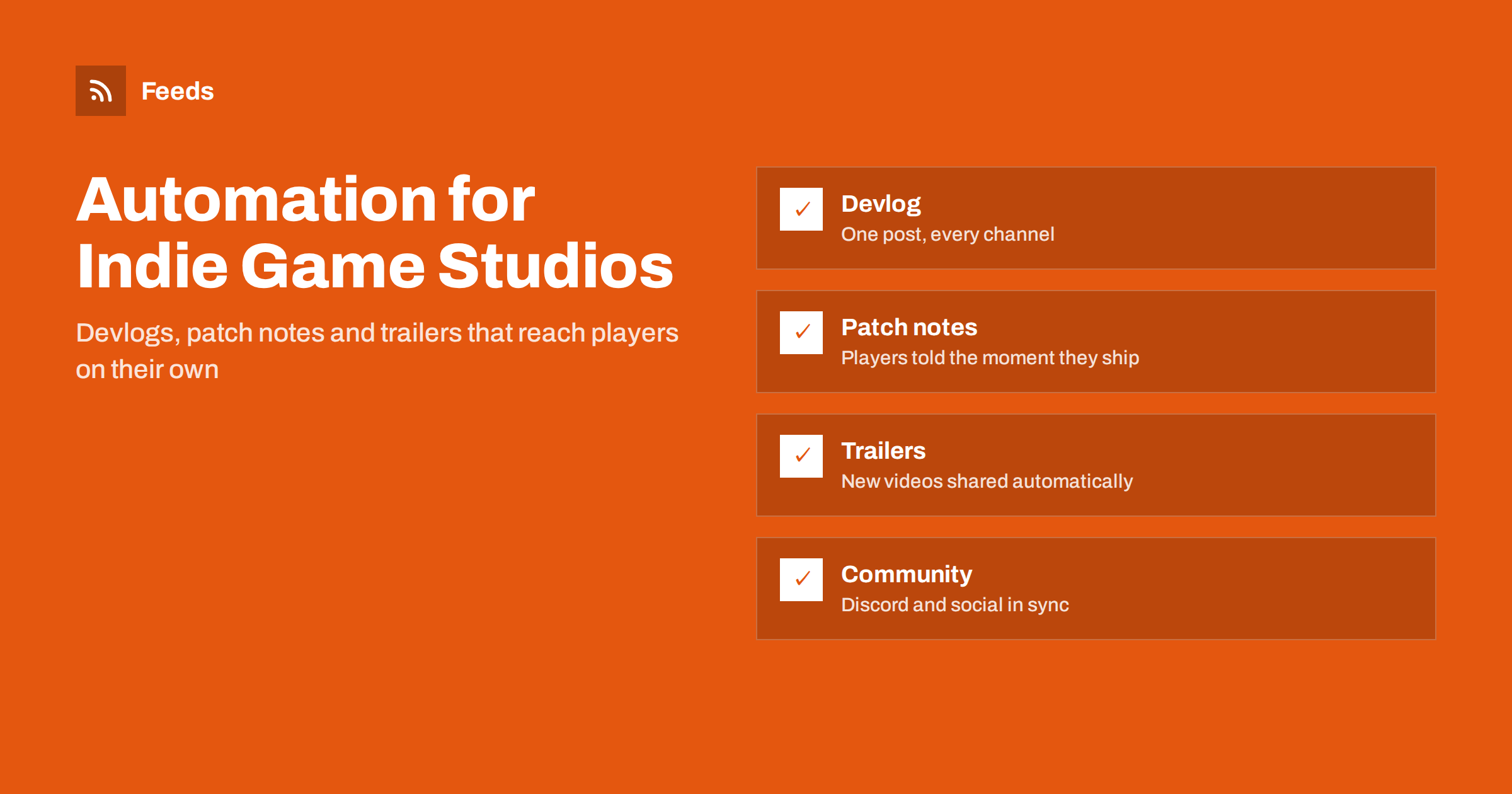
Short answer: A small studio produces a steady stream of updates while building a game, such as devlogs, patch notes, screenshots, trailers and store page announcements, but a team of two or three rarely has anyone whose job is to post them. Content automation takes the places where that material already appears, like the devlog, the changelog, the video channel and the store page news, turns each into a feed, and posts new items to Discord, X, Bluesky, Mastodon and the newsletter on a schedule. The developers keep writing in one place, and a short approval step catches anything that should wait for a launch date.
The problem: marketing is nobody’s job
Most indie studios know that a game needs a community before launch, and most have read the advice to post regularly for a year or more before release. Then the build breaks, a publisher wants a demo, and the social accounts go quiet for six weeks. The problem is not a lack of material. A studio that is actually working has new screenshots every week, a changelog that grows every sprint and a devlog that the lead writes at midnight. The problem is that each of those lives in a different place, and getting them onto five platforms is a job nobody has.
Automation does not make the devlog more interesting, and it will not replace the launch trailer campaign. What it does is make sure that the normal, routine output of the studio reaches players without anyone copying and pasting. The basic idea, and what it can and cannot do, is set out in what content automation is.
Sources a studio already produces
Almost everything worth posting already exists somewhere public or semi-public:
- The devlog. On the studio site, a blog platform or a game store’s community section. The richest source and the one players share most.
- Patch notes and the changelog. In the store’s update section, a page on the site or a repository. Every entry is a post that tells players the game is alive.
- The video channel. Trailers, gameplay clips and streams. Every upload is a post.
- The store page news. Announcements, sales and festival participation, usually posted in the store’s own system and nowhere else.
- Screenshots and GIFs. Often shared in the team chat and never anywhere public.
- Press and community coverage. Reviews, streams by others, mentions in round-ups.
The first four can be turned into feeds and automated. Screenshots need a tiny bit of process: a shared folder or a private channel that one person turns into a weekly post. Coverage is a monitoring job, handled with keyword alerts rather than publishing.
Patch notes as a feed
Patch notes are the most underused source. Players who have bought the game want to know that bugs are being fixed, and players who are undecided take a visible update history as a sign that the game will be supported. If the changelog is a page on your site, give it a feed; if it is inside a store, the store’s news section usually has one, or a feed can be created from the public page. Each new entry then becomes a post with a template: version number, two or three headline changes, a link to the full notes. The format players actually read is described in how to publish a changelog RSS feed.
Keep the template honest. “Fixed crash when loading saves” is a better post than “exciting new update”, and it is what the feed item already says. The automation is only reposting your own words.
Devlogs and screenshots
A devlog post is a natural social post: a title, an image and a link. The automation picks up each new entry and posts it to every channel with the first image attached. Two details make the difference. First, make sure the devlog feed includes the image, otherwise posts go out as bare links and get ignored. Second, write the devlog title for the social post, because that is where most people will see it. “Devlog 14” tells nobody anything; “How we made the water look wet (devlog 14)” does.
Screenshot Saturday and similar community rituals can be half-automated: one person drops the week’s best shot into a feed source such as a gallery page on the site, and the schedule posts it with a fixed caption format. The caption templates that work for repeated posts, and the mistakes to avoid, are covered in writing post templates for automated social media feeds.
Trailers and video
Every video channel exposes a feed of uploads, and a new trailer or gameplay clip is the single most shareable thing a studio makes. Connect the channel feed so that each upload becomes a post with the thumbnail and link, and add a delay of an hour or two so that the video is fully processed and the description is final before the post goes out. The setup is explained in how to auto-share new YouTube videos using the channel feed. Streams are different: a recorded stream is rarely worth an announcement post, so filter the feed by title keyword so that only uploads marked as trailers or clips are shared.
Where the posts go: Discord first
For most indie games the community lives on Discord, so the first destination is an announcements channel there, fed automatically from the devlog, patch notes and video feeds. The method, with the formatting that works in Discord, is in how to post RSS feed items to Discord automatically. Then the public networks: X remains important for reaching press and other developers, Bluesky and Mastodon have active game development communities, and a short newsletter assembled from the same feeds reaches the wishlisters who never open social media. The steps for the two decentralised networks are in how to auto-post an RSS feed to Mastodon and Bluesky.
Do not post everything everywhere. Patch notes belong on Discord and the store; the devlog belongs everywhere; a trailer belongs everywhere and deserves a hand-written post as well. Set the routing per source, not per studio.
The approval step and launch secrecy
Game marketing has embargoes, publisher sign-offs and festival announcement windows, and an automated post that reveals a date or a platform a day early is a real problem. The fix is simple: route devlog and store news through an approval queue where one person reads the post before it is sent, and keep patch notes and video uploads on full automation because they are already public by the time the feed sees them. When to use each mode is discussed in full auto vs approval queue. During a launch week, pause the automation entirely and post by hand; the hand-written posts matter more then, and a scheduled devlog repost landing in the middle of the launch thread looks careless.
Monitoring, not just publishing. The same tools work in the other direction. Set keyword alerts for the game’s name across the stores’ review feeds, video platforms and the press you care about, and route them to a private Discord channel. A stream by a mid-sized creator or a mention in a weekly round-up is something to reply to the same day, and a studio of three will miss it without an alert. Keep the alert feed separate from the publishing feeds so that nothing from monitoring is ever reposted by accident.
A weekly rhythm for a tiny team
- Whenever they ship: patch notes and video uploads post automatically.
- Weekly: one devlog, approved and posted everywhere; one screenshot post from the gallery feed.
- Daily, five minutes: check the approval queue and the mentions channel.
- Launch and festival weeks: automation paused, posts written by hand.
Run through the content automation checklist before switching it on, and look at the posts as a player would once a month. If the devlog feed stopped including images or the store changed its news page layout, you will see it there before the community does.
How RSS Feed Creator helps
RSS Feed Creator turns the devlog, news page or changelog of a website into a clean RSS feed, even when the site or store page has no feed of its own. It reads titles, images, summaries and dates, uses an existing feed when there is one, and shows a preview of the items before the feed is created. You can merge several sources into one feed (up to 10 on paid plans), keep only the items that contain your keywords, which is how you separate trailers from stream recordings, and have duplicates removed automatically. Feeds refresh every 3 hours on the free plan and every 30 minutes on paid plans, and paid plans send an alert when a page changes and a feed stops finding items. The free plan allows up to 20 items per feed, and the details are on the pricing page.
Related reading
- How to Post RSS Feed Items to X (Twitter) Automatically
- Content Automation for SaaS Companies: A Practical Plan
- How to Set Up Keyword Alerts Using RSS Feed Filters
The bottom line
An indie studio already makes enough material to stay visible; it just never leaves the devlog, the changelog and the video channel. Turn each into a feed, send patch notes and videos out automatically, put devlogs and store news through a quick approval step, route Discord first and the public networks second, and pause everything during launch week. The team keeps building, and the community keeps hearing from them.
KKK
What should a game studio automate first?
Patch notes and video uploads, because they are already public when the feed sees them and they are the clearest signal that the game is alive. Devlogs come next, with a quick approval step so nothing goes out before an announcement date.
Our devlog is on a store’s community page. Can it be automated?
Usually yes. Many store community sections provide a feed, and where they do not, a feed can be created from the public page. Each new entry then becomes a post on Discord and the social networks.
How do we stop automation leaking a launch date?
Route devlogs and store news through an approval queue, keep only patch notes and videos on full automation, and pause everything during launch and festival weeks. Automation should only repost things that are already public.
Should every stream recording be posted?
No. Filter the video channel feed by keywords in the title so that only trailers and clips are shared. A full stream recording rarely deserves an announcement post on every network.
Is Discord or X more important for an indie game?
Discord is where existing players and wishlisters gather, so it should be the first destination for every update. X, Bluesky and Mastodon reach press, other developers and new players; route devlogs and trailers there, and patch notes mainly to Discord.