ENEnglish
 LTLietuviškai
 DEDeutsch
 FRFrançais
 RUРусский
 ESEspañol
 PLPolski
 ITItaliano
 UKУкраїнська
 CSČeština
 PTPortuguês
 JA日本語
JA日本語 LVLatviešu valoda
 ETEesti
 HUMagyar
 IDBahasa Indonesia
 TRTürkçe
 HIहिन्दी
 ELΕλληνικά
 ARالعربية
 THไทย
THไทย VITiếng Việt
 RORomână
 MSBahasa Melayu
 BNবাংলা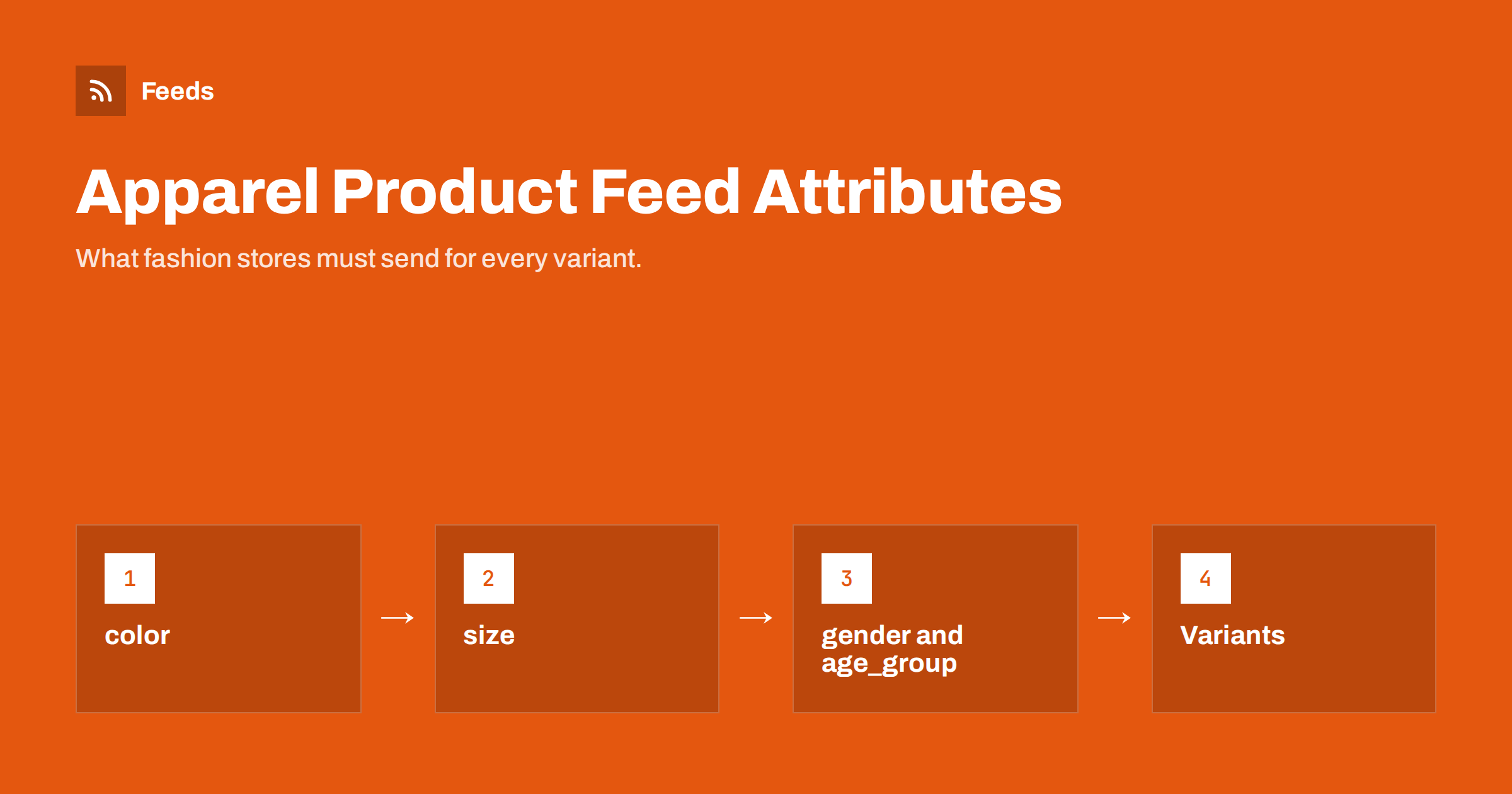
Short answer: Clothing, shoes and accessories need extra attributes in product feeds. For apparel targeting many countries, including the US, UK, Germany, France, Japan and Brazil, Google requires color, size, gender and age_group, plus item_group_id for variants. Send each size and color combination as its own item, use color names shoppers understand, sizes exactly as shown on the page, and consider size_system and size_type for international catalogs. Images should show the variant’s color.
Why apparel has extra requirements
Fashion shoppers filter by size, color and gender more than shoppers in almost any other category. Someone looking for women’s running shoes in size 39 wants to see only those, and Shopping surfaces offer filters that depend on exactly these attributes. Without them, products cannot appear in filtered results and are harder to match with specific searches.
That is why Google makes these attributes mandatory for apparel and accessories in its main markets, and why Meta uses the same attributes for variant grouping and filtering. The requirement applies to the category, not to the store: a general store selling a few T-shirts faces the same rules as a fashion brand for those items.
Apparel is also where variants multiply fastest. A single style in five sizes and four colors is twenty items, each with its own stock. Getting the structure right early saves a lot of work as the catalog grows.
Returns are another reason to care. Wrong expectations about color, size or fit are among the most common reasons for apparel returns. Clear attributes and matching images do not eliminate returns, but they reduce the ones caused by shoppers clicking on something that turned out to be different from what the listing suggested.
color
The color attribute should contain the color as a shopper would describe it, such as “Navy”, “Black” or “Olive”. Guidelines that help:
- Use real color names, not internal codes like “C-104” or supplier names like “Midnight Sky” without a common color. If you want the creative name, combine them: “Midnight Sky Blue”.
- For multicolor items, list the main colors separated by slashes, up to the limit Google documents, for example “Black/White”.
- Keep names consistent across the catalog. “Grey”, “Gray” and “grey” should not all appear.
- Make sure the image for that item shows the same color.
If your store uses swatches with creative color names, keep a simple mapping table from each creative name to a standard color. The mapping takes an hour to build and is reused for every new collection.
Color also belongs in the title of each variant, so that listings are distinguishable at a glance.
size, size_system and size_type
size should match the size shown on the product page and in the size selector: “M”, “38”, “10.5”, “W32 L34”. Do not convert sizes in the feed if the page shows the original size.
- size_system tells Google which country’s sizing the value uses, such as US, UK, EU, DE, FR, JP or IT. It matters for shoes and for international catalogs where “38” means different things.
- size_type distinguishes regular, petite, plus, tall, big and maternity sizing.
For one-size items, such as scarves or some hats, use “One size” or the equivalent value Google accepts. Consistent size values make filters work properly; mixing “Medium” and “M” splits the same size into two filter options.
If your products use international size labels, such as “EU 42 / UK 8”, decide on one primary value per market and use it consistently in the size attribute, with size_system describing it. Mixing formats within one feed makes filtering unreliable.
gender and age_group
gender accepts male, female or unisex. age_group accepts newborn, infant, toddler, kids and adult. Both are required for apparel in the countries listed above and are used for filtering and matching.
- Map gender from your store categories, such as “Women”, “Men” or “Unisex”, rather than guessing from titles.
- Use kids and the younger groups for children’s products; adult is the default for everything else.
- Be consistent: a unisex hoodie in a “Men” category of your store should still be marked unisex if it is sold to everyone.
Missing gender or age_group on part of the catalog usually traces back to products in categories where the store does not store this information. Add a mapping by category to fill the gaps.
Some stores sell products for both adults and children under one style, such as matching family T-shirts. Treat the adult and children’s versions as separate product groups with their own age_group, even if they share a design, because shoppers search for them differently and sizes do not overlap.
Variants and item_group_id
Each size and color combination is a separate item with its own id, price, availability and, ideally, GTIN. All combinations of one style share an item_group_id, usually the style or parent SKU. Each variant’s link should open the page with that color and size selected, so the platform sees the right price and stock.
| Attribute | Same for all variants | Differs per variant |
|---|---|---|
| item_group_id | Yes | No |
| id, gtin | No | Yes |
| color | No, if colors vary | Yes, per color |
| size | No | Yes |
| gender, age_group, brand | Usually yes | Rarely |
| image_link | Per color | Changes with color, not size |
| price, availability | Sometimes | Often per size |
A frequent gap in apparel stores is GTINs: many brands assign a barcode to every size and color, but stores import only the style number. Ask suppliers for the full barcode list per variant; it is usually available and fills a large share of identifier warnings in one import.
Images and additional apparel attributes
Apparel images have a slightly higher minimum size than other categories: at least 250 by 250 pixels, with much larger images recommended. The main image should show the item clearly, either on a model or laid flat, without text overlays. Additional images can show the back, details, fabric close-ups and the item worn in context.
Other optional attributes help too:
- material: “Cotton”, “Merino wool”, “Leather”.
- pattern: “Striped”, “Floral”, “Plaid”.
- product_detail: structured specifications such as fit, rise or sleeve length.
- product_highlight: short benefit statements like “Machine washable”.
Titles for fashion products
Apparel titles benefit from a consistent formula more than most categories, because shoppers compare many similar items side by side. A formula that works for many stores is: brand, gender, product type, key feature or material, color, size. For example, “Northwind Women’s Merino Wool Crew Neck Sweater, Navy, M”.
- Gender early: “Women’s” or “Men’s” near the start helps shoppers scan results.
- Product type in plain words: “sweater”, “running shoes”, “chinos”, not only a style name.
- Material or fit when it matters for the purchase: “merino wool”, “slim fit”, “high rise”.
- Color and size at the end, so the core description is always visible even when titles are truncated.
Creative style names, such as “The Harbour Sweater”, can stay in the title after the descriptive part, where they do not push essential words out of the visible space. On your own site, the creative name can lead; in feeds, clarity comes first.
Seasonal collections deserve a note too. Adding “Spring 2026 Collection” to titles adds length without helping matching. If you want to separate collections in campaigns, use a custom label instead.
Common apparel disapprovals
- Missing required apparel attributes: color, size, gender or age_group empty for part of the catalog.
- Invalid values: “Women” instead of female, or “Adults” instead of adult.
- Variants without item_group_id, appearing as unrelated duplicates.
- Wrong color image for a variant, causing mismatches and confused shoppers.
- Links opening the default size or color, leading to price or availability mismatches.
Most of these are solved by mapping store data correctly once, with category-based defaults for gender and age_group.
When a new season arrives, check a sample of the new products before they go live in campaigns. New collections are often imported by a different person or in a different format than the existing catalog, and they are the most likely place for missing gender, age group or size values to appear.
How Feeds helps
Feeds builds product feeds from WooCommerce, Shopify or a CSV link in Google’s XML format, with id, title, link, image, price, availability and brand for each item, refreshed automatically for Merchant Center and Meta. Title rules can add consistent wording across product groups, and other rules skip out-of-stock items and adjust prices. See the pricing page for plans.
Related reading
- Product Variants in Feeds: How item_group_id Works
- Product Feed Image Requirements for Google and Meta
- Google Product Feed Attributes: Required and Recommended
The bottom line
Apparel feeds need color, size, gender and age_group for every item in Google’s main markets, with each size and color as its own item grouped by item_group_id. Use readable color names, sizes exactly as shown, size_system for international catalogs, and images that match each color. Map these values from store data once and keep them consistent.
FAQ
Which attributes are required for clothing in Google Shopping?
In many countries: color, size, gender and age_group, plus item_group_id for variants, in addition to the standard required attributes.
What values can gender have?
male, female or unisex. Use unisex for items designed for everyone.
Do I need size_system?
It is optional but useful for shoes and international catalogs, where the same number means different sizes in different systems.
Should every size be a separate item?
Yes. Each size and color combination has its own stock and often its own price and GTIN, so each should be its own item.
Can accessories skip the apparel attributes?
Many accessories fall under the apparel and accessories category and need the same attributes. Check the requirements for your specific product category.