ENEnglish
 LTLietuviškai
 DEDeutsch
 FRFrançais
 RUРусский
 ESEspañol
 PLPolski
 ITItaliano
 UKУкраїнська
 CSČeština
 PTPortuguês
 JA日本語
 LVLatviešu valoda
 ETEesti
 HUMagyar
 IDBahasa Indonesia
 TRTürkçe
 HIहिन्दी
 ELΕλληνικά
 ARالعربية
 THไทย
 VITiếng Việt
 RORomână
 MSBahasa Melayu
 BNবাংলা
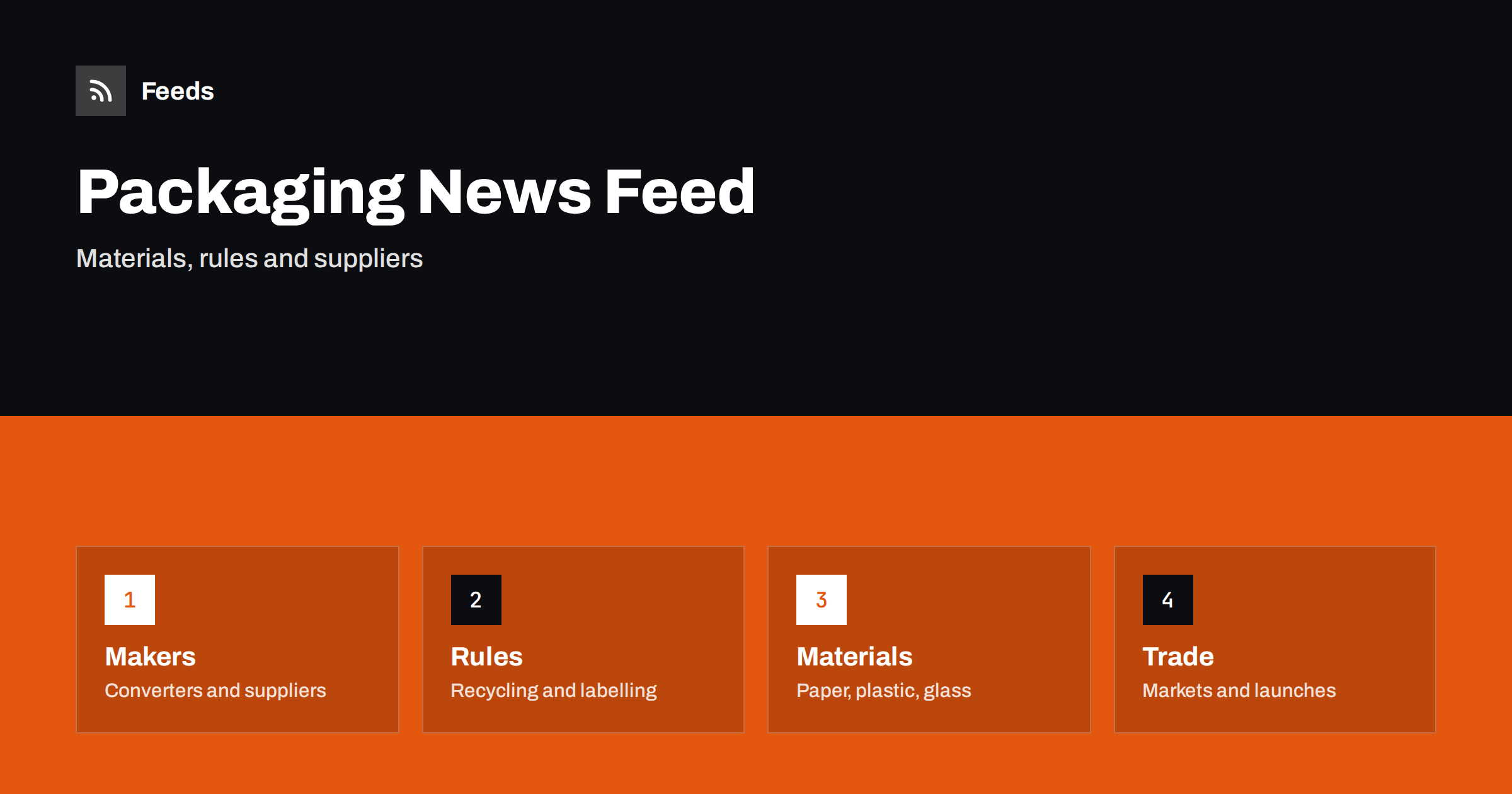
Short answer: Packaging news comes from converters and material suppliers, brands that buy packaging, regulators and standards bodies, recycling organizations and the trade press. RSS brings them into one reader, so you can filter by material, region or rule and read items in the order they were published. Start with official pages for rules, add suppliers and trade titles for context, and always open the original document before you change a design or a specification.
Why packaging news is hard to follow
Packaging is everywhere and nowhere. Every product needs it, but the news is scattered across industries: food, cosmetics, logistics, retail, chemicals and waste management. A change in a recycling rule, a new material, a supplier shortage or a labelling requirement may appear on a regulator page, a trade site or a brand’s sustainability report, and a general news search will not collect them.
The readers have different needs. A designer follows materials and formats, a buyer follows prices and supply, a compliance manager follows rules and a small brand owner follows anything that changes the cost of a box. If the idea of a feed is new, what is an RSS feed explains it in plain words.
Converters, suppliers and material makers
Start with the companies that make and sell packaging: converters, printers, film and paper makers, glass and metal producers and machine builders. They publish product launches, capacity announcements, certifications and case studies. These pages show what is possible and what is available, but they are written to sell, so read them as announcements and not as independent advice.
Keep the first list short: the suppliers you use or may use, and two or three associations in your segment. Many supplier sites have a news page without an RSS link, and how to create an RSS feed for a website without RSS shows how to turn it into a feed. Monitoring suppliers and partners with RSS describes a routine that fits well.
Recycling, labelling and packaging rules
Rules are the topic with the most consequences. Producer responsibility schemes, recycling targets, recycled content requirements, bans on certain materials and labelling and food contact rules differ by country, and they change. Official pages of ministries, agencies and recycling organizations are the reliable source, and a press summary may omit the condition that applies to your product.
Follow the authorities in each market where you sell. Note the date from which a rule applies, save the link to the official text and share it with the people who design and buy. Tracking government and regulator updates with RSS shows a routine that suits this area, and sustainability and ESG reporting rules with RSS covers the reporting side.
A rule that applies next year needs a plan, and a rule that applies next month needs action now. Put the date in the calendar when you read the notice, not later.
Think about the end of the life of the package as well. Collection systems, deposit schemes and sorting technology differ by country, and a design that is recyclable in one market may not be in another. Follow the notices of the recycling organizations in the markets where you sell, and keep a short table of what each market accepts. This table is useful for designers, buyers and the people who write the claims on the pack.
Materials, formats and innovation
New materials and formats appear all the time: recycled and bio-based plastics, lighter glass, mono-material pouches, refill systems and fibre-based alternatives. Research institutes, universities and trade fairs publish news about them, and brands announce pilots. Treat these items as signals, and ask for data before you rely on a claim.
Be critical about environmental claims. Words such as recyclable, compostable or sustainable depend on local collection and on the exact material, and a feed of rule updates helps you check what is allowed in your market. If a source makes a large claim without evidence, mark it as marketing and move on.
Trade fairs and conferences are a good source of ideas and contacts. Organizers publish exhibitor lists, programmes and award winners, and these show where the industry is going. Follow the pages of the main fairs in your segment and note the dates, and read the award lists to see which new materials and formats are being recognised. A short visit report to your team makes the news useful.
Supply, prices and logistics
Prices of resin, paper, board, metal and glass move with energy and raw material markets, and shortages affect lead times. The trade press and supplier announcements show these changes early, and a feed lets you see them in order. An RSS reader is not a price screen, but it gathers the slower signals around prices: capacity changes, plant stoppages, tariff changes and freight disruptions.
Commodity prices and supply chain news with RSS covers the adjacent topic, and customs, tariff and trade rule changes helps when you import materials or ship packaged goods across borders.
Keep a simple note of your suppliers’ lead times and minimum orders, so that a notice about a stoppage or a price increase can be compared with your plan at once.
Keep your own specifications in view when you read. A notice is only useful if you know what it touches, so keep a short list of your packs, their materials and their markets next to the reader, and check each new rule against it.
Filter by material, region and sector
A useful packaging feed is narrow. If you use glass, you do not need every news item about flexible films, and if you sell in one region, you can drop notices from others. Use keyword filters to keep items that mention your materials, formats and markets, and to drop the rest. Think of two lists of words, one to include and one to exclude, and review them every month.
Terms vary: a pouch may be called a sachet, a bag or flexible packaging, and a company may use a short and a long name. Test your filters on ten recent items before you rely on them. Set up keyword alerts using RSS feed filters explains the method, and reduce noise in RSS alerts without missing anything helps when the list grows.
Certifications and standards also matter. Food contact, safety, quality and environmental standards are updated from time to time, and certification bodies publish news about new versions and transition dates. Add the pages of the bodies that certify your suppliers, and note any date by which a certificate must be renewed or replaced, because a lapsed certificate can stop a delivery.
A routine that stays short
Do not read packaging news all day. Open the rules folder once a week, or more often when a deadline is near, and read general news two or three times a week. For each item you plan to use, open the primary source, mark the rest as read and move on. RSS triage: a fast daily routine for reading less shows a short routine.
Once a month, review the sources. Remove feeds that stopped publishing, add the sites you keep opening by hand and adjust the filters. If design, purchasing and compliance follow the same sources for different reasons, share one list with separate folders, as described in shared RSS reading lists for teams.
Keep a short note on why each source is in the list, such as supplier, regulator, competitor or research, so that a new colleague understands the setup in a few minutes.
How RSS Feed Creator helps
RSS Feed Creator turns the news, notice and announcement pages of converters, suppliers, regulators and recycling organizations into clean RSS feeds, even when the site has no feed of its own. It reads titles, images, summaries and dates, uses an existing feed when there is one, and shows a preview of the items before the feed is created. You can merge several sources into one feed (up to 10 sources), keep only the items that contain your keywords and have duplicates removed automatically, which suits a reading list for one material, market or rule set. Feeds refresh every 3 hours on the free plan and every 30 minutes on paid plans. The free plan allows up to 20 items per feed, and the details are on the pricing page.
Related reading
- How to Monitor Suppliers and Partners for Early Risk Signals
- How to Follow Sustainability and ESG Reporting Rules with RSS
- Commodity Prices and Supply Chain News: Follow Them with RSS
The bottom line
RSS gives you an ordered view of packaging news. Start with regulators and suppliers, add a few trade sources for context, filter by material, region and sector, and keep rule changes in a folder of their own. Open the original document before you act on an item, check environmental claims with care and review the list every month.
SSS
Which sources should I follow first?
Begin with your main suppliers, the packaging rules authority in each market and one trade association. Add trade publications later for context.
What if a supplier site has no RSS feed?
A page-to-feed tool can read the list of news items on its page and build a feed. Check the preview to make sure it shows real items with titles and dates.
Can RSS tell me whether a material is recyclable?
No. It helps you follow rule updates and announcements, but recyclability depends on local collection and the exact material, so check the official guidance.
How do I avoid a flood of items?
Use keyword filters for materials, formats and markets, and keep rule changes in a separate folder from general news.
How often should I read the list?
Rules once a week, or more often near a deadline, and general news two or three times a week.