ENEnglish
 LTLietuviškai
 DEDeutsch
 FRFrançais
 RUРусский
 ESEspañol
 PLPolski
 ITItaliano
 UKУкраїнська
 CSČeština
 PTPortuguês
 JA日本語
JA日本語 LVLatviešu valoda
 ETEesti
 HUMagyar
 IDBahasa Indonesia
 TRTürkçe
 HIहिन्दी
 ELΕλληνικά
 ARالعربية
 THไทย
THไทย VITiếng Việt
 RORomână
 MSBahasa Melayu
 BNবাংলা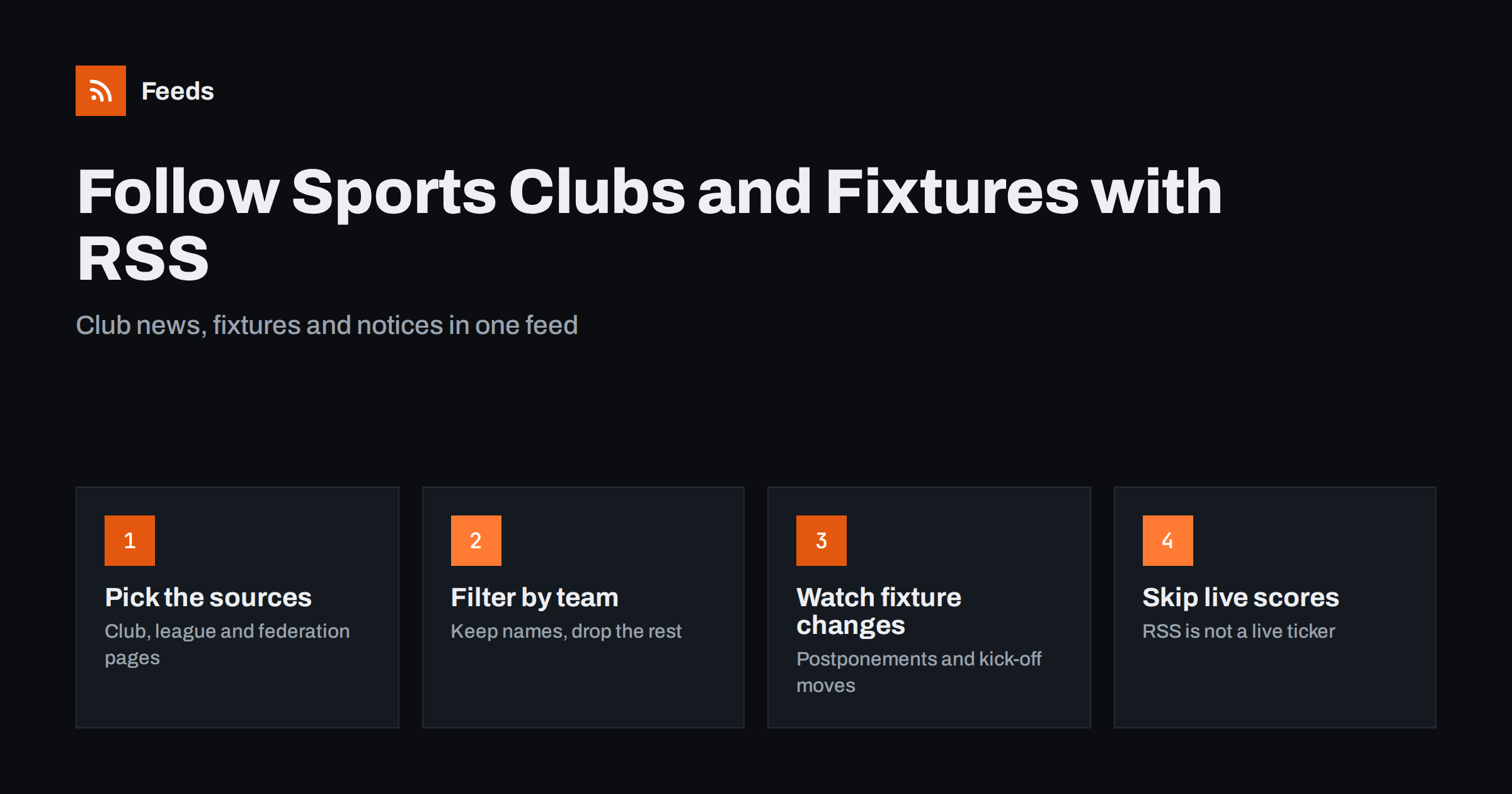
Short answer: To follow sports clubs and leagues with RSS, collect the pages where news, fixtures and official notices are published, use their existing feeds or turn those pages into feeds, merge them into one feed and filter it by team and competition names. RSS is excellent for news, fixture changes, squad announcements and ticket notices. It is not a replacement for a live score app, because feeds are checked on a schedule rather than second by second.
Why RSS still works well for sports updates
Sports news is spread across dozens of places: the club website, the league’s fixture page, the national federation, the stadium, local newspapers and the club’s video channel. Social media mixes all of this with opinions, adverts and replies, and the algorithm decides what you see. A feed simply lists new items in order, from sources you chose, and nothing disappears because it was not “engaging” enough.
That matters for very different people:
- Fans who follow a club, a women’s team, a youth academy or a lower-league side that the big sports apps barely cover.
- Local news sites and sports journalists who need every official statement, injury update and fixture change from several clubs in their area.
- Clubs, sponsors and venues who want to know when a league publishes the new season’s schedule or changes kick-off times.
- Parents and volunteers in grassroots sport, where fixtures and cancellations often appear only on a small website.
If you are new to feeds, our guide what an RSS feed is explains the basics in a few minutes.
Where sports updates are actually published
Before building anything, list the sources. Most sports information comes from a predictable set of pages, and each one changes at a different pace.
| Source | What you get | Typical feed situation |
|---|---|---|
| Club news page | Signings, injuries, match previews, statements | Often has RSS if the site runs on a common CMS; many custom club sites do not |
| League fixtures and results page | New schedules, postponements, kick-off changes | Rarely has RSS; usually a table or list that changes quietly |
| Federation or governing body | Rule changes, disciplinary decisions, calendar notices | Mixed; press release sections are good candidates for a page feed |
| Ticketing and venue pages | On-sale dates, extra matches, event changes | Almost never RSS; a page-to-feed setup is the usual route |
| Club video channel | Interviews, highlights, press conferences | Video platforms often expose a channel feed |
| Local newspaper sports section | Independent reporting and match reports | Usually RSS by section, sometimes only a site-wide feed |
For video sources, see how to get an RSS feed for a YouTube channel. For everything else, check the page source for an RSS link first, as described in our article on RSS autodiscovery.
Step by step: build a feed for one club
Start small. One well-built feed for one club is more useful than twenty half-working subscriptions.
- Find the official news page. Use the page that lists articles newest first, not the homepage slider. A category such as “First team” or “Academy” is even better if you only care about one squad.
- Check for an existing feed. Look for an RSS icon, a “/feed/” address or a link tag in the page source. If one exists, use it; it is the most reliable option.
- Turn the page into a feed if there is no RSS. A page-to-feed tool reads the list of articles from the outside, like a visitor, and produces a feed with titles, links, images and dates. Our explainer on how page-to-feed works covers what happens behind the scenes.
- Add the fixture page. Fixture tables change without a new article, so a separate feed for that page catches postponements and new dates that the news page may never mention.
- Add one independent source. A local newspaper section or a specialist site gives you reporting that the club itself will not publish.
- Merge and test. Combine the feeds into one, open it in your reader and check that the newest items look right: correct titles, working links, sensible dates.
If a site has no feed at all, the general method is described in how to create an RSS feed for a website without RSS.
Filter by team, competition and keywords
Federation and newspaper feeds cover many teams. Without filters you will scroll past dozens of items a day that are not about your club. Keyword filters fix that.
- Include filters keep only items that mention your words: the club’s name and its common short form, the stadium, the coach’s name, or the competition you follow.
- Exclude filters drop items with words you never want: betting promotions, merchandise sales, or a sister club with a similar name.
- Event words are useful for alert-style feeds: “postponed”, “rescheduled”, “injury”, “suspension”, “signs”, “loan”, “kick-off time”.
Think about spelling. Club names have short forms, nicknames and sponsor names; players’ names appear with and without accents. Add the variants you see in real headlines. Our article on RSS keyword alerts shows how to build filters that catch what matters without flooding you.
Following a whole league or several clubs
Journalists, fantasy players and regional sites often follow every team in a division. The same method scales if you keep it organised.
- One feed per club for official news, so you always know where an item came from.
- One merged league feed that combines all club feeds plus the league’s own announcements. Duplicate stories, for example a transfer announced by both clubs, are worth removing at this stage.
- One alert feed filtered for urgent words such as “postponed” or “statement”, which you send to your phone or a team chat.
Merging is covered in detail in how to merge RSS feeds into one. If the list grows past a few dozen sources, the folder and priority ideas in organising an RSS reader so it never overwhelms you will save you time.
Fixture changes: the updates people miss most
Most fans hear about a big signing within minutes. What they miss are quiet changes: a match moved for television, a cup tie rescheduled after a replay, a youth fixture cancelled because of the weather. These changes often appear only as an edited row in a fixtures table.
A feed made from the fixtures page helps, but understand what it can and cannot see:
- When new rows appear, for example when the next round is published, they show up as new items.
- When an existing row is edited, a page feed may or may not treat it as a new item, depending on whether the visible title or link changes. If kick-off times matter to you, also watch the league’s news or announcements page, where formal changes are usually explained.
- Calendar subscriptions (iCal) are better for putting fixtures into your diary, while RSS is better for being told that something changed. Many fans use both.
For a broader view of watching pages for changes, our comparison of page change monitoring and RSS explains when each approach fits.
Getting sports updates where you will see them
A feed is only useful if you read it at the right moment. Choose a destination per feed rather than sending everything everywhere.
- RSS reader: best for the full club and league feeds you read once or twice a day.
- Phone notifications: reserve these for a tightly filtered alert feed. See how to get RSS push notifications on your phone.
- Team chat: a supporters’ club, a newsroom or a club office can post filtered items into a shared channel, for example with RSS in a Slack channel or RSS to Discord.
- Your own website or social pages: a fan site or local club can share official news automatically, provided it links back to the source and respects the publisher’s terms.
Limits, etiquette and common mistakes
Feeds are polled on a schedule. Even a frequently refreshed feed is minutes behind real time, so do not rely on RSS for live scores, in-play events or anything where seconds matter. Use the official app or broadcast for that.
Other points to keep in mind:
- Do not republish full articles. Club and newspaper content is copyrighted. Share headlines and links, not copied text. Our guide on using RSS feeds from other websites legally explains the usual boundaries.
- Do not follow the homepage. Homepages mix news with shop banners and sponsor tiles, so feeds made from them are noisy.
- Re-check feeds at the start of each season. Clubs often redesign their sites in the summer, and URLs for fixture pages change every year.
- Do not over-filter. A filter that only keeps “transfer” will miss the same story written as “signs” or “joins”. Test with real headlines from the last few weeks.
How Feeds helps with sports sources
Feeds turns club news pages, league announcement pages and similar lists into clean RSS feeds without plugins or code on the source website. If a site already has RSS, it uses that feed. You can combine several clubs or sources into one feed, keep only items with your words or drop items with words you do not want, and duplicates are removed automatically. Before anything is created you see a preview of the items it found, with titles and images, and the feed then refreshes on its own. You can try it on one sports website on the free plan, and the plans page lists refresh intervals and limits.
Related reading
- How to monitor local news with RSS
- How to monitor websites for new content
- How journalists can build a beat monitoring feed with RSS
The bottom line
RSS is a calm, reliable way to follow sports clubs and leagues: official news, fixture changes, squad updates and ticket notices from the sources you choose, in one place. Start with one club, add the fixtures page and one independent source, filter by names and event words, and route only urgent items to your phone. Leave live scores to live apps.
SSS
Do sports club websites have RSS feeds?
Many do, especially those built on common content management systems, but plenty of club and league sites do not. When there is no feed, a page-to-feed tool can read the news list from the outside and turn it into one.
Can I get live scores through RSS?
Not reliably. Feeds are checked on a schedule, so even fast feeds lag behind live events. Use RSS for news, fixture changes and announcements, and an official app or broadcast for live scores.
How do I follow only one team in a league-wide feed?
Add an include filter with the team’s name, its short form and other common spellings. Then add exclude filters for clubs with similar names or for promotional words you never want to see.
Will a feed tell me when a match is rescheduled?
A feed of the league’s announcements page usually will, because formal changes are published there. A feed of a fixtures table catches new rows reliably, but edits to an existing row may not always appear as a new item.
Is it legal to share club news from RSS on my fan site?
Sharing headlines with links back to the source is common practice, but copying full articles is not. Check the publisher’s terms and always link to the original story.