ENEnglish
 LTLietuviškai
 DEDeutsch
 FRFrançais
 RUРусский
 ESEspañol
 PLPolski
 ITItaliano
 UKУкраїнська
 CSČeština
 PTPortuguês
 JA日本語
 LVLatviešu valoda
 ETEesti
 HUMagyar
 IDBahasa Indonesia
 TRTürkçe
 HIहिन्दी
 ELΕλληνικά
 ARالعربية
 THไทย
 VITiếng Việt
 RORomână
 MSBahasa Melayu
 BNবাংলা
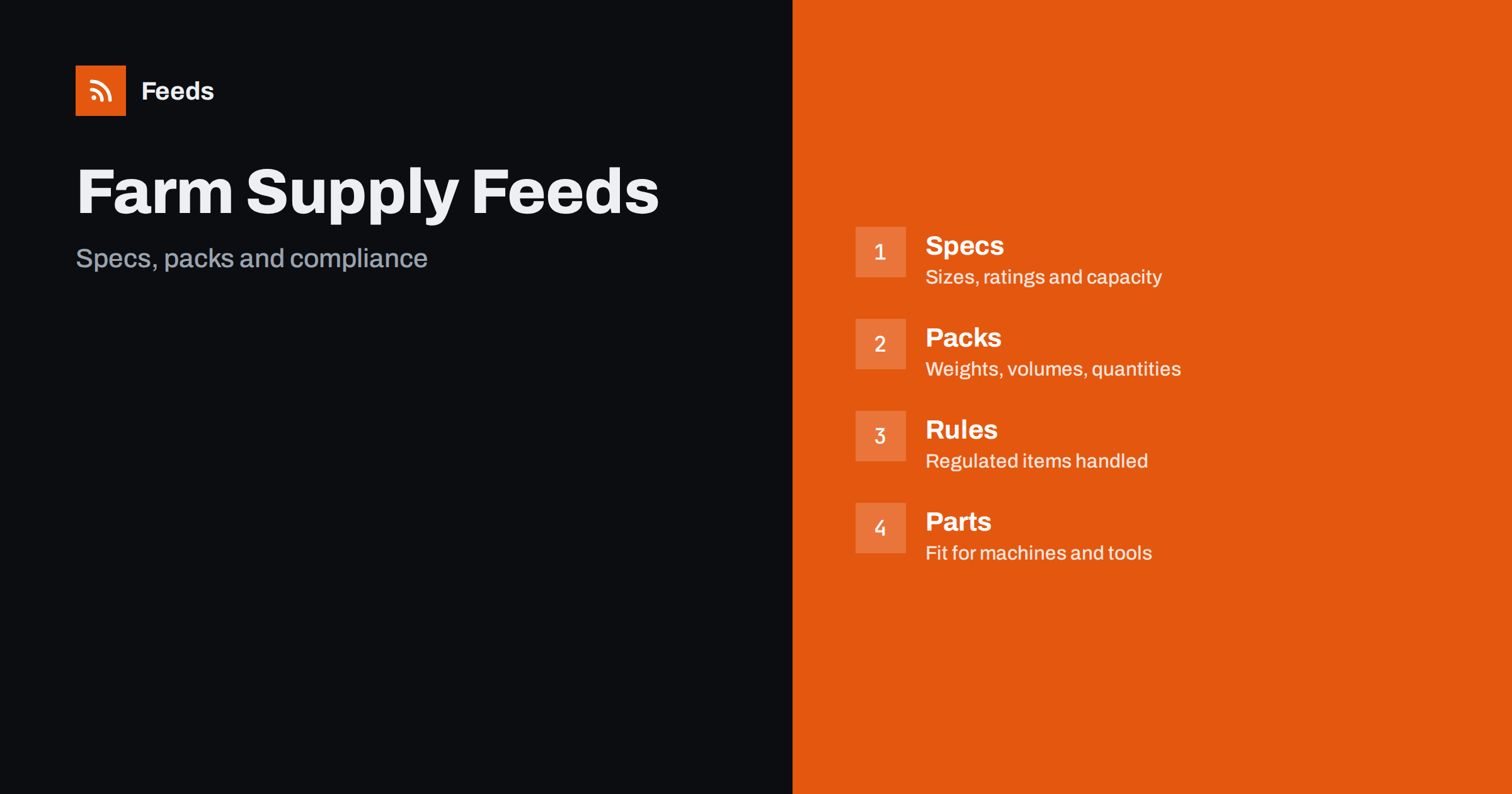
Short answer: Farm supply stores sell tools, fencing, water systems, animal feed and care products, seed, protective clothing, spare parts and much more. A clean feed gives every product a title with brand, type and the rating that defines it, states weights, volumes and pack counts in a consistent way, separates parts from the machines they fit, avoids restricted products where platforms do not allow them and keeps claims about animals, crops and results modest and tied to the maker’s wording.
Why farm supplies need careful feeds
Farmers, smallholders and gardeners buy for a job to be done. A fence needs the right post length and wire gauge, a pump needs a flow rate and a connection size, a feed bag needs the right species and life stage and a spare part needs the exact machine model. A feed that hides these details forces customers to call or leave, and a wrong match means a return of something heavy and awkward.
The category is also wide. The same shop may sell a drinking trough, a battery fence energiser, a work glove and a bag of seed. If you are new to the idea, what a product feed is explains the basics, and this guide covers what is special about farm supplies.
Titles that lead with type and the key rating
Start the title with the brand and product type, then add the rating that decides the choice: length and diameter for posts, flow rate for pumps, capacity in litres for tanks, weight in kilograms for feed and bags, power or voltage for electric equipment. End with the model name or the colour where it matters. A title such as “Brand Galvanised Gate 3 m Heavy Duty Model” is far more useful than a general phrase.
Use the same order across the whole catalog so that products are easy to compare, and write units exactly as the maker does. Keep the main words in the first 70 characters. Product feed title optimization has formulas and examples, and a similar approach for a neighbouring category is explained in product feeds for garden, DIY and hardware stores.
Weights, volumes and pack sizes
Many farm products are sold by weight or volume: feed, fertiliser, bedding, fuel additives, cleaning products and seed. Put the net weight or volume in the title and give the pack count where there is more than one unit. A 20 kg bag and a 5 kg bag are different products with different prices, and a pallet of bags is not the same as a single bag.
Unit pricing helps shoppers compare, and the rules differ by country. Unit pricing in product feeds explains measures and base units. For multi-packs and pallets, list each as its own product with the number of units in the title, as described in bundles and multipacks in product feeds, and do not mix unit and pallet prices in one listing.
Animal feed and care products
Feed and care products need extra attention. State the species and life stage the product is made for, such as poultry, horses, sheep, calves or dogs, and keep the product type clear: complete feed, supplement, treat, bedding or grooming product. Ingredient lists, analytical values and feeding instructions should appear on the page exactly as they appear on the label.
Do not make health or performance claims that the label does not support, and do not describe a product as treating or preventing disease unless it is authorised for that purpose. Veterinary medicines are regulated and often restricted in advertising, so check the rules of the platforms and the countries where you sell before you include them. A careful, neutral tone protects the shop and the animals.
Machine parts, tools and compatibility
Spare parts and attachments are the main source of mistakes. A belt, a blade or a hydraulic fitting fits specific models, and a customer who orders a part that does not fit loses time during a busy season. State the models a part fits, include the manufacturer part number and list the part as its own product with a clear picture and the dimensions.
Do not imply that a part fits every machine of a brand. The setup is covered in product feeds for spare parts and compatible accessories, and GTIN, MPN and brand: product identifiers in feeds explained shows how to send identifiers correctly. Use variants only for the same part in different sizes, as explained in how item_group_id works.
Safety gear, regulated and restricted items
Farms need protective clothing, boots, gloves, helmets and tools, and the same rules apply as in other safety categories: show certifications only when they appear on the product and the page, and use the maker’s wording. Product feeds for workwear and safety equipment stores goes into detail.
Some farm products are restricted on advertising platforms or by law: plant protection products, certain chemicals, veterinary medicines and some equipment. Check the policies of each platform and the rules of each country before you add them. If a product cannot be advertised, exclude it from the feed rather than risk a disapproval of the whole account, as explained in which products to exclude from your feed and how to do it.
Shipping heavy and bulky goods
Farm supplies are often heavy, long or bulky: gates, fence posts, troughs, pallets of feed and tanks. Shipping can decide whether a sale is profitable and whether the customer is happy. Make sure that the shipping settings reflect what you offer, as covered in shipping in product feeds, and state delivery times, freight rules and any collection options on the page.
If you offer click and collect or deliver on your own vehicle in a certain area, explain it on the page and keep stock levels accurate for each location. Local inventory feeds show how to display in-store stock in Google ads, which suits shops with a local yard or depot.
Seasons, stock and images
Farm demand follows the year: seed and fertiliser in spring, fencing and repairs in summer, feed and bedding in autumn, heating and winter care in cold months. Prepare the feed before each peak, check stock and mark products that cannot be delivered in time. Out-of-stock products in your feed: keep, mark or remove explains the options.
Use clean photos on a plain background, with extra pictures that show the size, the fitting or the label. Avoid text overlays and promotional badges. The landing page must open the same product with the same price and availability, and the specification must match the feed, as covered in product landing pages: what feed links must lead to. A weekly look at disapproved items and prices keeps the feed healthy.
Think about who buys. Professional farmers often reorder the same items and value exact specifications and reliable delivery, while smallholders and hobby keepers need more guidance and often buy a first fence, a first coop or a first set of tools. Use the product page to explain what a product does, how much is needed and what else to buy with it, and keep the feed focused on exact facts. Clear related-product links on the page, for example from a fence energiser to the wire, insulators and earth stakes, help new customers build a complete order and reduce the number of questions your team must answer.
Watch the market as well. Prices of feed, fuel and fertiliser change with commodity markets, and customers notice. A feed that is updated often enough, with prices and stock that match the page, protects both margins and trust. How often should a product feed update gives a practical guide, and following market news with a feed, as in follow agriculture and farm market news with RSS, helps you plan purchases and price changes before they reach the shelf.
How RSS Feed Creator helps
RSS Feed Creator builds Google Merchant Center and Meta catalog XML straight from your store. WooCommerce and Shopify are read automatically, and any other store can use a CSV link. You can skip out-of-stock products, rewrite titles with rules so that brand, product type and key rating appear in the same order every time, and adjust prices. Before you submit anything, check the preview and the Merchant Center diagnostics to confirm that ratings, pack sizes and stock arrive as you expect. The free plan includes product feeds with up to 50 products, and the Store plan covers one store with 3 product feeds and up to 2,000 products. The details are on the pricing page.
Related reading
- Product Feeds for Garden, DIY and Hardware Stores
- Product Feeds for Spare Parts and Compatible Accessories
- How to Follow Agriculture and Farm Market News with RSS
The bottom line
Clean feeds for farm supply stores come from titles with the key rating, clear weights and pack sizes, careful handling of feed and regulated items, parts with exact compatibility, honest shipping and a landing page that matches the ad. Check the preview before you submit and fix what the diagnostics report. Accurate details reduce returns of heavy goods and help farmers find the right product the first time.
FAQ
What should go in a fencing product title?
Use the brand, the product type, the length and diameter or gauge and the material, in the same order for all fencing products.
How do I list feed in different bag sizes?
Use one product per distinct size or variants where the products are the same feed in different weights, each with its own identifier and price.
Can I include veterinary or plant protection products?
Check the policies of each platform and country first. If a product cannot be advertised, exclude it from the feed.
How do I avoid wrong-fit returns for parts?
Name the models each part fits, send the manufacturer part number and list each part as its own product.
What if my store is not WooCommerce or Shopify?
Use a CSV file link. Check the preview and the diagnostics to confirm that ratings, pack sizes and stock arrive correctly.