ENEnglish
 LTLietuviškai
 DEDeutsch
 FRFrançais
 RUРусский
 ESEspañol
 PLPolski
 ITItaliano
 UKУкраїнська
 CSČeština
 PTPortuguês
 JA日本語
JA日本語 LVLatviešu valoda
 ETEesti
 HUMagyar
 IDBahasa Indonesia
 TRTürkçe
 HIहिन्दी
 ELΕλληνικά
 ARالعربية
 THไทย
THไทย VITiếng Việt
 RORomână
 MSBahasa Melayu
 BNবাংলা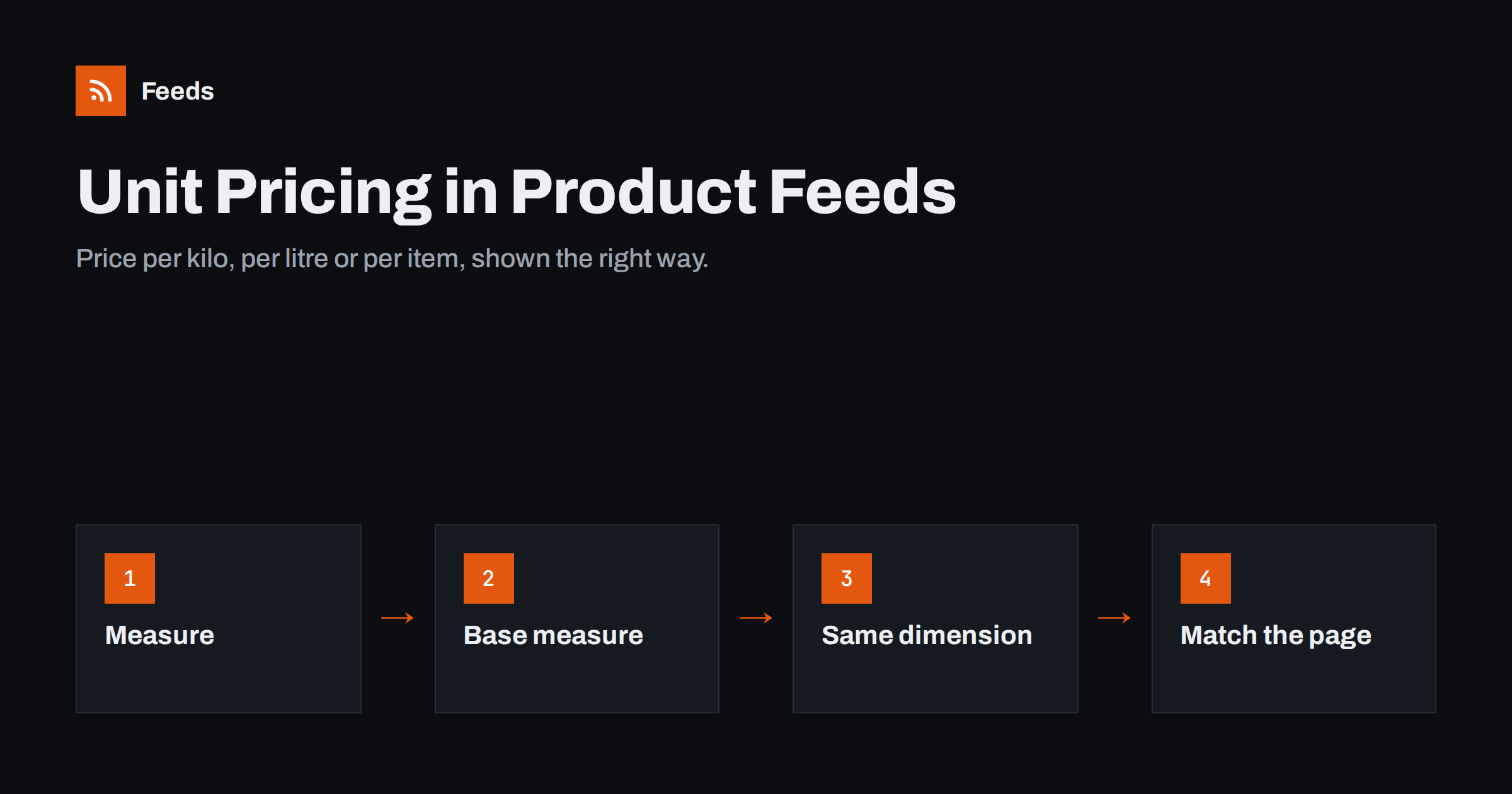
Short answer: Unit pricing shows shoppers the price per standard quantity, such as per kilogram, per litre or per 100 grams, so they can compare products sold in different sizes. In a Google product feed you set it with two attributes: unit_pricing_measure, the quantity of the product as sold (for example 750ml), and unit_pricing_base_measure, the quantity the unit price refers to (for example 100ml). Google then calculates and shows the unit price from your product price. It is optional in many markets, but often expected or legally required where consumer law demands unit prices, such as in the European Union for many goods.
What unit pricing is and why it matters
Shoppers comparing a 400 g jar with a 750 g jar, or a 6-pack with a 24-pack, cannot easily tell which is better value from the total price alone. A unit price, such as “12.40 EUR / kg”, solves that. It is common on supermarket shelves and increasingly visible in online shopping results.
For stores, unit pricing matters for three reasons:
- Legal requirements. In the EU, consumer protection rules require the unit price to be shown for many goods sold by weight, volume or length, and several other countries have similar rules. If your website must show unit prices, your shopping listings should too.
- Comparability. Products with good value per unit can stand out when shoppers compare offers side by side.
- Consistency. When the website shows a unit price, the feed should carry the same information, so shoppers see one consistent offer.
Unit pricing is most relevant for groceries, drinks, cosmetics, household products, pet food, building materials sold by length or area, fabrics and multi-packs. If your products are sold as single, non-comparable items, such as a jacket or a laptop, you usually do not need it.
The two attributes
| Attribute | Meaning | Example |
|---|---|---|
unit_pricing_measure |
The quantity of the product as sold, with its unit | 750ml, 1.5kg, 24ct |
unit_pricing_base_measure |
The standard quantity the unit price is expressed for | 100ml, 1kg, 1ct |
With a price of 4.50 EUR, a measure of 750ml and a base measure of 1l, the unit price becomes 6.00 EUR per litre. You do not submit the unit price itself; it is calculated from the price and these two values. That means that when the price changes, the unit price updates automatically, and when a sale price applies, the unit price is based on the sale price.
The base measure is optional in the specification, but setting it explicitly avoids surprises and lets you match what your website and local rules require. For example, some markets expect prices per kilogram for most foods but per 100 grams for small, expensive items like spices.
Supported units
Google accepts a defined set of units, grouped by dimension. At the time of writing they include:
- Weight:
mg,g,kg,oz,lb - Volume:
ml,cl,l,cbm,floz,pt,qt,gal - Length:
cm,m,in,ft,yd - Area:
sqm,sqft - Per item:
ct(count)
Two rules matter most. First, both attributes must use the same dimension: a product measured in grams must have a base measure in a weight unit, not in litres. Second, the base measure accepts only certain numeric values, such as 1, 10 or 100 of a unit, rather than any number. Check the current specification for the exact list before building your feed.
Write the number and unit together without spaces, using a dot as the decimal separator: 1.5kg, not 1,5 kg. Our guide to required and recommended Google product feed attributes covers formatting conventions for other attributes too.
Multi-packs, bundles and variants
Unit pricing gets trickier when a listing contains several items.
- Multi-packs of the same product: use the total quantity. A pack of six 330 ml cans has a measure of
1980ml, and a base measure such as1l. - Count-based products: for items like tea bags, nappies or capsules, where a per-item price is meaningful, use
ct, for example40ctwith a base of1ct. - Bundles of different products: unit pricing usually does not make sense, because the items are not the same thing. Leave it out unless local rules say otherwise.
- Variants: each size is a separate item with its own measure. A 250 g and a 1 kg bag of the same coffee each carry their own value.
For the related multipack and is_bundle attributes, see bundles and multipacks in product feeds.
Where the data comes from
The hardest part of unit pricing is usually not the feed format but the data. Many stores do not store net quantity as a separate, structured field. It sits in the product title (“Olive oil 750 ml”) or in the description.
- Check your platform. Some e-commerce platforms have built-in unit price fields in certain countries; others need an extension or custom fields.
- Extract carefully. Parsing quantities from titles works for consistent catalogs but produces errors when titles are inconsistent (“750ml”, “0.75 l”, “75cl”). Review the results.
- Use a supplemental feed. If your main feed tool does not output unit pricing, add the two attributes through a supplemental feed keyed by item ID. See supplemental feeds in Merchant Center.
- Keep one source of truth. The quantity used on the website’s unit price should be the same one used in the feed.
A practical way to start is a simple spreadsheet with three columns: item ID, net quantity with unit, and base measure. Fill it for the products where unit pricing matters most, usually the best sellers in food, drink and household categories, and check a sample against the physical packaging or the manufacturer’s data. Once the spreadsheet is correct, it can serve as the supplemental feed directly, and later be replaced by structured fields in your store when the platform supports them. Update it whenever a pack size changes, because manufacturers regularly shrink or enlarge packs while keeping the same product name.
Unit prices across countries
Selling in several countries adds another layer. Base measures that are normal in one market may be unusual in another; the United States commonly uses ounces and pounds, while most of Europe uses grams, kilograms and litres. Legal requirements also differ. If you run separate feeds or feed settings per country, adapt the unit and base measure to each market, and make sure the unit price shown on each country version of your site matches. Our guide to multi-country product feeds covers currencies, languages and prices.
Other advertising platforms have their own fields for unit prices, and support differs between markets. If you also send your catalog to other channels, check whether they read the same attributes or need a separate field.
Common errors and how to fix them
- Mismatched dimensions: a weight measure with a volume base. Use the same dimension for both.
- Unsupported base values: for example a base of
250g. Use an allowed value such as100gor1kg. - Wrong formatting: commas as decimal separators, spaces or unit names in words. Use
1.5kg. - Pack confusion: the measure of one unit used for a multi-pack. Use the total quantity.
- Website mismatch: the unit price in the listing does not match the one on the product page, often because the page uses a different quantity. Fix the source data. Price-related mismatches in general are covered in fixing price mismatch errors.
What Feeds does and does not cover
Feeds creates Google product XML feeds straight from WooCommerce, Shopify or a CSV link, with the core attributes: IDs, titles, links, images, prices, availability and brands, plus rules for stock, titles and prices. It does not currently add unit pricing attributes, so stores that need unit prices can add unit_pricing_measure and unit_pricing_base_measure through a supplemental feed keyed by the same item IDs. For plan details, see the pricing page.
Related reading
- Product Feed Glossary: Key Terms Every Store Should Know
- Product Feed Title Optimization: Formulas That Work
- Product Feed Checklist: 25 Checks Before You Submit
The bottom line
Unit pricing lets shoppers compare value across pack sizes, and in many markets it is expected by law. Set unit_pricing_measure to the quantity as sold and unit_pricing_base_measure to the standard base, keep both in the same dimension, use supported units and values, and make sure the result matches the unit price on your product page. Most of the work is getting clean quantity data; the feed attributes themselves are simple.
FAQ
Is unit pricing required in Google Shopping?
It is optional in many countries but may be required where local law demands unit prices, such as for many goods in the European Union. If your website must show unit prices, include them in your feed.
What is the difference between unit_pricing_measure and unit_pricing_base_measure?
The measure is the quantity of the product as sold, such as 750ml. The base measure is the standard quantity the unit price refers to, such as 1l or 100ml.
Do I submit the unit price itself?
No. You submit the measure and the base measure, and the unit price is calculated from the product price. It updates automatically when the price or sale price changes.
How do I set unit pricing for a multi-pack?
Use the total quantity of the pack. For example, six 330 ml cans have a measure of 1980ml, with a base measure such as 1l.
Can I add unit pricing without changing my main feed?
Yes. A supplemental feed with the item ID and the two unit pricing attributes can add them to products from your main feed.